Gael Newton AM, first published 2022
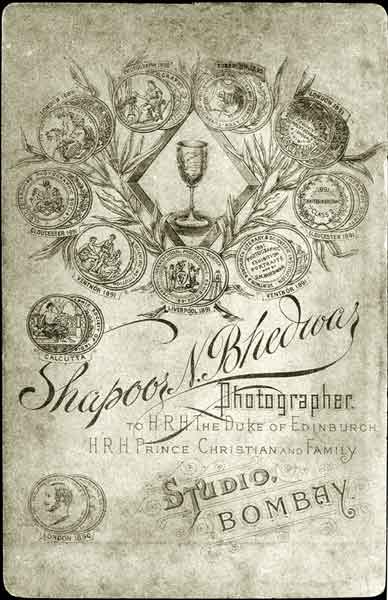
On 4 June 1891 under the heading ‘A Clever Indian Photographer', Photography Journal saluted the success of Shapoor N. Bhedwar since his arrival in London ‘twelve or so months’ previously to study art photography. The Journal’s profile was prompted by Bhedwar’s imminent departure for Bombay [Mumbai] to start a professional studio of his own.
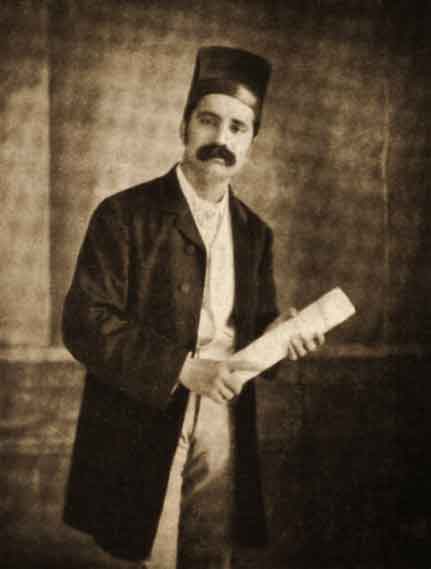
Essentially the same article titled ‘Distinguished Photographers of Today, Shapoor N Bhedwar’ appeared three years later in America in the Photographic Times of 23 March 1894. Both profiles included portraits of Bhedwar in his Parsi dress.
Since his first awards as a student at the London Polytechnic School of Art in 1889, Shapoor Bhedwar had won bronze, silver and gold medals for his portraits, genre studies and tableaux of young women in neoclassical robes at various photographic exhibitions and competitions. His work had been praised in a number of photographic journals and illustrated magazines. This was a remarkable achievement for any amateur in the new field of art photography.
Over the next two decades Bhedwar worked from a well-appointed studio at his home in Swiss Lodge, Cumballa Hill - an affluent elevated suburb in South Bombay. His was an exclusive portrait service far from the many commercial portrait studios business district. He continued his art practice and international exhibiting from Bombay to become the first internationally recognized Indian art photographer.
Shapoor N Bhedwar was not the first nor only, Indian photographer to exhibit abroad, Bombay professional Hurrichund Chintamon (w. c.1856-c. 1874) had done so in London in 1860s -70s and Lala Deen Dayal (1844 - 1905) was well known in Britain as photographer to the Nizam of Hyrdrabad and for services to the British Raj.
Bhedwar, was the first and only Asian among some one hundred members of the exclusive Linked Ring Brotherhood of art photographers that ran in London from 1892–1910. He was the first Indian member of the Photographic Society of Great Britain and first Asian photographer to be published in the Society’s Photograms of the Year annual in 1894 and subsequently appeared in 1895,1898,1901,1906 and 1907 - years before any other Asian members. Japanese professional Kasumasa Ogawa (1860-1928) was the first Japanese to be a member of the Society in 1889 and the first Asian awarded an F.R.P.S. in 1895.
 |
Shapoorjee Naaserwanjee Bhedwar was born in Bombay on 28 August 1858 to an affluent Parsi family and was raised by his widowed mother – his father having died when Shapoor was four. The Parsi were Persian followers of the prophet Zoroaster, who after the Arab/Muslim conquest of Persia, sought refuge in Gujarat and Sind in the eighth and ninth centuries. They became a small but very entrepreneurial mercantile and educated class in Calcutta and Bombay closely affiliated with the British both in the era of the East India Company and later under the British Crown rule after 1857.
Bhedwar was educated at the Proprietary High School in Bombay where elite Indian boys were grounded in English language, literature, Imperial social mores and cricket. His early ambition was to be an artist and his ‘favourite companions’ in English literature were Shakespeare, Milton, Byron, Thomson, Moore, and Wordsworth and among Eastern poets, Ferdoosi (Ferdowsī Tusi]) author of the Persian national epic poem, Shāh–nāmeh (Book of Kings). He had practical skills in mechanical model making and sport. Bhedwar toured England in 1886 as a member of the first Parsi Cricket team.
After the cricket tour, Bhedwar pursued his interest in mechanical contrivances, as well as writing poems and a play inspired by ancient Persian legends. He became involved with the vibrant Parsi theatre scene in Bombay, the progenitor of the mix of melodrama, music, traditional and popular culture in present–day Bollywood cinema. Parsi theatre adopted the Western style proscenium arch and stagecraft. Shakespearean plots and characters were adapted to Hindu epics and Islamic romances.
On his own account Bhedwar took up photography to illustrate his play but became fascinated with the new medium and applied himself energetically to learn the process. He sought instruction from local amateurs. Although not mentioned by him, there were also plenty of studios, stores, courses and a photographic society in Bombay to draw on.
After seeing an advertisement for photography courses at the London Polytechnic of Art Bhedwar determined to take up photography as a vocation. Leaving his wife and son behind, Bhedwar departed Bombay in May 1889, undertaking a tour of art galleries in Italy and France before arriving in London in July 1889. He enrolled for technical classes with E. Howard Farmer (1860–1944) the Head of Photography at the Polytechnic in Regent Street and with W. Arndt for retouching and Alfred H. Bool (1844-1926) for enlarging.
At some point Bhedwar began studies in composition, lighting and art with London professional Ralph W Robinson (1862–1942) at his Redhill studio. Ralph’s father, the famed Pictorialist photographer Henry P Robinson (1830–1901) had retired to Tunbridge Wells by this time but was still very active in Photographic Society events and salons.
Magazine profiles suggest Bhedwar was an amiable, enthusiastic, even flamboyant personality. Of Bhedwar’s personal impact H.P. Robinson said in 1891 ‘He came, he saw he conquered’. Bhedwar’s writings show a high level of English and considerable erudition. His Parsi education, fluency in English and wealth facilitated his smooth entry into the circle of British art photographers. While his capacity as a fee–paying student might have helped, it appears Ralph Robinson just a few years his junior, was a friend as well as tutor and mentor. Robinson would have a long association with Bhedwar and acted as an agent for his work in Britain. They exhibited together until c.1899. Bhedwar had prints by both Henry and Ralph on display in his Bombay studio.
 |
| |
 |
| |
 |
| |
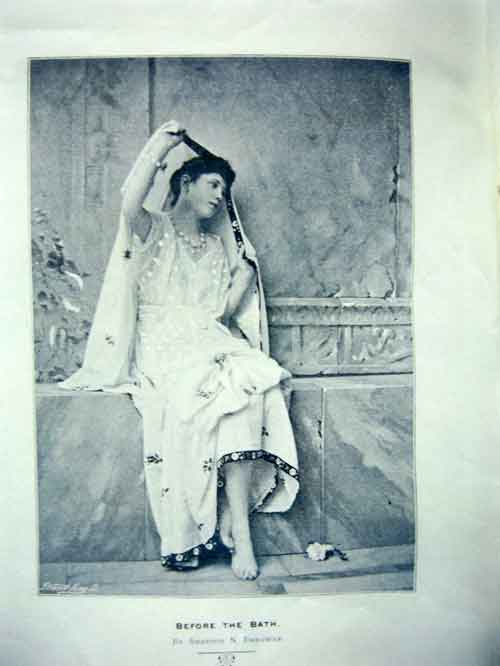
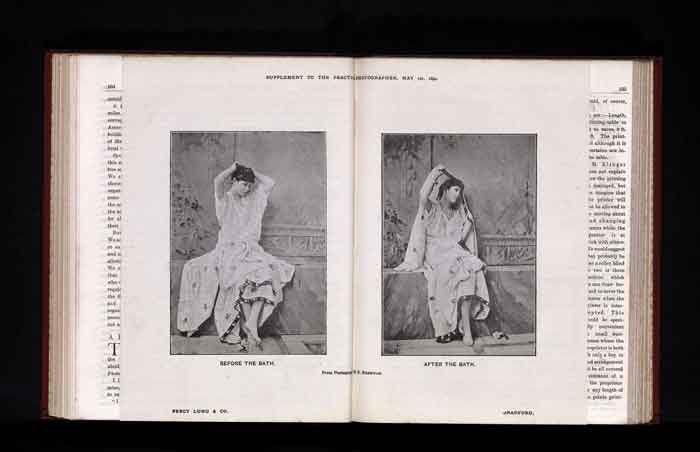
In 1890 Bhedwar had his first salon success in the Royal Photographic Society annual exhibition held at the Crystal Palace, with two very large ‘Opal’ prints on milk white glass, showing a young girl in classical robe before and after her bath. These were suggestive of an oriental harem scene but the model was demurely covered in both images.
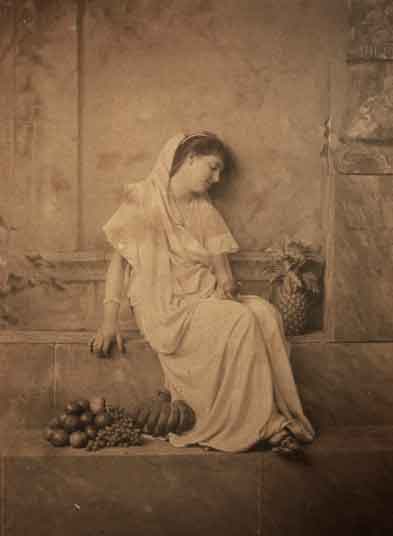
Bhedwar’s style and subject matter evoked a past world of Greco–Roman or orientalist ladies languidly posed against marble benches seen in the contemporaneous paintings of English Neo–Classical artist J.W. Godward (1861–1922) and E. J. Poynter (1836–1919). Indeed, Bhedwar reportedly used the same models as Poynter and L Alama–Tadema (1836–1912). The quality of his prints best seen in the woodbury-gravure of another print on the antique theme called ‘The Fruit Seller’ published to accompany his 1894 profile in The Photographic Times. (op fig 3).
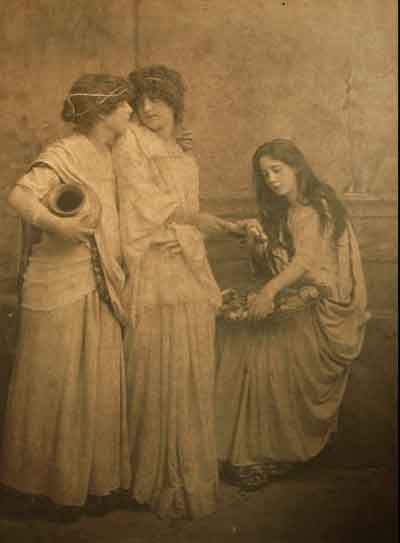
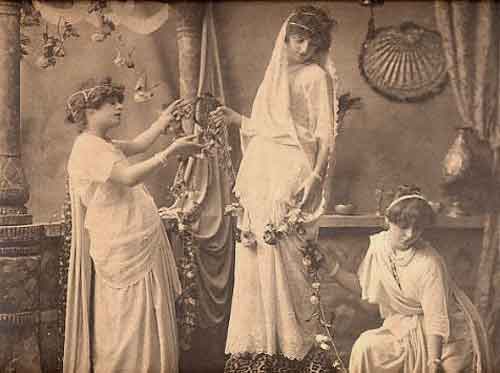
Bhedwar’s next work in the same vein was The Feast of Roses in 1891. The suite of six large platinum prints featured dark haired young women in softly draped robes seen singly and in groups; Weaving the Garland, Hanging the Garland; L’Innamorata [The one in love], The Flower Girl; Confidences and The Messenger. It was shown at the Photographic Society Fourth annual exhibition of the Photographic Society of India in Calcutta in 1891 where L’Innamorata won a silver medal. The series was shown a number of times garnering further medals.
Charles W Hastings in his ‘Critique of the Prize Pictures at the Pall Mall Exhibition’ in The Photographic Quarterly of October 1891–July 1892, noted that Bhedwar’s Feast of Roses had been given the ‘post of honour in the centre of the end wall’. He also noted Bhedwar’s title came from the ‘Light of the Haram’ story from the last section of Lalla Rookh: An Oriental Romance by Irish balladeer, poet and patriot, Thomas Moore (1779–1852).
The titles Bhedwar used in The Feast of Roses would have been familiar to many viewers with visions of the beauties of Cashmir and its fabled roses. A phenomenal best–seller ever since its publication in 1817, Thomas Moore’s book length prose poem tells of princess Lalla Rookh, the daughter of the Mughal Emperor Aurangzeb, who on her journey from Delhi to the Vale of Cashmere (Kashmir] to marry the Prince of Bucharia (Uzbekistan) falls in love with one of her entourage Feramorz, a Persian minstrel poet.
The poet turns out to be the Prince in disguise and Lalla Rooke’s despair turns to joy and the marriage proceeds. Moore’s four poems were based on tales from ancient Persian poetry and included references to ‘The brave struggles of the Fire–Worshippers of Persia…against their Arab masters’.
‘The Light of the Haram’ is set in the court of Soliman the Great and tells how Nourmahal, the favourite in the harem of Crown Prince Selim, wins back his love by magic. It is Nourimahal and her attendants we see. The soft flowing robes and simple pearl jewelry worn by Bhedwar’s models in The feast of Roses depart from the very elaborate bejeweled Mughal costuming and settings seen in illustrated editions of Moore’s poem. That gap may be significant, for on closer examination the embroidered hems and beaded slippers are akin to the distinctive sari style adopted by Parsi women in India. Bhedwar has adroitly affirmed his heritage and identity with the Persian literary references in one of the British public’s most popular books.
 |
| |
 |
| |
Some of Bhedwar’s Feast of Roses scenes with fake doves and roses and often strained poses and the ‘Englishness’ of the ladies did not convince all reviewers. The simplest and finest image The Flower girl is exquisitely posed and has a captivating moment as one young woman whispers in the ear of the central figure. With human figures these photographic images have an intimacy and warmth compared to the fastidiously detailed but impersonal orientalist paintings by Godwin and Poynter.
Lalla Rookh is a story of true love tested, and in one episode, a tale of doomed love. For Bhedwar what was lost was the glory of his Persian Zoroastrians ancestors forced into permanent exile.
The Feast of Roses was very popular winning six prizes, including two championship gold medals and a silver cup. The appeal of the series was not limited to foreigners as a sale of the series for 28,000 rupees was reported. Bhedwar’s countryman the successful painter and publisher Raja Ravi Varma (1848–1906) fused naturalistic details with legendary and religious figures, had a copy of one in his collection which served as a prototype for his 1899 painting Damayanti and the Swan.
Bhedwar’s success was due to his directorial talent learned in Parsi theatre and skill in the production and printing of his images using the finest quality papers. He chose to print only with platinum toned matt papers. The Feast of Roses and earlier neoclassical figures were shot at Ralph Robinson’s Redhill studio. Organising models, costuming and props would have been time consuming and expensive facilitated by Bhedwar’s resources and Robinson’s contacts.
 |
| First ablution |
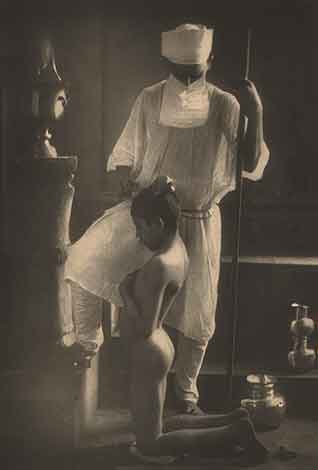
In 1892 Bhedwar’s art took on a very different subject and mood when he presented The Naver, a set of five dramatic dark toned platinum photographs showing the five stages in the consecration of a Parsi priest Invocation, First Ablution, Initiation, Final Orders and Full–Blown priest. These would appear to be of a Navojte ceremony when before puberty, Parsi children are inducted into the Zoroastrian religion. The suite shows the liturgical part of the ceremony held in its own space – whereas other parts are in front of other priests and an assembly of family and friends and the Parsi community. Bhedwar would have undergone this ceremony himself
The Naver is immaculately staged with dramatic backlighting adding mystery. The setting is his studio and probably using models. No actual ceremony would have been interrupted or staged for a photographer – although one commentator thought the initiate was Bhedwar’s son.
The Naver was first shown at the international Photographic salon in Calcutta in 1892 where it earned a gold medal – suggesting his community was not opposed to the revelation of a ritual open only to Parsi. It was shown next in the World’s Columbian Exhibition in Chicago in May-October 1893. Leading American art photographer Alfred Stieglitz (1864-1946) understood the artifice – he regarded it as a ‘bold piece of work, an attempt undoubtedly worthy of an award. The technical work, which in this case must have been of the most difficult kind, is beyond criticism’.
Despite – or because of, its presentation of an ancient Parsi ritual, The Naver attracted attention when shown in Britain, Japan, Europe and America. Four Naver images (the naked boy was excluded) were reproduced in the Freemason’s journal Ars Quator Coronatorum with an essay on the ceremony by Scottish war artist, photographer and ethnographer William Simpson (1823–1899) who had worked in India 1859–62. His comment that images were the first images of The Naver he had ever seen, suggests he thought, as others may well have done, that the images real or faithful re–enactments of an actual the ceremony.
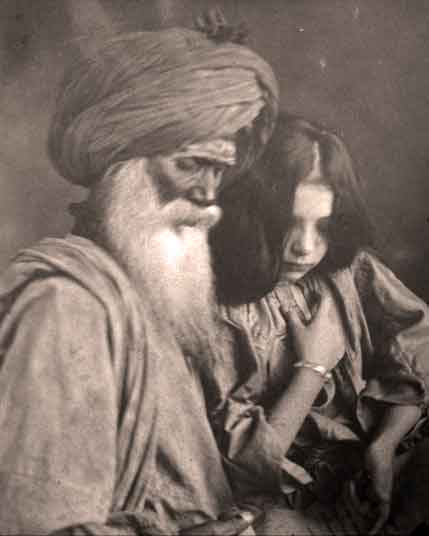
In October 1892 the year after his return to Bombay, Bhedwar had been invited to join the newly formed Linked Ring Brotherhood of art photographers. For their first exhibition in London in 1893, he showed a somber religious series under the heading The Voice of Silence. The story supplied by Bhedwar was that a blind Hindu Fakir was training his young daughter to take on a life of renunciation. An earlier title was The Amir’s Daughter’. Individual titles were In Trance , Divine Reading, From Door to Door*, At the Altar. and The First Grief
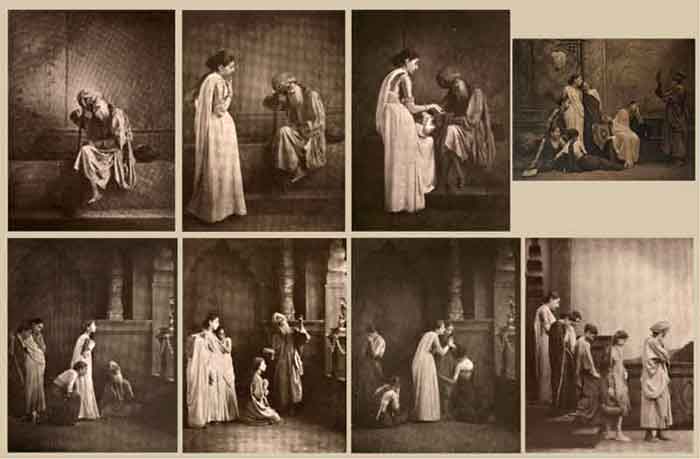
Even more complex was Bhedwar’s narrative of eight elaborately stageds eries Tyag; or, the Renunciation that seems to develop the Fakir story line . The images were iindividually titled; I – Weary sits the yogi–raj, II Abigail – the surprise, III – all intent the palm he reads, IV –The Mystic Sign, VI –The world renounced, V The Soul’s Awakening, VII The Parting, VIII On the Temple Steps.
The suite was first shown at the Photographic Salon of the Linked Ring in London from 24 September to 7 November,1896. Tyag showed a fakir who has followed a path of renunciation of the world. He is invited into a gathering of Parsi women. The youngest inclines to the spiritual and the group are next seen going to the temple of Shiva. The young girl changes to poor clothing and watched by her sad companions ,departs the temple abandoning her comfortable life to follow the Fakir.
Tyag was generally well received and widely shown. The critic Photograms of the year ‘96 finding the subject matter passe. The January 1897 issue of The Photographic Times included Bhedwar’s explanatory text for Tyag which makes clear Bhedwar’s agenda in the opening sentence ‘‘Art is nature humanized and the following pictures are calculated to spiritualize art by inspiring into our life nobler aims and purer aspirations’.
The editorial noted that the series had been inspired by the artist’s recent study of Theosophy. There was no mention that the title was from a founding text on Theosophy published in Bombay in 1889 by Russian mystic Helena Blavatsky. Zoroastrians as well as Freemason texts were a source for Blavatsky. Bhedwar was a member of the Rising Star of Western India Masonic Lodge in Bombay from 1892-97 and a number of Bombay Parsis found Theosophy aligned with their faith. Neither does Bhedwar identify that the words he ascribes to the Fakir were from the Book of the golden precepts cited by Blavatsky, A number of passages are from the Bhagavad–Gîta .
What his Parsi community or English readers made of his depiction of a young girl adopting a life of poverty and renunciation is not clear. A male follower might have been expectd. There may have been a personal crisis for Bhedwar behind his religious turn. Several Gujurati texts from before and after Bhedwar’s death in 1916 tell how his wife’s death led to him moving closer to the Paris temples and that and he also took up studies with Hindu Sadhus at that time.
Shapoor Bhedwar was thirty–eight when he made The Tyag. Religious subjects of this intensity were rarely part of the Pictorialist repertoire. Bhedwar was perhaps suggesting a return to ancient wisdom at the core of different religions as advocated by Theosophy was a step to universal brotherhood.
A fourth series of work created in Bombay is known only by two images in which Bhedwar himself takes the role of a rather amused artist watching a woman at a chess board in an image titled, Mate in three. Research in Parsi theatre archives may shed light on these enigmatic works. Bhedwar continued writing poems and was active as a theatre critic for the newspapers.
In 1907 Bhedwar made his last appearance in The Photogram’s of the Year and drew a dismissive comment from H Snowden Ward “Mr. Bhedwar is fascinated by Eastern poetry, history and romance but quite out of touch with the pictorial ideal – in fact, he has advanced no further than when he made his frost great success at the Crystal Palace, years ago.
Bhedwar ‘s studio continues to around 1910. His theatrical sense was undimmed when on a visit to England advertised in the 13 October 1910 issue of The Kinematograph & Lantern Weekly that had :
"A number of exceptionally interesting Plots and Photographs, which he is anxious to have produced as Film Subjects. Beautiful and wonderful conceptions. Film manufacturers interested should communicate with:- SHAPPOOR N. BHEDWAR, 79 Kensington Gardens Sq., Bayswater, W..”
Shapoor Bhedwa was still listed in a 1915 directory as a current practitioner of international fame. He died in Dr Masina Hospital, Byaculla on 26 August, 1916 with funeral at the Doongarwadi Tower of Silence near Kemp’s Corner.
Dearest to Bhedwar’s heart were his photo plays bringing full circle his youthful dramatic aspirations. He would possibly be pleased to find his work once again attracting international attention. In 2012 American historian Scott Lesko undertook a deep study of Bhedwar’s narrative series as a member of The Linked Ring in his dissertation ‘Aesthetics of Soft Focus: Art Photography, Masculinity and the Re–Imagining of Modernity in Late Victorian Britain, 1885—1914”,.
Lesko positions Bhedwar’s choice of Moore’s Lalla Rookh now interpreted as an affirmation of nineteenth-century Irish Catholic ant–British nationalism, as similarly political. Bhedwar’s elevation of his Persian ancestors in his Feast of Roses is interpreted in the context of nationalist movements in India focused on elevating the ancient scriptures and focusing on the body of the Fakir as a symbol of spiritual disciplines of Hinduism. Bhedwar’s turn to religious series and investigation of Freemasonry, Theosophy and Hindu scripture from 1893–96 also takes on a political dimension. Lesko provides a background to the rise of the charismatic yogi Swami Veiekananda who appearing at the World’s Columbian Exposition in 1893 stimulated knowledge and appreciation and exponents of Yoga practice in the west.
From the explanatory Bhedwar supplied for his religious series 1891-96’s, his spiritual path was undoubtedly sincere and erudite. He seems not to have become a Parsi high priest nor actively engaged with or advocated for Freemason, Theosophical Hindu or nationalist organizations, his deliberate political agenda remains open.
Earlier twentieth century histories of photography in India made only a passing if any note of Bhedwar’s contribution. What has been most enriching in the current reappraisal by Indian scholars in the context of local art and culture. The Alkazi Foundation in New Delhi holds the most important body of work by Bhedwar Shapoor; a deluxe presentation album titled Art Studies with thirty-one fine prints s covering the range of Bhedwar’s work. It was oresented by the photographer to Sohrab Palamkote a Parsi patron of the arts and poet.
 |
| |
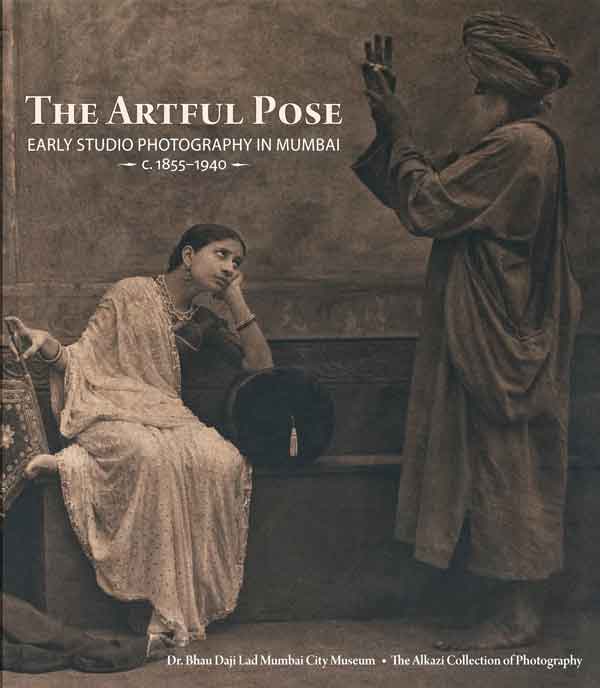
In the catalogue for the exhibition The Artful Pose: Early Studio Photography in Mumbai, c. 1855–1940 mounted by the Foundation in 2010, curator Rahaab Allana writes sensitively on Bhedwar. He traces the thread of performance and the possibilities for identity and expression that the photographic studio allowed. Allana deems Bhedwar’s narrative series as perhaps ‘the first Indo–European theatrical stylizations in photography’. Allana also references the role actual gurus might have played in Bhedwar’s spiritual evolution.
Professor Jyotindra Jain in Bombay/Mumbai Visual Histories of a City of 2013, places Bhedwar in the rich history of visual culture in turn of the century Bombay. In addition to the mix of realism and fantasy in the art of Raja Ravi Varma and other painters, there was a conjunction of the practices of theatre, cinema and photography at work in Bombay. Bhedwar and his successor JS Tarapore, engaged. themselves with imaginary theatre stills.
Art Historian, Atreyee Gupta researching global modernism has looked at Bhedwar‘s presence in the British section at World’s Columbia Exposition in Chicago in 1893, where he was the only Asian speaker at the World’s Congress of Photographers.
Shapoor N Bhedwar was more than ‘a clever Indian photographer’ He was a significant , innovative and talented artist. Steeped in British and Parsi cultures Bhedwar undertook a serious spiritual path in the mid 1890s. He sought to bring these separate elements into the unified space of his photoplays whilst affirming his dearest Persian heritage.
Return to Shapoor Bhedwar main page
return to photoweb contents