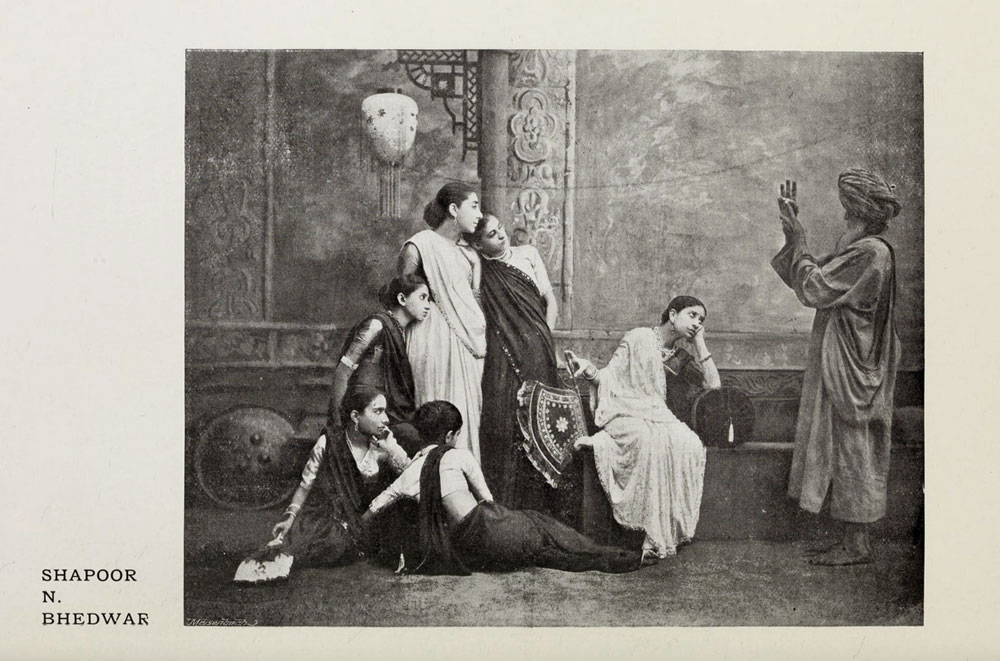
Shapoor N. Bhedwar was a pioneering Indian art photographer who achieved international renown in the late 19th and early 20th centuries. A prominent figure in the Pictorialist movement, Bhedwar was highly celebrated for elevating photography from a purely documentary medium into a recognized fine art form. His work stands out for its theatrical tableaux and rich cultural storytelling.
Born into a wealthy Parsi family in Bombay (now Mumbai), Bhedwar initially pursued a broad range of passionate interests, including theatre, poetry, literature, and spiritualism. Before dedicating himself to photography, he was notably an accomplished athlete and toured England in 1886 as a member of the very first Parsi cricket team. He took up photography around 1888, originally intending to use it to illustrate his own literary writings, but quickly became consumed by the artistic possibilities of the medium.
To master the craft, Bhedwar traveled to London in 1889 to study at the Polytechnic School of Photography. During his time in England, he studied under prominent masters, including the influential English Pictorialist Ralph W. Robinson (son of Henry Peach Robinson). Bhedwar quickly made an impact on the international salon circuit. Utilizing artistic models and sophisticated staging, he won numerous prestigious awards across Europe and America within just a few years. His technical mastery of lighting, posing, and the platinum printing process earned him high praise from contemporary photography giants, including Alfred Stieglitz, who lauded Bhedwar’s work for a "richness of tone and delicacy rarely seen at a photographic exhibition."
Unlike many contemporary studio photographers in India who focused on straightforward portraiture or ethnographic documentation, Bhedwar approached the camera as a painter would a canvas. He staged elaborate, allegorical scenes that seamlessly blended Eastern and Western motifs, often inspired by literature, religion, and moral plays.
Some of his most celebrated series and works include:
The Feast of Roses (1890s): A highly acclaimed series of six photographic tableaux illustrating Thomas Moore's popular Romantic poem Lalla Rookh, set in ancient India. It won multiple international championship gold medals.
Force of Silence / The Voice of Silence (1891): A poignant image depicting a blind mystic (fakir) conversing on faith with his young daughter. The title is heavily associated with Helena Blavatsky's theosophical book The Voice of the Silence.
The Zoroastrian Series: A rare and deeply personal series documenting Parsi religious life. Notably, his image The Naver—invocation (1892) captures the initiation of a young Zoroastrian priest—a subject rarely made public due to strict religious traditions.
The Renunciation Series: A narrative photographic sequence published in The Photographic Times (1897) that follows a yogi initiating the process of worldly renunciation.
Bhedwar returned to India and established a highly regarded studio in Bombay, also contributing essays on the psychology and aesthetics of "Portraiture" to journals like The Photographic Times. By the early 1920s, his work slipped into relative obscurity following the sale of his studio. However, Bhedwar's legacy has been significantly revitalized by modern curators and historians. He is remembered today not merely for adapting Western Pictorialism, but for uniquely transforming it to express his own complex cultural, religious, and artistic heritage.
Shapoor N. Bhedwar's surviving prints are preserved in major international collections, including the National Gallery of Australia and the Asian Art Museum in San Francisco.