 |
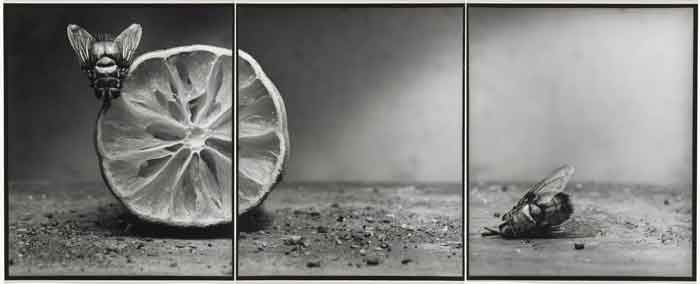
| Joachim Froese, 2000, Rhopography #15 |
Joachim Froese, born Canada 1963, Germany 1966-1991, Australia from 1991
Gael Newton, small essay 2004
Rhopography is an archaic term for still lifes and comes from the Greek root, ñùðïò (rhopos), referring to small, trivial bits and pieces. Principally referencing seventeenth-century Flemish still-life painting, Joachim Froese investigates the transient nature of existence in his Rhopography series.
Traditional still life studies often show opulence – beautiful ripe fruit, flowers etc – but with the inclusion of symbolic references to death and decay: the viewer understands that the fruit will go off, and that the flowers will wilt or their perfection be marred by the butterflies, snails and bugs included in the scene. In the images in Rhopography, the suggestion has become manifest.
In Froese’s meditations, dead bugs and flies from the dust of the floor and windows become actors in a gloomy yet strangely beautiful drama. He collects the specimens with care and their performance in his tableaux is achieved by means of a painstaking process of arrangement and rearrangement.
This involves interventions such as gluing feelers in new positions for each subsequent shot. Photographed in extreme close-up with a resulting exceptionally shallow depth of focus, the insects become gargantuan and dust that would usually be imperceptible is seen in extreme detail. It is also carefully arranged and rearranged for each shot.
There is a grimly comical aspect to all this: art critic Timothy Morrell has written perceptively that the ‘morbid antics’ of the insects ‘cannot escape comparison with the theatre of the absurd … The absurdist philosophy embraces the irony of striving hard when the ultimate reward is death’.
Froese's work also makes reference to nineteenth-century photography, emulating the frozen stillness of early studio work where sitters were forced to hold poses to allow for the long exposure times. He is also interested in the convention of the print as a precious object, producing works with a beautiful surface quality and, like traditional Dutch still life painting, with an almost hyper-real degree of detail.
In the way the works are presented, here too Froese looks to traditional western painting as a model, choosing formats such as the triptych.
Return to Joachim Froese main page