John F Williams
Exhibition review, The Shrine War Memorial, Melbourne
Robert McFarlane 2020
As the son of British soldier Frank Williams, who served in the First World War but spoke only rarely of his horrific experiences, the late John Williams(1933–2016) had long been drawn toward finding a deeper understanding for his father’s time as a soldier. In the three decades of their sharedrelationship as father and son, attempts to discover the depth of Frank Williams’s wartime experiences were, Williams once remarked, met withstony silences.
In 1991, John Williams and his second wife, the late gifted photographer Ingeborg Tyssen, would use their three-month residency in Paris to visit the Somme and the battlefields of the Western Front. Australia holds a special place in France’s memories for this country’s assistance in the battles ofthe First World War. For many years after war’s end blackboards in French classrooms carried the poignant inscription: ‘Ne Oubliez Pas L’Australie’. Never forget Australia.
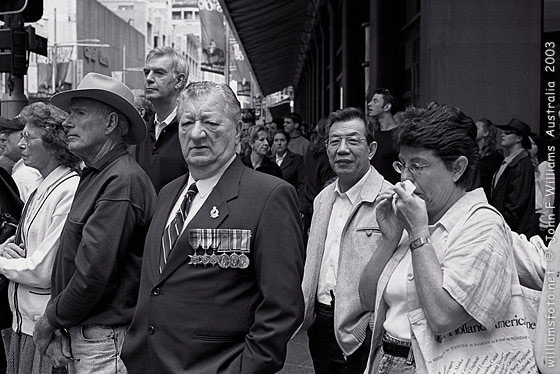
The space that exists between the late John Williams’s photographs from these arenas in which the First World War occurred contains poetic, bittersweet elegies for the alleged ‘the war to end all wars’ and its inevitable, tragic consequences. In assessing this gifted photographer’s exploration of these theatres of conflict there appear to be three acts: The bleak, distant fields Williams photographed where many decades agowarfare actually took place, but realised with a spare, distinctly poetic vision; and later collages created by Williams, drawn from text, propaganda,memorabilia and documentary photographs taken on the battlefields. His final act was to be, appropriately, photographing war’s timeless, annualpostscript, Anzac Day.
The apparent emptiness suffusing many of John Williams’s photographs of arenas of early 20th Century savagery cannot shield our realisation, that war, the ultimate expression of the failure of political wisdom, once occurred on these distant fields.
His later collages also take us closer to the personal realities of warfare and its consequences. When I first looked at a dense, dark collage of a group of men gathered before the camera lens I thought I detected one soldier wearing a pale ribbon of commendation around his neck only to quickly realise it was his injured arm suspended in a sling.
In other moving collages by Williams we also sense the companionship that becomes a part of serving in armed conflict. In one image a group of young soldiers address the camera, without a shred of visible fear but bonded by what seems an ocean of resignation. Williams also suggests the dislocation war causes in another moving collage of a young soldier photographed with perhaps his wife or sweetheart, either before or after activeservice.
Williams appropriately layers his image with copious quantities of words, deeply felt, but perhaps never spoken.
John Williams also addressed the ultimate equality war creates by also photographing the gravestones of German soldiers with their names gradually being obscured by Nature’s encroaching leaves. His sculptural photographs of totemic Germanic crucifixes are also seen near groups oftiny oval portraits of distant loved ones, initially resembling a scattering of pearl shells.
Ultimately the late John Williams addresses the nature of time itself in these images. This exhibition expresses brilliantly the longer moments that eminent Australian documentary photographer David Moore (1927—2003) once described to me as ‘The soft spread of Time’.
Apart from Williams’sagile Anzac Day reportage his images generally do not conform to what French master photographer Henri Cartier-Bresson (1908—2004) pioneered with his definition of ‘The Decisive Moment’. Williams chooses longer, more gently revealing instances.
Moving from observing the quiet moments in distant battlefields converted to memorials, Williams revealed his considerable documentary skills indocumenting Anzac Day. In one memorable, unsentimental 1964 image, a now middle-aged ex-serviceman is watched by a ragged, homeless man, as he nonchalantly stands in the street wearing his medals, defiantly smoking a cigarette, perhaps reliving wartime memories on ‘The One Day of The Year’.
This exhibition, curated with great subtlety by the Shrine of Remembrance’s Kate Spinks, allows us to contemplate, unsentimentally, events that sadly, are not diminishing.
John Williams’s contribution as a photographer, artist, educator and critic to Australian cultural life is unsurpassed.
A journey through his visual legacy, meticulously preserved by his widow, Jean Curthoys, promises wisdom, and a moving experience, informed by aquestioning vision.
Return to John Williams main page