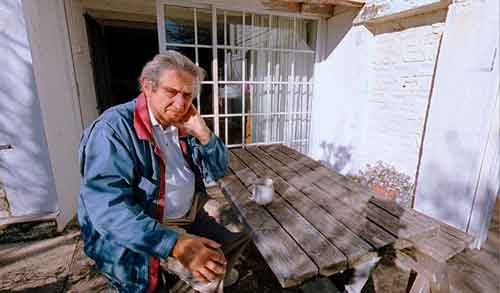
About John F Williams
Australian Photographer 1933 - 2016
Text drawn from several sources, including ArtBlart
John Frank Williams was a prominent Australian documentary photographer, academic, art critic, and social historian. He used his camera to critique Australian national identity, capturing everything from urban transitions to unsentimental, poignant studies of aging veterans at ANZAC Day marches.
As a foundational academic, he shaped the next generation of artists as the inaugural Head of Photography at the Sydney College of the Arts and co-founded one of the country's first dedicated photographic art spaces, Melbourne's Photographers' Gallery, leaving behind a profound legacy that treated photography not just as art, but as a vital tool for writing history.
He famously operated at the intersection of image-making and historical analysis, once describing himself as "a photographer who wrote history and a historian who took photographs." His work serves as a gritty, analytical critique of Australian national identity, mid-century social structures, and the cultural legacy of the World Wars.
Williams began as an amateur street photographer in the late 1950s, heavily inspired by seeing Edward Steichen's landmark The Family of Man exhibition when it toured Sydney in 1959. While influenced by Henri Cartier-Bresson’s concept of the "decisive moment," Williams developed a more complex, gritty, and formally layered style. His early work capturing Sydney’s urban landscape in the 1960s was famously described by him as "rough, hard, and grainy."
He possessed a brilliant, classical understanding of the image plane, often utilizing off-centre vanishing points, complex reflections, and spatial layering. His street photography didn't just look at people; it looked through them at Australian society. His images captured the realities of the White Australia policy, the rigid remnants of the British Empire, the sharp contrast of powerful men behind corporate desks next to anonymous secretaries, and the rising tide of rebellious youth and beach culture.
The son of a British World War I veteran who emigrated to Sydney in 1925, Williams grew up around the "stony silences" of wartime trauma. This deeply shaped his intellectual path. He went on to earn a PhD in Modern History from Macquarie University and authored seven books—most notably Quarantined Culture (1995)—which examined Australian cultural history and the home front during WWI.
Over several decades, Williams documented ANZAC Day marches. His approach was completely unsentimental, focusing on the isolated, aging veterans standing apart from the crowds, capturing a sense of internal exile and a society replacing its lack of a complex intellectual identity with the myth of the lone warrior.
WWI Battlefields & Collages: Later in his career, he created deeply poetic, bleak bodies of work (such as the 1985 series From the Flatlands) photographing European battlefields. He layered these modern views with archival family album prints, snippets of text, and historical documents to explore the passage of time, memory, and the tragic consequences of conflict.
Williams was a central pillar in the "booming new wave" of Australian art photography in the 1970s, stepping forward as a rare figure who was simultaneously a highly articulate practitioner, critic, and academic. In 1973, alongside filmmaker Paul Cox and photographer Rod McNicol, he co-founded The Photographers' Gallery on Punt Road in South Yarra (Melbourne), establishing one of Australia's very first commercial fine art photography galleries.
Williams served as the foundation Head of Photography and Film at the Sydney College of the Arts, helping shape the pedagogical foundation for a generation of emerging Australian contemporary photographers.
Williams abruptly ceased traditional black-and-white darkroom work around 2002 out of growing concern for the toxic health effects of darkroom chemicals on practitioners. From then until his death in Hobart in 2016, he transitioned completely to digital photography, shifting his focus to intricate digital image stitching, layering, and multi-image overlays. He was married to the talented photographer Ingeborg Tyssen, who tragically predeceased him in 2002.
Williams' work remains a cornerstone of Australian documentary modernism, striking a deliberate balance between sharp social critique and a formal, poetic beauty found in the everyday streetscape.
Return to John F Williams main page