Gael Newton 2002
originally published in World of antiques & art
In 1910 F. J. (Frank) Hurley, the Sydney photographer best-known for his production of stylish postcards, was facing financial difficulties from a downturn in the market. He was very relieved indeed then to be able to close his business to take up an appointment as official photographer and cinematographer to the Australasian Antarctic Expedition led by Douglas Mawson from 1911-1914.
That role led to his appointment to Ernest Shackleton's British Trans Antarctic expedition which ended prematurely when their ship Endurance was caught and crushed by ice floes in 1916 initiating a lengthy, and dangerous and finally desperate fight for survival by the leader and crew. These adventurous journeys and the dramatic photographs and films he made of them, brought Hurley undreamed of international and national fame.
The National Gallery of Australia holds several of Hurley postcards from 1905 -1910 and a small group of carbon print enlargements circa 1920 from his Antarctic photographs and lesser known trip to northern Queensland in 1913 with adventure-motorist Francis Birtles.
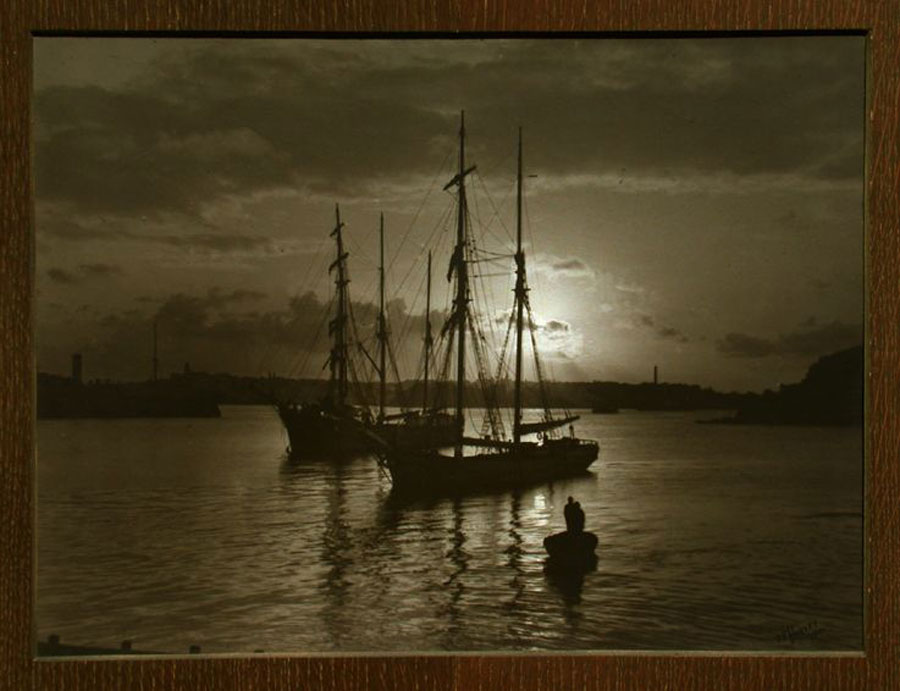
No vintage exhibition prints from his pre-Antarctic years were known until 2001 when Sydney photographic dealer Josef Lebovic offered the Gallery a signed Hurley print of Sydney Harbour at twilight in its original dark wood frame with a framer’s date of 'April 1910' on the back.
The subject is one of two closely related images published by Hurley in 1909 and 1910. The first titled Toilers of the Deep, was published in the Australasian Photo Review in 1909 while the Gallery's variant was published under the title Safe at Anchor in Harringtons Photographic Journal in March 1910
Safe at Anchor is closely related to Hurley's dark atmospheric 'arty' postcards as well as the low-tones favoured at the time in art photography salons of the day. It has not yet been established where Hurley exhibited his picture. His contemporary Harold Cazneaux had mounted the first one-person person photographic show in Australia in 1909, and Hurley may have gone to the expense of mounting and framing some of his prints to show his equality.
While elements of the romantic atmospheric effects remained in Hurley's later works, after his Antarctic adventures he parted company with the gentler world of art photographers and their salons and developed a brighter, more detailed but dramatic style suited to wide publication in newspapers, books and magazines.
for more on Frank Hurley
for more Gael newton's essays
return to photoweb contents page