|
Lucia Moholy
The Kitchen
Gael Newton AM, March 2026
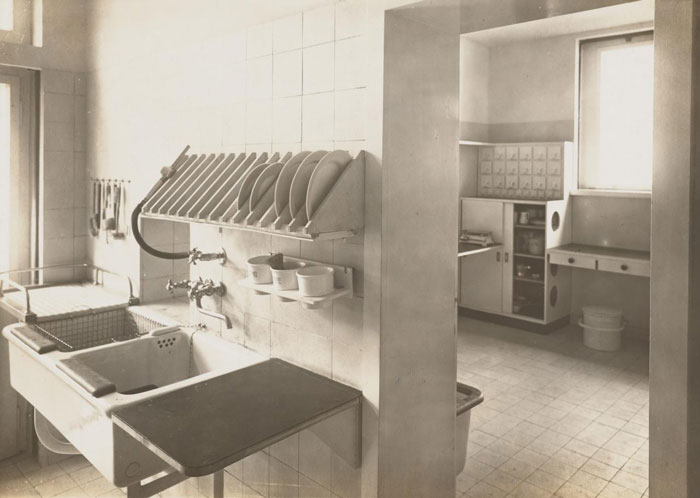 |
Lucia MOHOLY Bauhaus residences Dessau, kitchen – sideboard [Walter Gropius House] (1926) gelatin silver photograph11.9 × 16.8 cm (image) 13.0 × 17.9 cm (sheet)
National Gallery of Victoria, Melbourne Bowness Family Fund for Photography, 2023© 2023 Lucia Moholy Estate/Artists Rights Society (ARS), NewYork/VG Bild-Kunst, Bonn |
One of the many highlights when visiting the National Gallery of Victoria's 2026 exhibition, Women Photographers 1900–1975: A Legacy of Light, was to see works that have not always drawn a lot of attention. One is a quiet gem showing the kitchen and scullery in the Director’s residence of the Bauhaus Art School at Dessau, Germany.
The photograph was made in Dessau between 1926-27 by Czech-born photographer, editor and writer Lucia Moholy (1894–1989). The house was designed by the Bauhaus Director, architect Walter Gropius (1883–1969) and furniture by designer Marcel Breuer (1902-1981) with the latest gas appliances by Junkers & Co factories in Dessau. The Gropius house complex kitchen image is a rare vintage print from Lucia Moholy’s now celebrated Bauhaus photo archive of over 500 5 x 7 inch glass plates.
Architectural photography is a demanding art/craft in which the immoveable construction has to be orchestrated in light and perspective to convey both its vital essence and information. Lucia Moholy’s skill is evident in her choice of a close-in angle showing the kitchen and scullery that places the viewer intimately in the scene. The timing of the exposure when light floods the scene enlivens its utilitarian character. Other images of the Kitchen and caretakers unit kitchen are held by the Bauhaus-archiv, Berlin a museum built on Water Gropius estate and Harvard University Bauhaus archive.
Lucia Moholy’s Bauhaus campus images are largely austere exterior and interior views of the Dessau in perfect sync with the School’s reductive streamlined aesthetic of glass, steel and concrete architecture and still life studies of the workshop design prototypes. There is a classical clarity and serenity to Moholy’s Bauhaus images fitting the School’s mission to unify individual artistic vision with design for modern industrial mass production.
Born in Prague in 1894, Lucia Schulz came from an affluent and cultured Jewish family in a German speaking part of Prague. She qualified as teacher of German and English teacher in 1912, and attended lectures in philosophy, philology and history at Prague University. From 1915 she worked as an editor for various publishers in Germany.
After marrying Hungarian artist László Moholy-Nagy (1895-1946) in Berlin in 1921, Lucia continued work as an editor supporting her husband. László attracted the attention of Walter Gropius who appointed him as a teacher at the Bauhaus Arts and Crafts school at Weimar in 1923 and as Master of the metal workshop at the purpose built modern Bauhaus campus at Dessau in 1925.
From the beginning of their relationship Lucia Moholy collaborated intensely with László theorising and writing about new technology and art what László called ‘the new vision’ including on experimental art photography. She took up photography around 1920 and had an apprenticeship in a photography studio in Weimar in 1923-24 with additional and studies at a graphic art academy in Leipzig while at the Bauhaus in Dessau. In 1925 László and Lucia moved into one of the three duplexes for the workshop masters.
Lucia Moholy was not a teacher or employee at the Bauhaus which had no photography courses or facilities until 1929 but as a master’s wife she was expected to contribute. The Bauhaus photo archive that Moholy undertook was not a commission. She used her own wooden stand camera, had no fancy lights or studio space and had to set up a darkroom at home in the duplex. Moholy retained the negatives and rights to the images.
Bauhaus images online reveal many sharp views of modern buildings and stylish interiors fitted out with furniture and lighting by Marcel Breuer head of the carpentry workshop as well as products designed in the various workshops. There are very few kitchen images and these are presented as marvels of clinical efficiency and new gas appliances technology. Gropius declared ‘Today, many things appear to us to be luxury which will become normal just the day after tomorrow’. The kitchens are like laboratories but not part of the Bauhaus brand of beauty and utility.
The Director’s house included a caretaker’s flat with another kitchen and a Junkers central heating boiler.
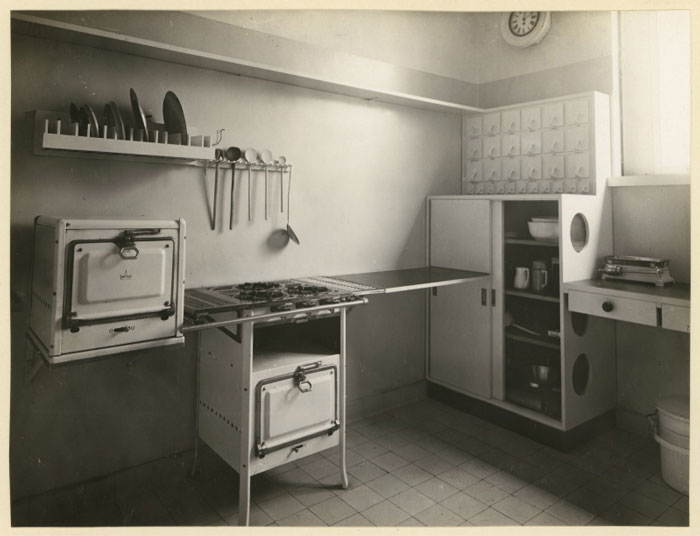 |
| Mohoy Kitchen in Gropius Master House With Cupboard By Marcel Breuer, circa 1925–1926 gelatin silver print 2.07 X 16.81 cm. Bauhaus-archive Berlin |
| |
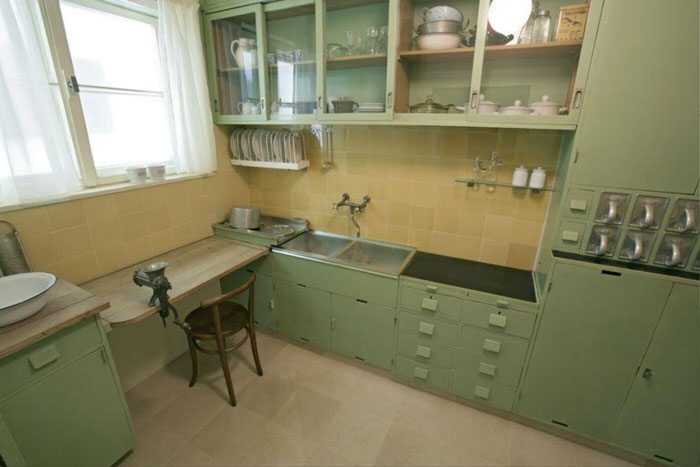 |
| The Frankfurt Kitchen 1926 |
The Bauhaus was not at the forefront of modern kitchen design or concepts. Modern prototypes were in production in Frankfurt where a massive post World War I modern mass housing was being built. Austrian architect Margarete Schütte-Lihotzky was commissioned to design the first ergonomic, streamlined modern kitchen in 1926 for the new housing complexes. ‘The Frankfurt kitchen’ as it is known was the first ‘dream kitchen’. It was colourful, workable and appealing. Several surviving examples are housed in museums including the Museum of Modern Art, New York.
I suggest that Walter Gropius was most likely not interested in the 'design' of kitchens. These function rooms he would have not visited often nor did he cook. Gropius had a maid while in the Bauhaus as well as in later life. The kitchen at the Bauhaus was functional according to the times and the needs as seen by the employers of the maids who worked in them. Whereas the Frankfurt Kitchens were a result of attention to design as well as function and efficiency.
Quoting from the web site about this (link below): To the woman who designed it, Margarete Schütte-Lihotzky, the Frankfurt Kitchen was a revolution. Not just because it was part of a huge effort to get people housed, but because of its wildly efficient layout. It was designed to fit, and to bring modern appliances and architecture to the masses — but it was also designed to conserve the user’s energy. To make cooking as fast and easy as possible. And to Schütte-Lihotzky, that ease was political.
In 1928 Walter Gropius resigned from the Bauhaus and relocated to private practise in Berlin. László Moholy-Nagy and Lucia followed. The couple’s close collaboration had eroded over their time at Dessau and they separated in 1929.
Lucia had not enjoyed small town Dessau and intense campus life at the Bauhaus. She worked in Berlin but at in 1933 Moholy had to flee in fear of arrest for her communist association, leaving all her possessions behind including her negatives.
After time on Prague and Paris, Lucia Moholy settled In England in 1934 where she worked as a portrait photographer and teacher. In 1939 she published A hundred years of photography 1839-1939 - the Pelican paperback version was in circulation throughout the photoboom of the 1970s and remains popular.
In England Moholy had a significant role as a pioneer and innovator in the microfilming of archives before her retirement to Switzerland in 1959. |
|
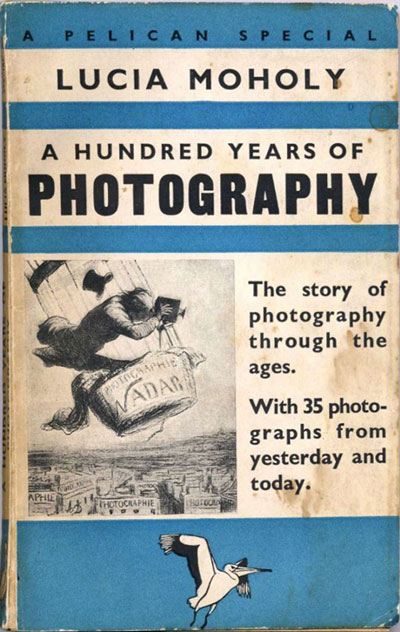 |
Lucia Moholy A Hundred Years of Photography, 1939 paperback edition |
|
After seeing her images as uncredited illustrations in the catalogue of a 1938 exhibition on the Bauhaus at the Museum of Modern Art, New York and many later publications, Lucia Moholy became aware that her negatives had survived. She found they had come into the possession of Walter Gropius who took them to his new teaching post America in 1937. He could easily have found Lucia post war. For years Lucia Moholy asked Gropius to give the plates back but he would not until her lawyers were able to force the return about half the original number in 1957. She complained that Gropius enjoyed the use and income from the photographs while she lived in want.
(Legal letters concerning Lucia Moholy’s quest to retrieve the negatives from Gropius are held in the Harvard Bahaus archive.)
The rise of awareness of photography as art in the 1960s led to attention on Lucia Moholy from photographic historians. Lucia Moholy was awarded a fellowship by the Royal Photographic Society and President Professor Margaret Harker (1920-2013) first President, did a series of interviews and articles on Moholy in the British Journal of Photography in the 1980s.
Lucia Moholy lived to see shows and publications on her work and to issue her own account of the role she played in collaboration with László in modern photography in 1972. There are great portraits of her rather amused self looking out at us in late life. There is an abundance of material and images online and a few very recent new publications and exhibitions.
In 2024-2025 the most comprehensive retrospective Lucia Moholy: Exposures was a collaboration between Kunsthalle and Fotostiftung Schweiz and and the Bauhaus Archive, Berlin. The accompanying monograph is by Jordan Troeller and Oliver A.I. Botar Praha Prague and with Fotostiftung Schweiz in Winterthur was published in 2024 by Hatje Cantz.
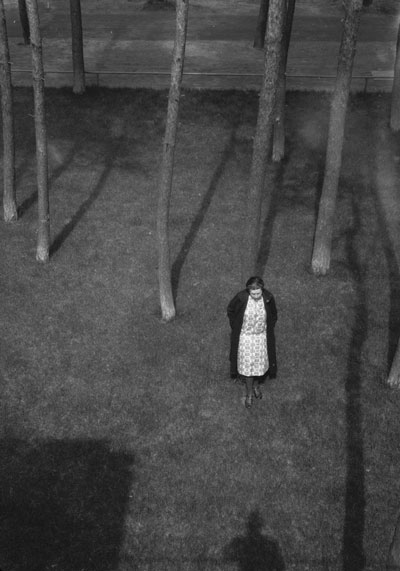 |
Fig11 László Moholy-Nagy. Hungary 1895 – 1946 USA
Lucia Moholy among the pine trees around the Walter Gropius designed Meisterhäuser [teaching masters house] Dessau] 1926/28. The illustration is from an estate edition of 30 at 30 x 21 cm made by William Pelletier custom printer who opened a photography gallery in Maine in 1995. |
To conclude there is an image held by Queensland Art Gallery, Brisbane of Lucia in the landscaped grounds of the duplex residences taken from the top floor balcony by László Moholy-Nagy, Lucia stands hands behind her back as if tied to a tree. László‘s shadow can be seen lower centre. She doesn’t look up. Lucia did not enjoy life in Dessau and her relationship was failing. Our present knowledge of Lucia Moholy’s long and productive life happily belies this sombre image.
Return to Lucia Moholy main page for more related resources
|