|
A View of Collins Street Melbourne 1839
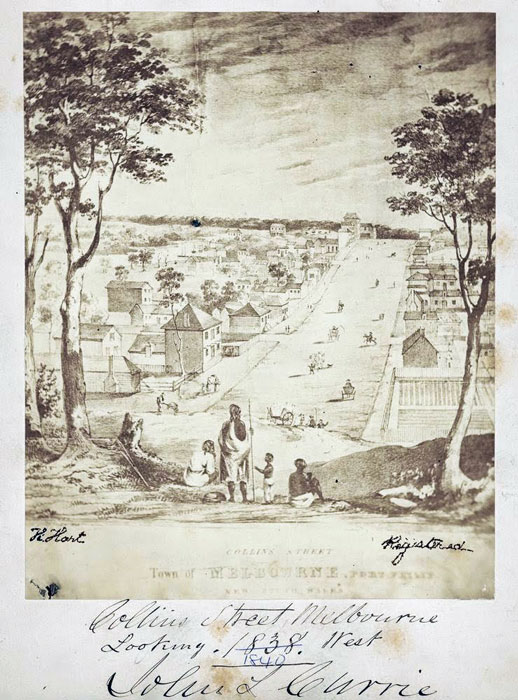
In early 2016 I had a commission to travel to Melbourne to catalogue photographs in the Dennis Joachim Collection later auctioned in June by Mossgreen, Melbourne. Lot 526 was an 1861 album presented by ‘Mr J H Kerr to Mrs Stewart’ and within it was a photograph (not in the clearest condition) of a drawing of ‘Collins Street Melbourne 1839’. The photo was signed lower right with the initials of John Hunter Kerr.
Kerr was not the original artist. Somewhere around 1860 he had photographed a lithograph of 'Collins Street, Town of Melbourne, Port Philip, New South Wales'* that had been published in London in August 1840 by J Cross of 18 High Holborn. The original print imprint lists E. Noyce as lithographer after a drawing or painting by W. Knight.
* Victoria officially became a self-governing British colony on July 1, 1851, separating from New South Wales.
I did quite a bit of research on the image and its variants as it is one of the earliest views of Collins street. Having moved to Melbourne in late 2023 and occasionally travelling along Collins street, the image now means more to me. I have written an appreciation of the Knight image but also surveyed later photographs and images of Collins street. Such is the nature of research it changes with different contexts and each step is part of a family tree with many side branches.
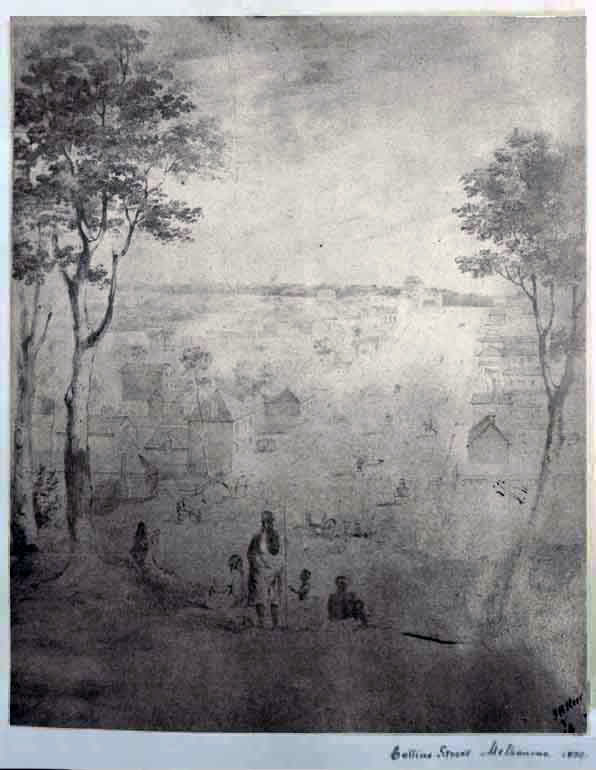 |
| c.1860 photograph by John Hunter Kerr of the 1839 lithograph |
One of the earliest views of the newly named and gridded Melbourne town was a lithograph (and therefore based on a drawing) titled 'Collins Street - Town of Melbourne, Port Philip, New South Wales' published in London in August 1840.
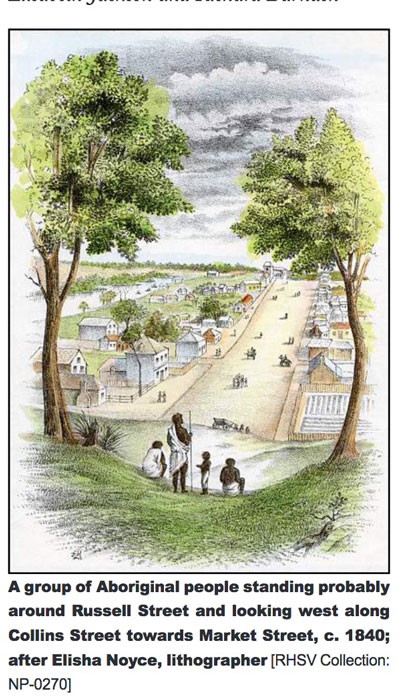
At the centre foreground of the lithograph three Wurundjeri adults and child stand on the small hill at the eastern end of Collins street at about the present day site of the Old Treasury Building. The elevated viewpoint looking west towards market street emphasises the very generous wide street plan instituted by Surveyor Robert Hoddle in 1837.
(The 1837 Hoddle Plan for Melbourne featured exceptionally wide major streets measuring approximately 30 metres (99 feet) and narrower "little" streets for rear access measuring 10 metres.)
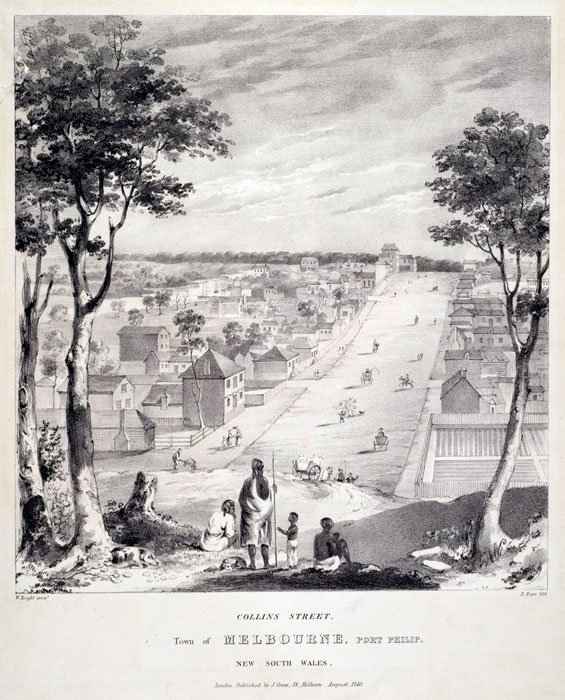 |
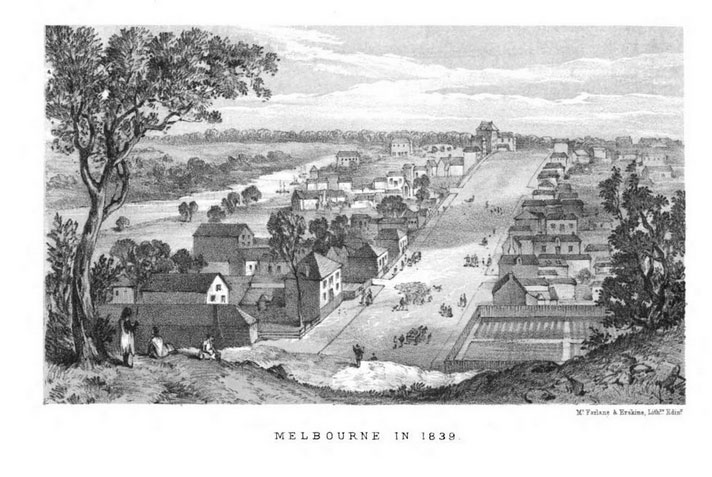
| 1839 lithograph by E. Noyce after a drawing or painting by W. Knight |
On the left side of the lithograph ships can be seen in the Yarra (no tall buildings yet to obscure the view). The Australian News for Home Readers of 24 March 1864 compared this view to an 1864 scene and described the various premises of 1839 including identifying the two story building in the distance on the left as the new Shakespeare Hotel built by founder John Pascoe Fawkner at the corner of Collins and Market street.
The lithographed scene is of an ordered established settlement of cottages and substantial buildings interspersed with scraggly native trees. Men, women and children are busy with barrows, carts, horses, animals and vegetable gardens. The cart going down the hill has initials ‘J C’ of the publisher on a sack.
The Aboriginals who are dressed in toga like garments appear to benignly approve the progress of the settlement having sold the land to John Batman by treaty in 1835. In 1839 George Robinson of the newly formed Port Phillip Aboriginal Protectorate was actually discouraging Aboriginal people from entering the town and breaking up their camps by the Birrarung (Yarra River).
The lithographer was English graphic artist Edward Noyce (1816-1854) and the publisher the engraver and bookseller Joseph Cross ( w.1823-c1854) of 18 Holborn, London. Joseph Cross had specialised in British colonial topographic views since the mid 1820s. He had published a ' Map of part of the colony of Port Phillip exhibiting the situation and extent of the sections of land marked off for sale at Sydney on the 12th September 1838’. Noyce’s name appears on a series of Australian scenes in the 1850s by other publishers but there is no evidence that he ever travelled to the antipodes.
The Cross lithograph imprint credits ‘W Knight pinxt’ as the artist of the original image. He was business agent and amateur artist William Thomas Knight. He had been born in London in 1809 the son of William Sr a London Lawyer who dispatched him aged seventeen to Hobart in 1827 to become established as a merchant with a land grant.
William Thomas Knight did not immediately become a settler. He was back in London in September that year and again in Hobart in May 1828 with a cargo of general merchandise. He made at least three more trips between London and Hobart spending 1833-1837 in North Wales and Devon with frequent trips to London. In October 1838 he purchased a map of Van Diemens Land possibly one of Joseph Cross’s, and was back in Hobart in December arriving on The Emu as an agent for a Mr Wilkinson. He travelled back to London via The Hindoo on 25 November 1839, departing again 21 August 1840 arriving in Hobart in early December on The Calcutta and set up trading on the Old Wharf.
Knight was well connected often acting as an agent for wealthier associates. He had considerable drawing skills making attractive views of Rio de Janeiro on his trips which he exhibited in Hobart in 1828. The Allport Museum Hobart holds Knight’s attractive watercolours from his voyages. He settled down in Hobart and died there as a prominent citizen in 1877. His portrait by Thomas Wainwright and a later photograph by Batchelder & O’Neill in Melbourne, are held by descendants.
In 2016 family historian Robin Knight advised that the most likely date for the Collins street sketch was July-August 1839 based on notices in the The Tasmanian of 28 June 1839, the Port Phillip Patriot and Melbourne Advertiser 1 July, various advertisements in the Port Phillip Patriot throughout July and a letter of 5 August William Knight wrote to the editor of the Port Phillip Patriot and Melbourne Advertiser in relation to the case of Grant v. Knight. William thus arrived in Melbourne on the ‘Mary Ann’ from Hobart on 1 July probably to sell merchandise. He had left by 14 September and departed for London from Hobart on the barque ‘Hindoo’ on 25th November.
This dating is supported by The Port Philip Patriot and Melbourne Advertiser of 18 March 1841 which reported on the arrival of the lithograph and the date of the original drawing.
View of Collins Street — Messrs. Kerr & Holmes, of the Book and Stationery Warehouse, Collins-street, have exhibited in their premises, for public, inspection, a view of Collins-street, Melbourne, very neatly lithographed in London, from a sketch taken some fifteen or eighteen mouths ago by Mr. Knight, a gentleman who came here on a visit from Hobart Town about that period.
The view, though it does not bear much resemblance to Collins-street now, conveys a very faithful impression of the street as it was then, and is better calculated to give a stranger an idea of the appearance of the town than any sketch that has previously come under our notice. We are glad to see that the people at home are having opportunities of becoming acquainted with Melbourne, and we are of opinion that every man who contributes to attracting the attention of the British public to the actual condition of the province, does a service to the whole community.
By the Rookery, we believe, directions were sent for the re-publication in England, with many emendations and additions, of Mr. Ardcn's valuable pamphlet on Port Phillip, and the same vessel took home a consignment of Kerr's Melbourne Almanac and Port Phillip Directory to Messrs. Smith, Elder, & Co., Cornhill, for sale in London. This is the way to "Advance Australia Felix."
Curiously the lithograph is not listed in Cross’s published catalogue or advertisements in Australian papers. However in 1864 the Australian news for home readers of March 1864, compared a woodcut based on the lithograph with an up to date view of the very busy densely built up Collins street. The editors were able to quote pioneer settler John Fawkner to identify the 1839 buildings.
Commencing at the right hand foreground, the garden allotments were Captain Howie’s, now occupied by buildings in which Mr G. Nicholson, the grocer, and others carry on their trade. On that side of the street, up to William street, there were a few scattered buildings, the property of Scarborough, Marshall, Batman, Ross, Fleming, Peers, M’Lean, Coombes, Umphelby, Ebden, Lilly, Robson, Smith, and Wilson and Eyre.
On the left hand side of the picture, commencing in the foreground, the first two buildings are where Powell’s ironmongery store now stands. The single two-story house was built by Mr M’Nall, butcher. Messrs Coulstock, Howson, Napier, Sharp, Pender, Hodgson, Powell, Fawkner, Batman, Smith, Fisher, Skene, Craig, and Wilson and Eyre occupied the southern side of Collins street, up to King street. The two-story house in the distance is the Shakespeare Hotel, built by Fawkner; the two houses lying between that and the Yarra were the British Hotel and a house of Batman’s. The water seen is the Yarra Yarra River, and that portion where the vessels are seen is a wide deep part of the Yarra Yarra known as the basin, where there was found seven and a quarter fathoms of water, when the river was first sounded by me in 1835
William Knight’s original art work is lost but would certainly have been less tidy a scene than the print. The reality in front of Knight would also have been of a raw new town barely four years old and possibly with a few tents, more rubbish and far more men than women and children. The production of colonial topographic views of this type was about encouraging emigration and attracting British investment in real estate, not truth or art.
Quite a few variants of the Knight print some redrawnsurvive including several in the National Library of Australia:
- A large watercolour Collins Street. Town of Melbourne, New South Wales 1839 in the Rex Nankivell Collection;
- A wood engraving Collins Street, Melbourne from the Australian news for home readers of March 1864;
- An undated lithograph and a circa 1888 lithograph by painter Walter Withers (1854-1914) who replaced the Aboriginal observers with white workers, horse and carts.
Aboriginal people were still living in Melbourne town in the 1830s but by Withers time many were on reserves.
A watercolour titled ‘Collins Street -1843” with ‘EN’ lower left in the image is held by the National Gallery of Australia as is a version of the Australian News wood engraving on thin blue paper as used by the series known as the ‘Newsletter of Australia’.
English architect, surveyor and amateur artist and photographer Robert Russell (1808-1900) owned a photograph of the Cross lithograph which he inscribed saying that the scene comprised, ‘Very nearly the whole of Melbourne at that date, 1838. The two stone building east end is Mc Nall's butchers shop. Afterward is the Commercial Hotel. The prominent buildings at the west end are J. P. Fawkners establishments.’ The population of Melbourne in 1839 is variously estimated as being approximately 3000.
Robert Russell drew his own view of Collins street looking west in November 1844 with the large Mechanics' Institute opened in 1839 appearing on far right. Renamed The Atheneum the building still stands at 188 Collins street.
Melbourne Stationer Scot John Hunter Kerr (1820-1874) passed off a drawing of the Cross lithograph as his own work in an album of 1861 he presented to a Mrs Stewart in 1861. In 1872 he used the image with alterations in his own book Glimpses of Life in Victoria. He aslo made his own photograph of Collins street looking west circa 1860.
Quite how William Knight's sketch came to be printed in London, and for what purpose is unknown. A possible reason for the rarity of the original Knight lithograph which has not been located in British collections maybe that it was seen as outdated even by the time of publication and especially after Melbourne’s explosive population growth after the goldrush in the 1850s. The lively character of Collins street can be seen in ST Gill’s 1853 view. The residents of Victoria had little need of an image.
Collins Street would continue to have an illustrious and central role in Melbourne and appealed to successive generations of artists and photographers as a subject conveying an essence of Melbourne’s busy metropolitan sophistication. These as well as images in this article can be found using a TROVE or State Library of Victoria search. Some views are from a point close to where Knight made his view in 1839.
The early lithographs and later the photographs of Melbourne's first days as a colonial town are precious and very much valued. They have a vivacity that evoke moments in the history of Melbourne as a burgeoning metropolis. This was a time when immigrants were arriving in large numbers and the town was expanding at an extraordinary rate.
It was also a time when the first nations peoples were very much present but were being marginalised. Today's indigenous communities have a different view of the 'wonders' of the early years of British settlement.
These images stand for the many scenes being enacted in Australia and other British colonies in these years. Each era has applied a style reflecting the aesthetic and social values of their day from quaintly picturesque to dynamic modern.
For a newcomer to Melbourne like myself these images have become a visual narrative of the evolution of the city and a reminder of what that process of development involved.
Thanks are due to Robin Knight for a detailed biography of William T Knight in email communications of 2016 and 2026.
Background references
John Cross, Engraver, 18 Holborn, London
Population of Melbourne 1839
Mapping Aboriginal Melbourne
Population of early Melbourne
George Augustus Robinson
Comparing Collins street 1839 with Collins Street 1864
William Thomas Knight DAAO
For reference: a few illustrations and photographs
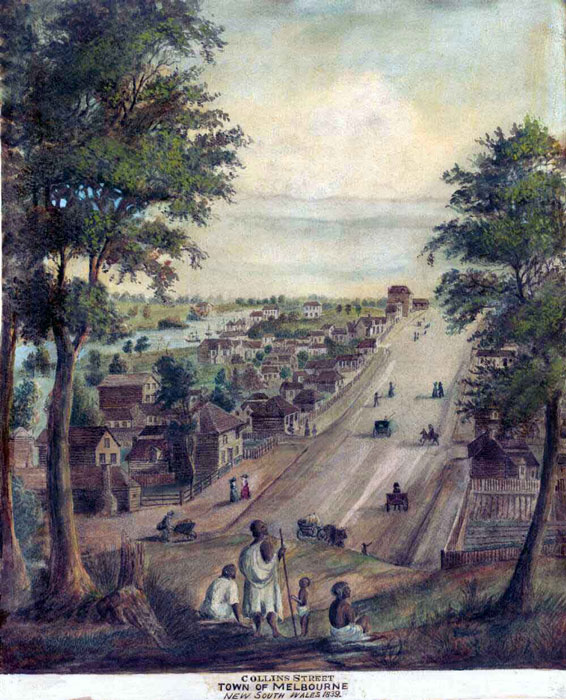 |
| 1839: Collins Street, town of Melbourne, attributed to William Knight |
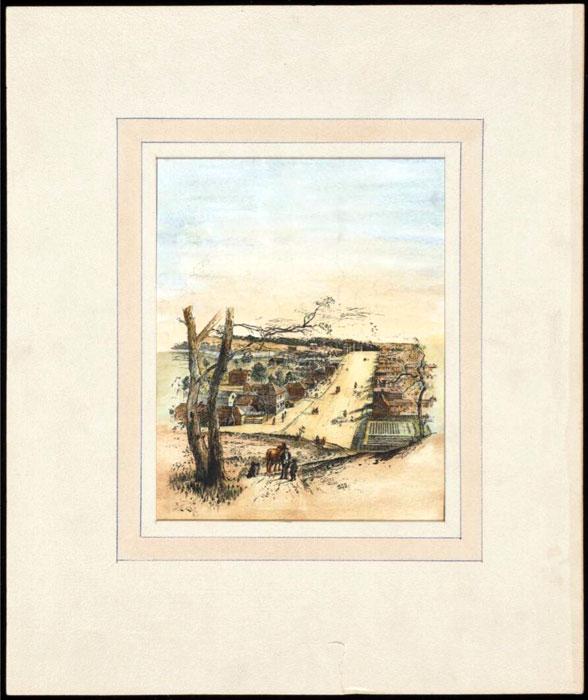 |
| 1839, Lithograph, Collins Street; Walter Withers, 1854-1914. Collection National Library of Australia |
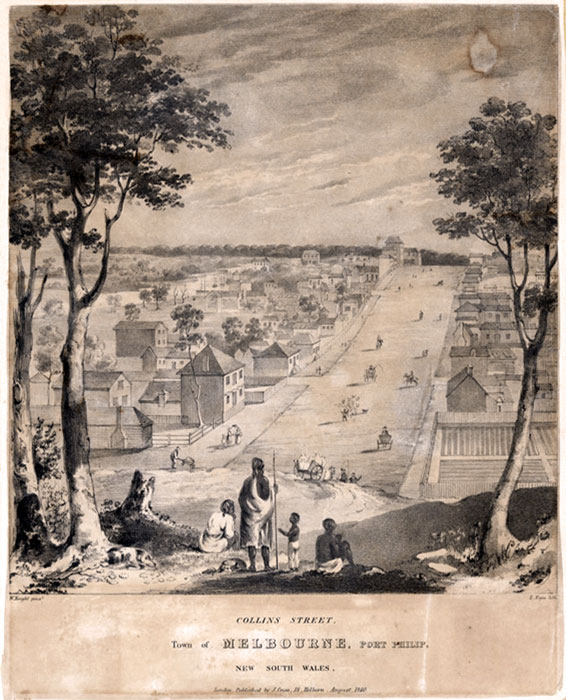 |
Collection NGA Canberra: William Knight, London, England 1809 - 1877, E. Noyce lithographer,
Collins Street, Town of Melbourne, Port Phillip. New South Wales, August 1840 |
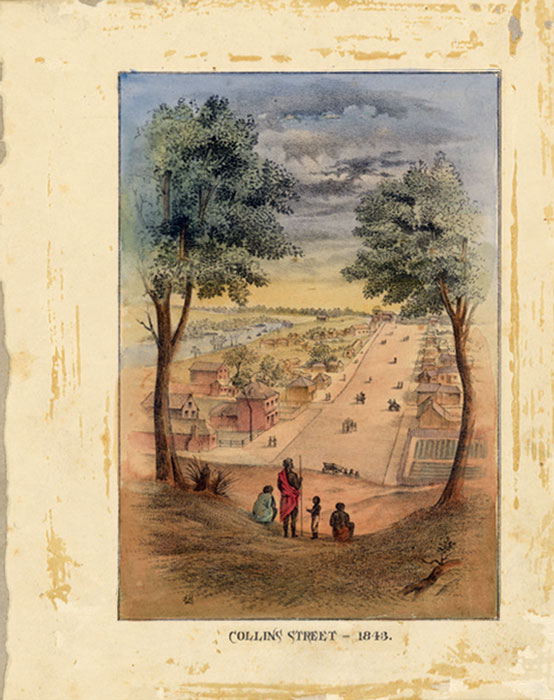 |
Collection NGA Canberra: Collins Street - 1843
Copy afterf the original lithograph with many small details changed and the date is 1843 - not 1839 |
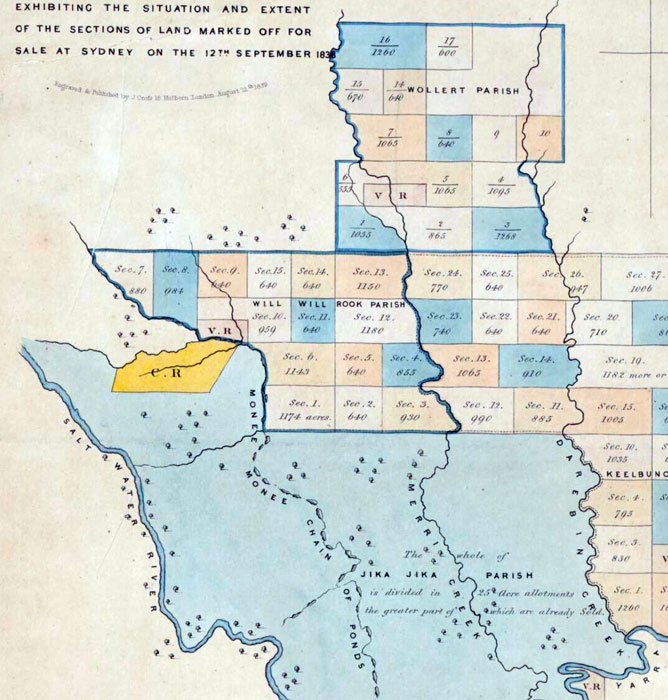 |
| Map of part of the colony of Port Phillip : exhibiting the situation and extent of the sections of land marked off for sale at Sydney on the 12th September 1838 / engraved & published by J. Cross. Collection National Library of Australia |
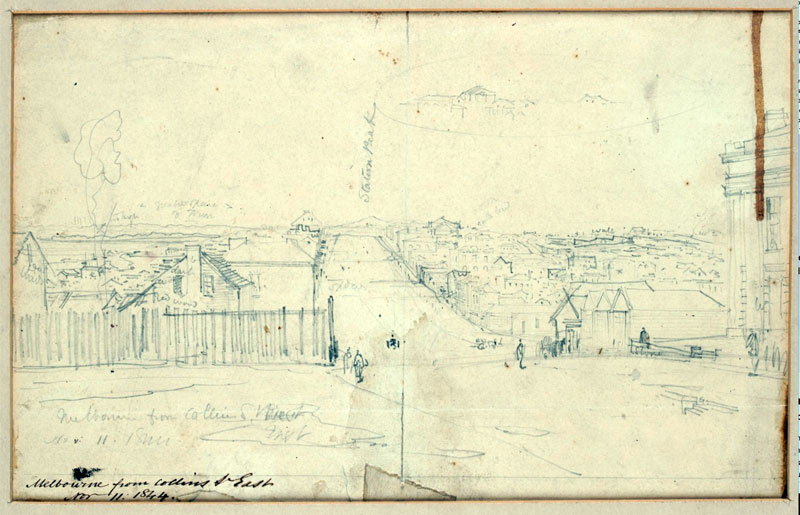 |
| 1844: drawing for Melbourne from Collins Street east, the Mechanics Institute, Robert Russell |
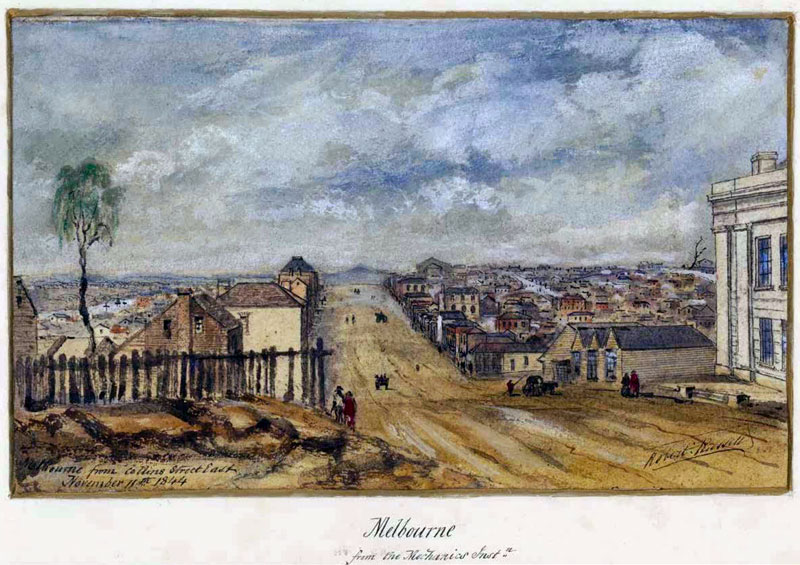 |
| 1844:Melbourne from Collins Street east, the Mechanics Institute, Robert Russell |
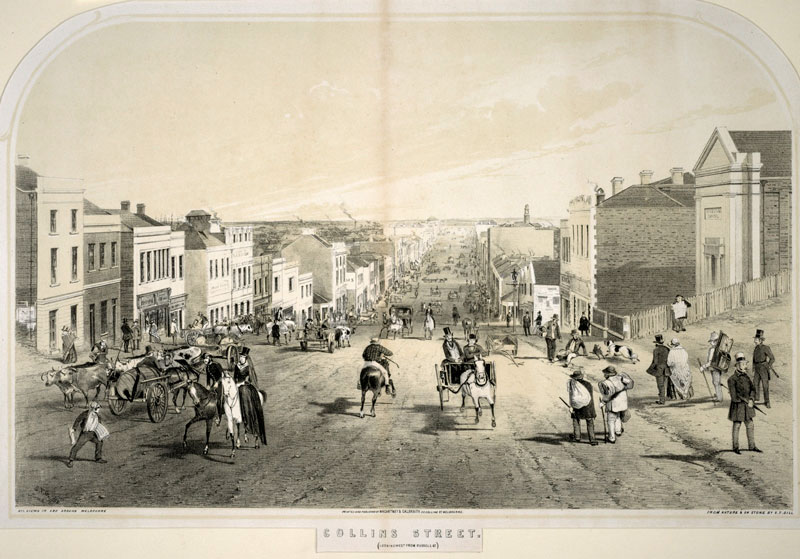 |
| 1853: Collins Street (Looking West from Russel St.) Gill, S. T., 1818-1880 lithographer.
Collection State Library of Victoria |
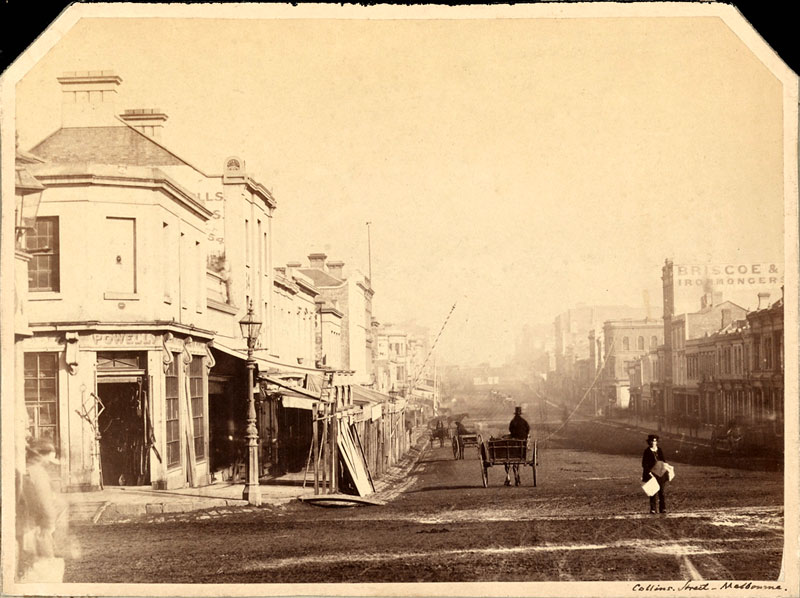 |
Collection National Gallery of Victoria, 1858 Collins Street, Richard Daintree
|
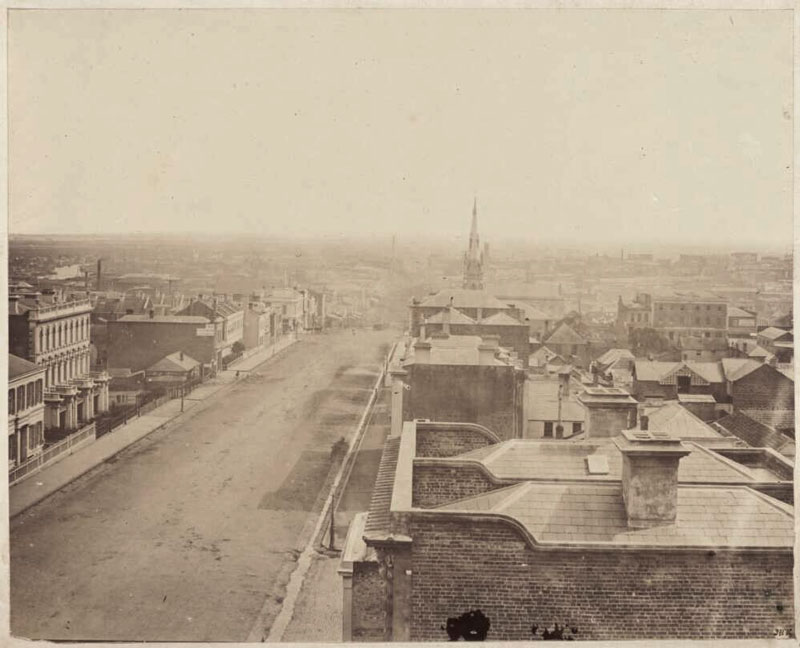 |
Collection National Library of Australia: View of Collins Street from the Club looking west, 1861,
John Hunter Kerr, 1821-1874 |
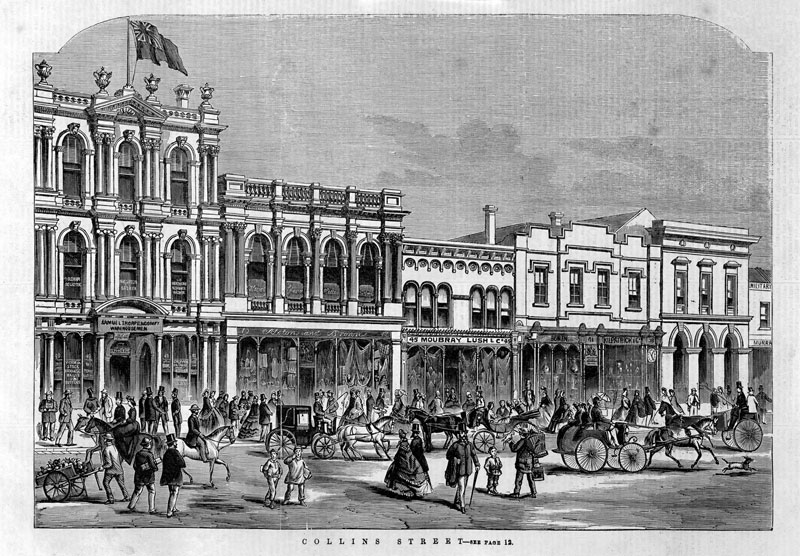 |
| 1864: Collins Street wood engraving |
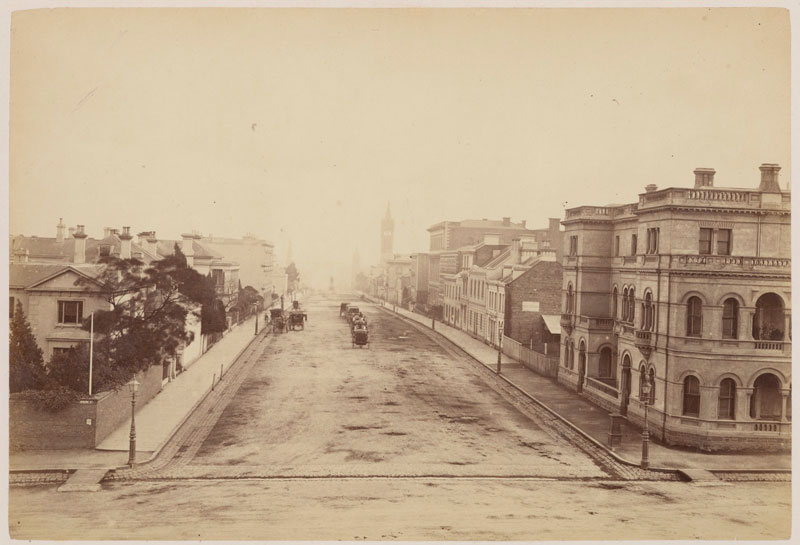 |
| 1865: Collins Street looking east, Charles Nettleton |
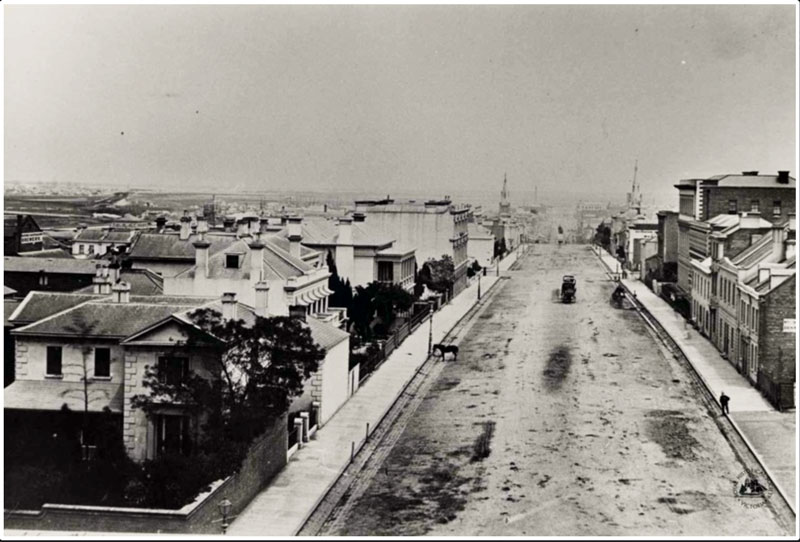 |
| 1866: Collins Street looking west from Spring Street, 1866; Charles Nettleton |
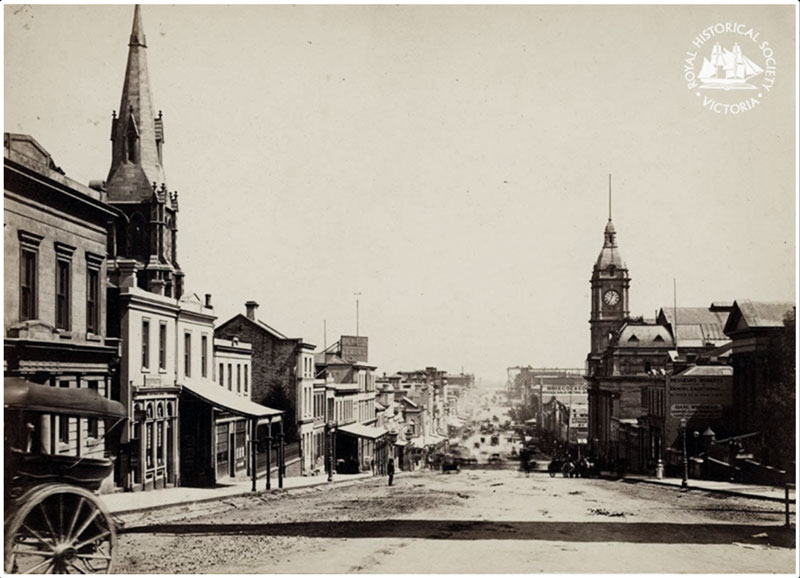 |
1875: View of Collins Street, Melbourne, looking west near the intersection with Russell Street.
Showing Baptist Church, Town Hall and St. Enoch's church spire. |
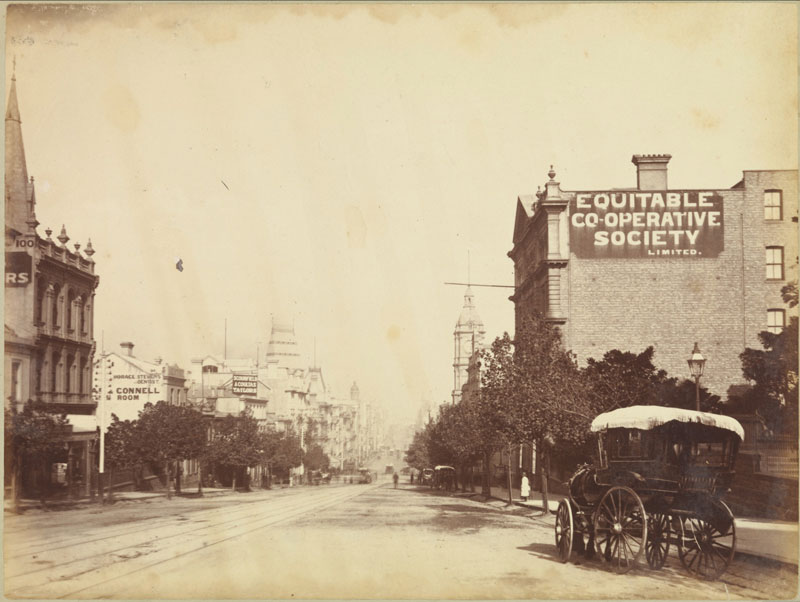 |
| 1890s: J. W. Lindt, Collins St. looking West |
A pair of lithographs
the first about arriving in Australia to commence the adventure
and the second about surviving the trip home following the successes in the colony.
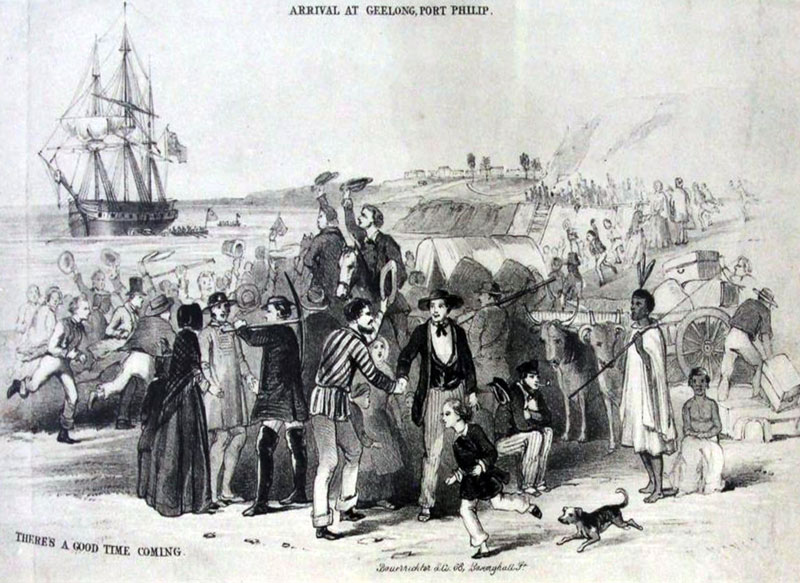 |
| sketch by E. Noyce. 'Arrival At Geelong, Port Phillip'. 'There's A Good Time Coming' |
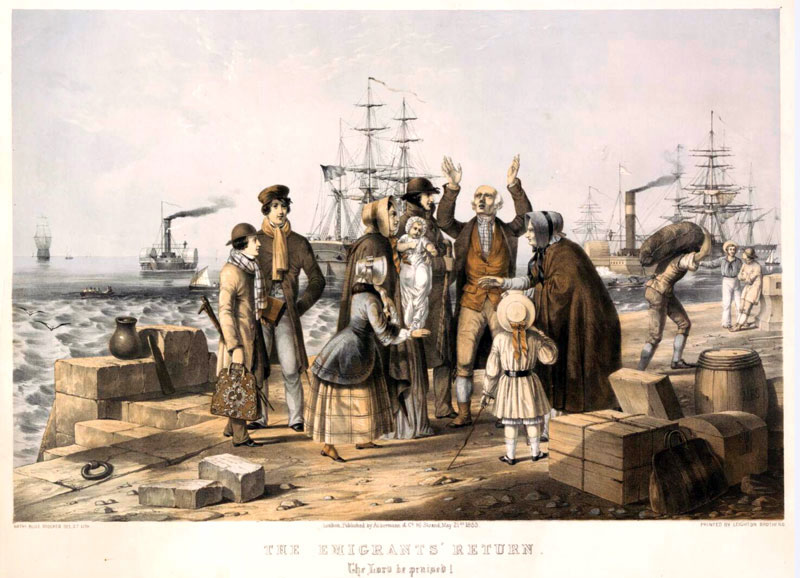 |
| 1853: The emigrants' return, the Lord be praised! Lithograph, Nathaniel Bliss Stocker Published London by Ackermann & Co., |
More essays by Gael Newton
|