ROBERT McFARLANE
Gael Newton AM
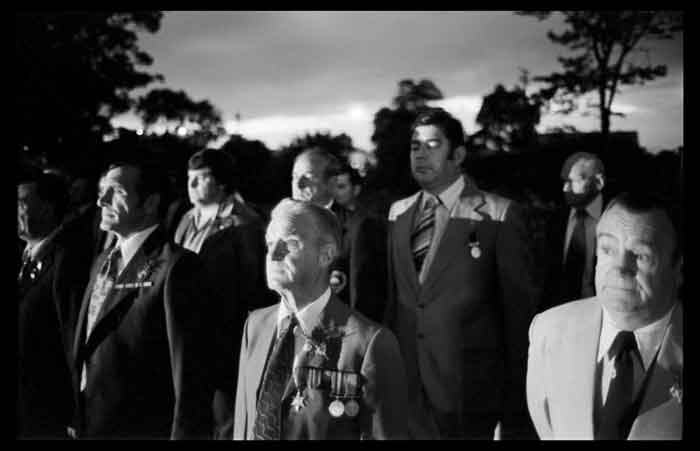 |
| Robert McFarlane: Anzac Dawn Service, Thirroul |
This piece was originally published 2017
What do you think has become of the young and old men?
And what do you think has become of the women and children?
Walt Whitman Song of Myself 6, 1819-1892
Along with his archive of documentary photographs dating from the late 1950s, and performing arts portraiture made since the mid-1970s, Australian photojournalist Robert McFarlane is well known to the public for his observations over 25 years as photography critic for the Sydney Morning Herald.
Many readers are also familiar with his articles in magazines, photobooks and exhibition catalogues. Most recently McFarlane has thrown his voice to the internet with an eloquent and entertaining web blog and established a site for his personal selection of work by Australian photographers.
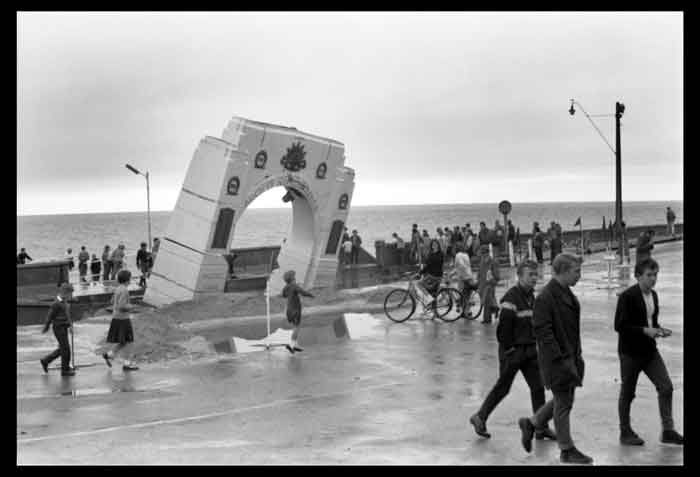 |
| Robert McFarlane: War Memorial Arch at Brighton Beach Brighton Jetty 1963 |
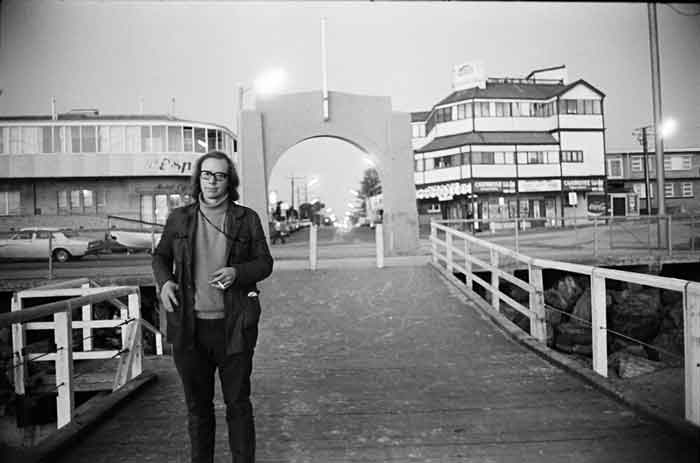 |
| Kathryn McFarlane: Robert McFarlane, Brighton Jetty 1973 |
In 1963 carrying his 21st birthday present of a professional Nikon F 35 mm single lens reflex camera, McFarlane departed his hometown of Adelaide, South Australia, for a career in photojournalism, settling later that year in Sydney. Apart from overseas travel and years in London from 1970 to 1973, Sydney remained McFarlane’s base until his return to Adelaide in 2007.
He was fully formed as photographer by the time he left Adelaide. Robert's aesthetic can be seen in his surreal 1963 image of the War Memorial Arch at Brighton Beach, precariously slumped after a recent storm. The image has the ‘decisive moment’ shooting of an event and its audience via classic photojournalism but its scatter of figures in space picks up on the visual mayhem found in art styles of the ‘swinging sixties’. It is a busy image in which a small girl in the centre seems to levitate above a puddle. This motif pays a bit of homage to the famous 1932 photograph by French photojournalist Henri Cartier Bresson of a man doing a balletic leap across a rain puddle behind the Gare St Laze, Paris. In the lower right corner a trio of modish youths in fashionably narrow jeans, are leaving the scene.
Blues music and beat culture had paved the way for the hip in the fifties but what energized the sixties was rock music and pop culture. Image-packed and often raunchy picture magazines and photobooks primed the post-war generation to look for more immediately engaging, emotional styles of imagery. McFarlane’s simultaneous exposure in Adelaide in 1959 to the Museum of Modern Art touring show The Family of Man dominated by Life magazine photojournalists, and the publication of Swiss photographer Robert Frank’s gritty and un-heroic The Americans photobook played a pivotal part in his career.
On the other side of the jolly sixties was the ernest counter-culture protest movemens and a younger generation’s rejection of the status quo of compliant consumerism. These influences provided the impetus that turned McFarlane’s school boy hobby into a vocational and social ambition that would make him the most distinguished South Australian photographer of his generation. He is also a significant member of the somewhat neglected generation of Australian photographers whose careers began in the late fifties and early sixties.
They slip between pre-war modernists and pioneer photojournalists like David Moore, and the ‘baby boomer’ personal documentary photographers of the 1970s who claimed photography as their medium and dismissed photographers of the recent past. The young photographers of the seventies - mostly using modern 35mm reflex cameras - redefined documentary photography as a subjective form of witness. Their preference was to show their work in books and art exhibitions rather than in mass market picture magazines.
Images made in Adelaide between 1958-63 show that McFarlane had developed a reportage aesthetic using his waist level square format camera as if it was the more flexible eye level 35mm reflex camera. His preference then and now, was for using available light rather than intrusive artificial flashlight. This was helped when Germany’s Gossen introduced the Lunasix CdS lightmeter, which allowed for quick, accurate metering of difficult, low light scenes.
Fast lenses enabling quick exposures and responses were essential and around 1976 McFarlane would adopt the Leica M2 rangefinder camera for its responsiveness. “The Leica’s wonderful range/viewfinder made focussing in low light levels easier and very decisive. And, unlike a SLR, you saw the actual moment when the shutter was pressed.
There was no SLR blackout when the mirror flies up during exposure. The M2 was also much quieter to use.“ His concern for speed was rarely to freeze extreme action - as it is for the news or sports reporter - but to preserve intimately observed moments of reverie and concentration in his subjects.
As a photojournalist McFarlane has never gravitated to shooting hard news and frontline dramas. He tends to focus on the dignity and integrity of an individual to which our attention is drawn through his eye/camera. In McFarlane’s universe all subjects are equal; whether a child, a celebrity, actor, activist, worker or beautiful woman. This reciprocity between subject, photographer and viewer is reflected in the title for his 2009-2010 retrospective exhibition Received Moments, from which this publication arises.
For McFarlane the phrase aptly counters the aggression implicit in words most often used to describe photography as a medium such as ‘taking’, ‘capturing’, ‘shooting’ etc.
“I see making pictures as a receiving of the image. Where you stand, both physically and emotionally, decrees the kind of picture you, through your camera, will ‘receive’,” says McFarlane.
Peopled spaces which provide a stage for humanity form the bedrock of McFarlane’s is predominantly urban subject matter. We viewers have a sense of being given a privileged glimpse behind the scenes. A gentle craziness can lurk in the shadows, though, drawing us out of familiar ground, as in his 1966 picture of a thin man in a Sydney harbourside pub with his pet rabbit on the bar. McFarlane has chosen only a few delicate landscapes to lodge in his canon but these have a similar intimacy and emotion and include such intense images as Wilson’s Promontory 1969.
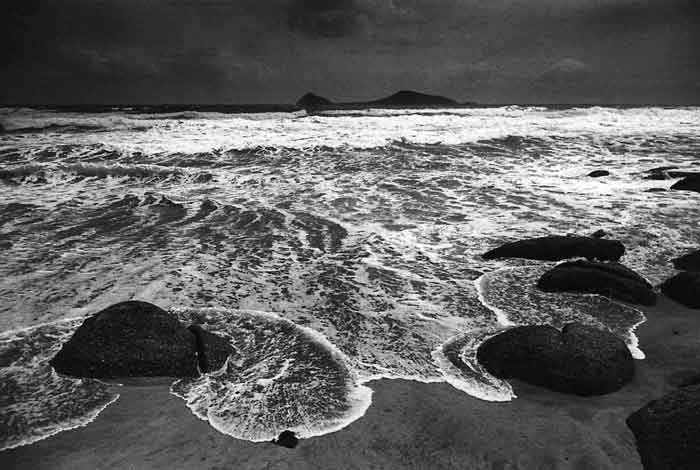 |
| Robert McFarlane, Wilsons Promontory 1969 |
Appropriately, McFarlane’s favourite quote comes from early twentieth century American documentary photographer Lewis Hine, who said that documentary photographs were “pictures showing what should be (either) appreciated or changed”. For McFarlane ‘appreciation’ can be nurtured by his camera as an agent of compassion and communication. His aims are modest; “Looking back I have tried to witness what was in front of my camera as accurately as possible. I don’t make claims about any picture’s quality. I just hope people find the pictures as faithful as I tried to make them.”
It should also be noted for those who do not get to meet the artist that McFarlane is renowned for the absolute joy he takes in human contact in general but in particular his delight in women of all ages and roles. “I have always been comfortable in the company of women. Even as a small child I loved to sit and listen to my mother and her friends talking in the kitchen. Eventually Mum had to pay me threepence to either stay silent or go outside and play.”
Some of his earliest images are of the females in his family and a key early work shows a the profile of a young woman against a train window lit like a Vermeer painting, and with the romantic longing of a photographer’s worship from afar. Her solemn beauty reappears in McFarlane’s top-lit 1999 picture of fatigued ABC reporter Leigh Sales in the Election Tally room at Homebush.
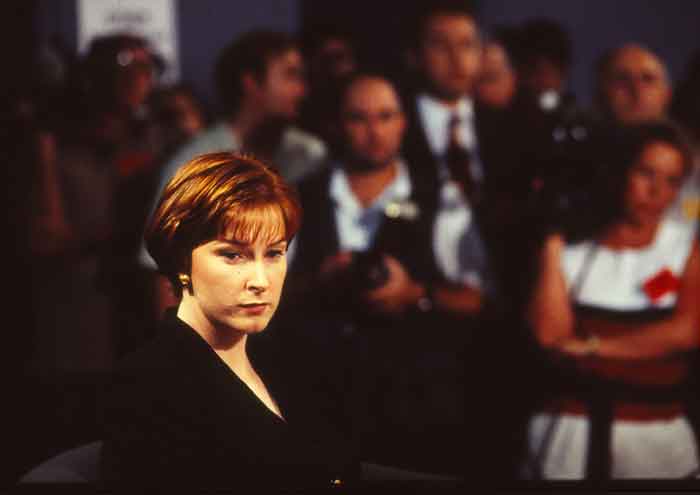 |
| Robert McFarlane: Leigh Sales, election tally-room 1999 |
Rewind…
Born in Glenelg, a founding port of colonial Adelaide, South Australia in 1942, Robert grew up the second of six of Bill and Poppy McFarlane’s children at Brighton, a popular beachside suburb. The family were descended from settlers of Scottish, English and German origin. Among the earliest images that McFarlane includes in his canon are portraits from the early 1960s of his grandfather Amos Chaplin, a baker at Hahndorf, who also raised trotting horses.
An uncle who had served in World War I as an ANZAC, gave the teenage Robert boxing lessons with little outcome for his prowess, but giving McFarlane a lifelong empathy for boxers and their sport as grueling theatre of the body and mind. Perhaps this legacy also accounts for the photographer’s gravitation towards images of WWII veterans and the earlier ‘model’ Australia they symbolize in which the conduct and camaraderie of the rank and file is celebrated as much as commanders and victories.
His remarkable portrait of surgeon and war hero Sir Edward Dunlop seated on the banks of the River Kwai conveys the quiet strength and compassion of the man who enabled many Australian soldiers to survive imprisonment by the Japanese during WWII and forced construction of the Burma-Siam (Thailand-Myanmar) ‘Railway of Death’,.
McFarlane’s relationship with the camera began - typically as in the biographies of so many professional photographers - at puberty with the gift from his parents of a baby Box Brownie 127 in 1954. Colin West, a lecturer from Kodak, visited Brighton High School to provide basic technical instruction to the students’ camera club. But like so many young male photographers McFarlane did not shine academically and was essentially self-taught in photography. A basic knowledge of technique, some ability in English and history, strong intellectual curiosity and heightened social compassion fed his development.
In 1956 at 14 while on the balcony avoiding assembly and carrying a Durst 120 viewfinder camera, McFarlane took a photograph which captured the deputy Headmaster at Brighton High School delivering a face slap to a student in assembly in the schoolyard. He has kept that image which marks a moment when the power of photography as witness registered.
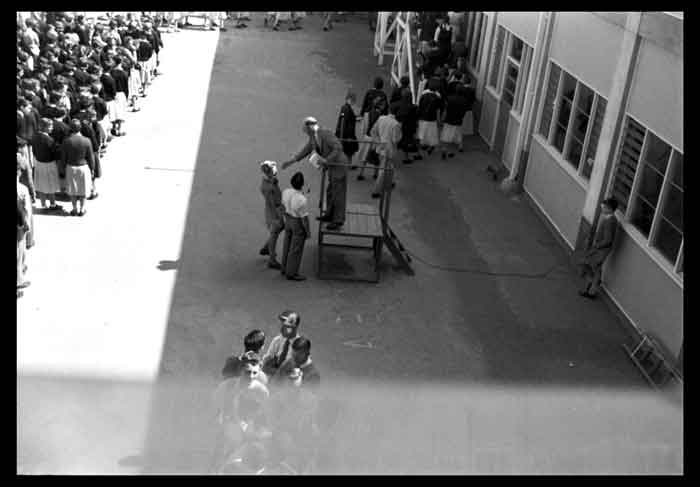 |
| Robert McFarlane: The slap 1956 |
McFarlane later bought a more professional quality Ricoh Diacord G 2 1/4 twin lens reflex square camera (a medium format camera still recommended on web sites, for young people progressing to serious photography).
South Australia has a rich photographic history with outstanding 19th century figures like Captain Samuel Sweet, the maestro of wide and deep perspectives that perfectly celebrated the city’s grid laid down in the 1830s by the founder-surveyor Colonel Light. Adelaide. At the turn of the century Adelaide camera clubs and societies also saw the earliest expression of the soft focus romantic style of camera art from Europe known as Pictorial photography. John Kauffmann and Harold Cazneaux, two of the most famous Australian exponents of early modern art photography, started their careers in Adelaide before moving east to the bigger cities of Melbourne and Sydney respectively.
When McFarlane was growing up in post-world War II Adelaide, however, even these more recent artistic photographic traditions were largely forgotten and there were no local heroes to follow. Commercial and theatrical photographer Colin Ballantyne offered the first criticism of any value. (McFarlane was also briefly a member of the Adelaide Camera Club) “They gave me a bronze medal in one of their many competitions, which I felt was mostly because they didn’t know how to categorize my (documentary) pictures.”
High profile modernist art, commercial or documentary photographers and new breed ‘photojournalists’ were concentrated in the surging economies of Sydney and Melbourne. Apart from adventurers like Antarctic hero Frank Hurley, Australasian photographers didn’t travel much even across the country and rarely went overseas for training before the 1950s. Aspiring photojournalists like New Zealand born George Silk, and Brian Brake, Anglo-Australian Axel Poignant, and Aussies David Moore and David Potts, headed for London to work for the big picture magazines. In 1958 David Moore felt the climate was right to return and work from Australia as a base. The country was flush with a mining and wool boom which would roll on for decades.
McFarlane finished secondary school at the age of 16 in 1958 without gaining the Leaving Certificate. He was however, gifted at History and English (author Colin Thiele was one of his teachers) and had edited an issue of the school magazine. His elder brother Peter, became a teacher, novelist and poet. Robert found the Beat poets and the songs of Billie Holiday inspiring as a teenager.
He worked in a variety of jobs but seeing the blockbuster Family of Man travelling photojournalism exhibition from the Museum of Modern Art, New York, when shown at Myers store in Adelaide in 1959, was a defining experience of the power of photography and sealed his own lifelong humanist concerns. After farcical attempts to become a welder at the appropriately named Victorian Engineering, McFarlane landed his next job at McCallum Richardson, a small advertising agency in Adelaide. McFarlane found his interest in photography was taken seriously and encouraged.
Through a chance meeting at Kodak’s store in Rundle Street, McFarlane formed an enduring friendship with Denis Gooden, two years older and also an enthusiastic amateur photographer. “Dennis had very stimulating ideas about photography,” McFarlane remembers. “He used to say a good picture reflects how involved with the subject you are. We used to race up to the newsagent at the top of the ramp at Adelaide Railway Station to buy the latest issues of the great picture magazines LIFE, LOOK and also Esquire, which was where I first saw Bruce Davidson’s photo-essays.” (Gooden would travel to Britain several years before McFarlane and enjoy a successful career as a fashion photographer for Harpers Bazaar and Queen.)
McFarlane however, was primed to rock music and became inspired by the gritty tough urban photojournalism of Swiss photographer Robert Frank whose seminal 1959 book The Americans tracked a social void at odds with the increasingly colourful and upbeat Post-War consumer paradise promised in American advertising and movies. “I had seen pictures from Frank’s book and they simply ‘spoke’ to me.”
McFarlane’s longing for Frank’s book led him to take a bus to Melbourne where, with a false identity, he intended to steal a copy of the Frank book from Melbourne’s State Library. “I stood nervously at the curved desk in the centre of the huge main room of the library waiting for the Librarian to come back with the precious book - only to be told, ‘we had a copy but it’s been stolen.’ I was disappointed but also aware there was a lesson for me in this debacle.”
Returning to Adelaide he gravitated toward the European art house films that were shown at the alternative Curzon cinema. “Films such as Hiroshima mon amour and the haunting images, framing and use of space in Italian director Michelangelo Antonioni’s 1960 film “L’Avventura” impressed me, though in retrospect my appreciation was more visual than anything else.
I was also influenced by the gritty black and films of Britain’s ‘Angry Young Men’ such as Room At The Top in 1959 and Marlon Brando’s early films. Their use of black and white was a visual language I instantly understood.”
A concert at the Adelaide showground by wild Rock and Roller Johnny O’Keefe inspired McFarlane’s first offering of a photo-essay to Brian McArdle, editor of Australian National Tourists Association magazine Walkabout then one of the few local outlets for photo-essays. McArdle dismissed rock concerts as an appropriate subject for his magazine but soon after commissioned McFarlane’s first freelance photoessay, on Adelaide art dealer, jazz promoter and radio announcer Kym Bonython.
When McFarlane completed the assignment, he travelled to Melbourne to deliver the pictures after which he intended to continue to Sydney. At Walkabout’s offices in Melbourne, McFarlane met the brilliantly entrepreneurial American photojournalist Robert B. Goodman purely by accident. “He was sitting at the front desk typing and I asked to meet the editor Brian McArdle. Goodman jumped to his feet and started to shout, ‘there’s no one called McArdle here!’
A secretary came and ignoring the brash American, took me into the editor’s office.” Goodman was hustling for sponsorship from the Australian National Travel Association for his book on Australia later published independently as The Australians in 1966 (in McFarlane’s view ‘still the best book on Australia’). A dream opportunity arose when Goodman and his wife Barbara suggested McFarlane share the driving on their trip to Sydney, via Canberra.
McFarlane moved to Sydney in 1963 where he soon began freelancing for national magazines including the Bulletin, Vogue Australia and Walkabout. His first serious Sydney exposure was in The Bulletin in 1964 with a colour portrait of Catholic Cardinal Gilroy which was used on the magazine’s cover. McFarlane was also assisted by David Moore who offered him free use of his Walker Street darkroom, as long as it was at night.
At the same time he became interested in fringe theatre, following the completion of a second assignment from Walkabout - photographing Adelaide Festival founder Professor John Bishop.
McFarlane’s interest in theatre was further encouraged by Robert Walker, then Australia’s leading theatre photographer. “Robert Walker was a taciturn ex-WW11 bomber pilot and didn’t say much, but in the time I spent in his darkroom, I could not help but admire his ability to capture performance under the most difficult lighting conditions. Walker was also photographing Australian artists during this time. Discounting Brian McArdle’s disinterest in rock music McFarlane made sure he was present to photograph the Beatles arrival in Australia in 1964.
During the next six years McFarlane continued to freelance while also editing the national photography magazine Camera World, beginning an involvement in writing about photography that continues to the present.
In 1970 McFarlane travelled overland through Asia to Europe and London with the artist Kate Burness, whom he would marry in 1971. Shortly after his arrival he began freelancing for British publications, first for The Daily Telegraph Magazine and later for the Sunday Times Colour Magazine and NOVA. During this period McFarlane established important contacts with seminal figures in world photography such as legendary U.S. photojournalist W. Eugene Smith and Norman Hall, the Australian-born London Times Picture Editor.
(Hall would be first to publish McFarlane in London, using his picture of boxer Henry Cooper training for his last fight, in The Times newspaper.)
As editor of Photography Magazine and its Yearbook in the 1950s Hall played a critical role in launching several generations of new wave post-war photojournalists including the first British focus on French photojournalist Henri Cartier-Bresson and portfolios by London photographer Lewis Morley, who would record so much of the scene around the new satirical theatre of Peter Cook and Dudley Moore. He also published Australian photographers David Moore and David Potts.
One of McFarlane’s most important projects while in London was his last (self initiated) assignment - writing and photographing a 1973 story, published in the Sunday Times Colour Magazine, on the efforts of Kirov Ballet dancer Valery Panov and Galina Ragozina to migrate from Russia to Israel.
“I had been frustrated by mundane assignments from The Telegraph Magazine, for whom I was travelling to Scotland. By chance I bought the Times to read on the train. Inside was a stinging attack by their leading columnist Bernard Levin on Russia’s repressive policies toward two Jewish dancers in Leningrad, who wanted only to emigrate to Israel. I knew instantly I had to go to Russia to document, and hopefully ‘change’ their plight - but not for the Telegraph Magazine.“
McFarlane says the subsequent publicity in Britain (the story was also published in the National Times in Australia) played an important role in obtaining their release in 1974.
In late 1973 McFarlane returned to Australia where there had been a renaissance in support for the visual and performing arts. The Australia Council had been established and at the urging of leading photographers gave birth to the Australian Centre for Photography. Museums had begun to collect and show photography. Australian artists and performers arts were also gaining international success and interest in the Australia in America also flowed indirectly from the American troops on leave in Australia during the Vietnam war. He responded to the new off beat contemporary street photography coming out of America which often seemed hostile and alienated from older generation. McFarlane’s sensibility however, had a default position of respect for a wide gamut of the generations.
The turbulent political scene under a new Labor Government and it ultimate dismissal in 1975 was a subject McFarlane photographed with relish, building a significant archive which for the first time is being given full measure in his Received Moments touring exhibition. An important essay in 1964 on Aboriginal law student and activist Charlie Perkins (also for Walkabout) marks the beginning of McFarlane’s interest in Indigenous leaders and communities, which forms a line within his work of the last few decades.
Later, in the lead up to the Bicentenary celebrations in 1988 he was one of the photographers selected for the Australian Institute of Aboriginal Studies by the Institute of Aboriginal and Torres Strait Islander Studies for the massive documentation project edited by Penny Taylor and published in 1988 as After 200 years: photographic essays of Aboriginal and Islander Australia today. (Most recently McFarlane was present in Marree, South Australia in 2008 to document the handover of land finally purchased by the local indigenous Dieri community)
During these often politically focused Bicentennial years, McFarlane maintained his commitment to documenting performance in film and theatre, becoming a photographer of choice for many of the top stage and screen directors and performers including Bruce Beresford, John Duigan, Peter Duncan, Gillian Armstrong, Phillip Noyce, P.J. Hogan, Megan Simpson-Huberman, Richard Wherrett, Jim Sharman, Gale Edwards, Bob Ellis and George Whaley.
In ways analogous to the relationship between architectural photographers Max Dupain and John Gollings role of McFarlane is held in the highest regard by theatre arts community for his capture spirit and essence of their productions. The fields might seem contradictory - the artificially lit stage and props - the awkwardness of frozen performances on cramped stages, but the magic of the moment and the occasion made this work a challenge.
“Performers create a bubble which only exists for a moment - which I am interested in capturing. I admire them (performers) greatly. Robyn Archer used to say I was her best audience.” Sometimes McFarlane’s answer has been to treat the theatre and film like street photography and politics as theatre. Photographs of politicians for example convey the process and strains of performance. We see backstage Bob Hawke, flashy-suave looking ACTU leader and future prime minister, sipping a cuppa with an immaculately groomed television presenter. In the background a cardboard figure of the Hollywood Oscar choked by a coat hangar watches on.
McFarlane has also documented many of the performances in Australia of British actor, writer and director Steven Berkoff including East, Metamorphosis, The Fall of the House of Usher and, more recently, Oscar Wilde’s Salome. He has also documented many of the key performances at Australia’s premier writer’s theatre, the Griffin Theatre Company.
A highlight was photographing Cate Blanchett’s acclaimed early professional role in Timothy Daly’s play “Kafka Dances” at the Stables Theatre in 1993. In McFarlane’s theatre portraits there is a strange alternation between our sense of the character of the actor and the role they are playing.
Looking at McFarlane’s pictures we seem to witness a changeover of generations from a solid sober pre - and immediate post- war world to the hectic present. These are McFarlane’ episodic ‘received moments’ but also the shared recent history, and heritage, of his present day audience.
Robert McFarlane has been married, and divorced, twice - first to artist Kate Burness and then actor/director Mary-Ann Vale. He has two sons, Morgan (1974-1994) and Billy (1990- )
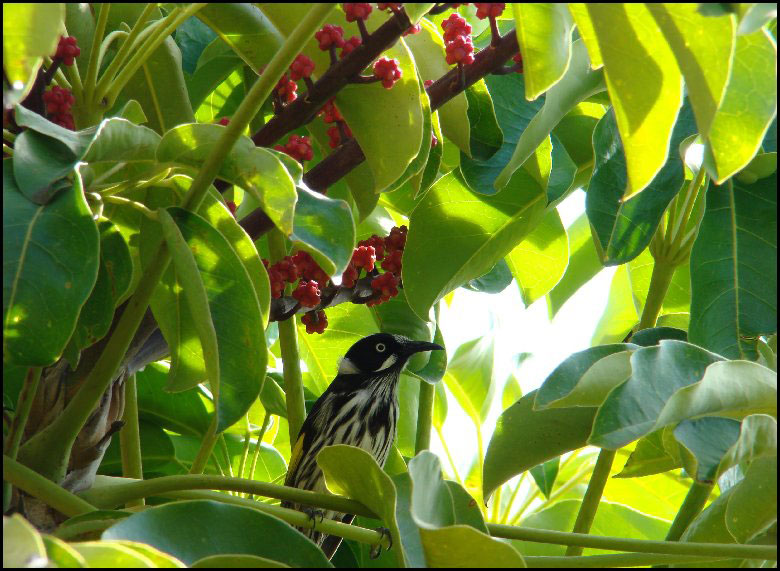 |
| Honey Eater, Hallet Cove, Robert McFarlane October 2020 |
more about Robert McFarlane
more of Gael Newton's Essays and Articles
|