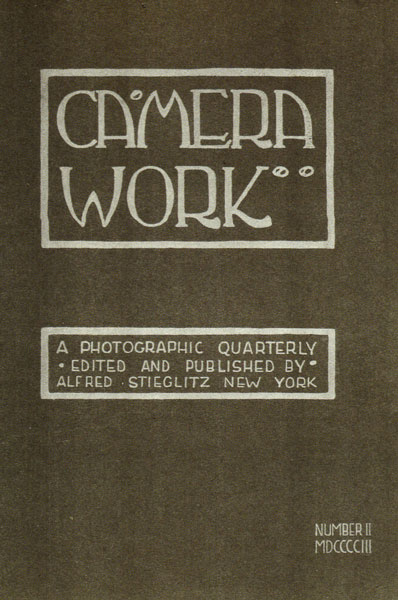
Camera Work was a groundbreaking quarterly photographic journal created and edited by the legendary American photographer Alfred Stieglitz. It was the official voice of the Photo-Secession movement and is widely considered one of the most influential art publications of the 20th century. Its primary mission was to establish photography as a legitimate, fine art form on par with painting and sculpture.
Pictorialism: When Camera Work launched in January 1903, the art world largely viewed photography as a purely mechanical process rather than a creative medium. Stieglitz used the magazine to champion Pictorialism, a style that emphasized the photographer’s psychological and artistic vision over mere factual documentation. Pictorialist photographs often featured soft focus, atmospheric effects (like fog, rain, or twilight), and visible textures that mimicked charcoal drawings or etchings.
As the years progressed, Camera Work tracked Stieglitz’s own evolving taste. By the 1910s, it shifted away from soft-focus Pictorialism toward "Straight Photography"—sharp, unmanipulated images that celebrated the unique geometric and mechanical qualities of the camera, laying the groundwork for photographic modernism.
Stieglitz was notoriously meticulous about production, treating every single issue of Camera Work as a standalone piece of art. Instead of using cheap, mass-production halftone printing, the magazine is famous for its exquisite photogravures. These were high-quality plates printed from copper plates, often on delicate Japanese tissue paper, which were then manually tipped (pasted) onto heavier, tonal paper stocks.
The reproductions were so exceptionally accurate to the original negatives that photographers like Paul Strand and Edward Steichen often considered the gravures in Camera Work to be definitive, original prints. The magazine’s elegant cover design, distinctive typeface, and minimalist advertising sections were designed by prominent Secessionist artist Edward Steichen.
While it began as a photographic journal, Camera Work evolved into a critical introduction to European and American avant-garde modern art for the American public. Through his concurrent work at the 291 Gallery in New York, Stieglitz used the magazine’s pages to publish essays, reviews, and reproductions of radical new artwork.
Camera Work was among the first American publications to feature the work of Henri Matisse, Pablo Picasso (including his Cubist drawings), Auguste Rodin, Paul Cézanne, Georgia O'Keeffe. It also featured intellectual, cutting-edge literary contributions and art criticism from writers like Gertrude Stein, George Bernard Shaw, and Maurice Maeterlinck.
Camera Work 1903 - 1917 a paper by Robert Deane
Camera Work magazine - website
Alfred Stiegliz and Camera Work
Camera Work issues available online
Return to photoweb books
Return to photoweb contents