Gael Newton AM, October 2012
Early naturalists described the Australian colonies as an upside-down world where the instead of the leaves, the bark fell off the trees in winter. In her enigmatic 2009 photo-tableaux Between worlds, Australian artist Polixeni Papapetrou also seems to want to craft some sense out of the mix of native and introduced species and tales in the antipodes.
Australian-born, of Greek background and a lawyer by first vocation, Papapetrou has been in thrall to masqueraders of various persuasions. This ranges from the real Elvis fans and impersonators and bodybuilders she photographed in Melbourne in the 1980s through a succession of series of studio tableaux from 2003.
For the latter, her young daughter and son are the costumed models but also masqueraders in their own right who journey through scenarios derived from European fairy tales and the fantasies of the British Victorian era writer/ photographer the Reverend Dodgson, author of Alice in Wonderland.
Followers of Papapetrou’s works have watched as her children have grown their way out of literary fables and into masked roles in series of works based on well-known European and Australian paintings and colonial myths. Papapetrou’s interest in her own landscape was heightened after overseas travels in 2004 and her increasingly expanded and more enigmatic cast of anthropomorphic ‘watchers’ are now located outdoors in evocative and spacious Australian landscapes and settings.
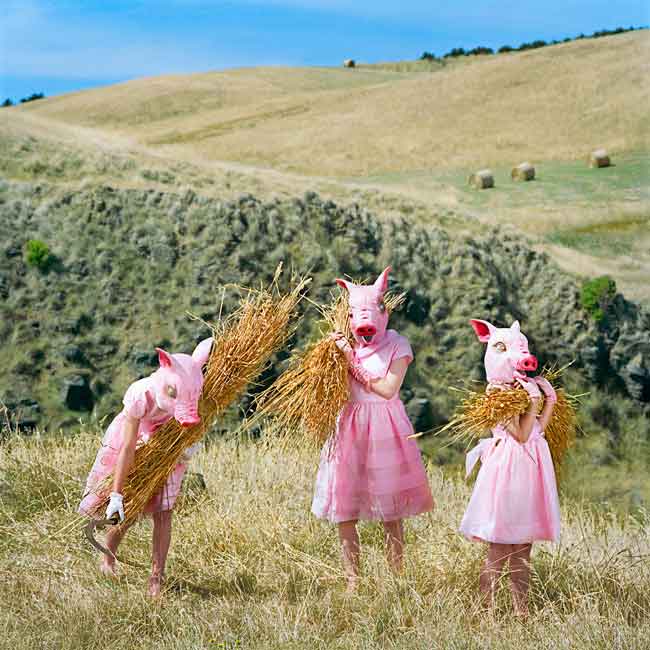
The Harvesters mixes metaphors and motifs. It draws first on French painter J-F Millet’s The Gleaners of 1857 a work which has long intrigued the artist for its ‘astheticisation of the other’ in this case the grinding poverty of the gleaners contrasted with the lush harvest of the landowner. The Millet was seen as controversial and dangerously sympathetic to the working class. The Aussie ‘Gleaners’ of 2009 however are girly young pigs in pretty pink nylon flounces recalling stories and Disney films of The Three Little Pigs, a Victorian era moral tale about being productive and sensible.
The new Harvesters are genetic and gender-bending pretenders whose immaculate frocks show they glean their grub only for amusement. Their bucolic setting in this fractured fairy tale is recognizably Australian only from the brilliant depth of the blue sky and a strip of rocky untamed land in the middle ground.
Perhaps a wider metaphor also wants to break in to the scene. As a settler society of relatively short history, Australians of European descent must perforce domesticate the immigrant cultural narratives just as the bush land is turned to pastoral haymaking.
It is said than all versions of a myth are true, but maybe the disquiet underlying Papapetrou’s images is how they suggest Australians have not quite yet domesticated their inherited and transported narratives. Or are these now unforgettable creatures of Papapetou’s creation Darwinian adaptations to a new land. So what if the gleaners have cross-bred with cartoon pigs and are even a little monstrous. But they are Our Monsters and rather friendly at that.