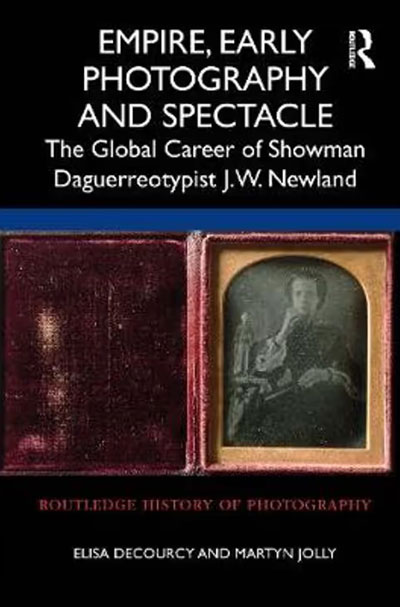
The Global Career of Showman Daguerreotypist J.W. Newland
Empire, Early Photography and Spectacle: The Global Career of Showman Daguerreotypist J.W. Newland reconstructs the itinerant career of James William Newland (c. 1810–1857), an English-born photographer who treated the burgeoning medium of the daguerreotype as a form of global theatrical spectacle.
Newland was not merely a studio photographer; he was a traveling entrepreneur who leveraged imperial trade and mail routes to bring "modern vision" to various colonial outposts. His career began in the United States (New Orleans) before he traversed Jamaica, Panama, Peru, and Chile. In 1846–47, he traveled through Fiji, Tahiti, and Aotearoa New Zealand. Notably, he captured some of the earliest photographic portraits of Pacific royalty, including Queen Pōmare IV of Tahiti.
Newland established a "Daguerreian Gallery" at the corner of King and George Streets in Sydney. He exhibited approximately 200 daguerreotypes from his travels, an unprecedented visual survey for the time. He also worked in Hobart, where he produced what is considered Australia's oldest extant outdoor photograph.
After a brief return to England, he settled in Calcutta (Kolkata) to establish a studio catering to the city's cosmopolitan community. His life ended tragically there when he was killed during the Indian Uprising of 1857.
DeCourcy and Jolly use Newland’s career to argue that early photography was deeply entangled with popular entertainment rather than just "fine art." Newland staged theatrical shows using "dissolving views" and magic lanterns. He is credited with operating the first limelight apparatus in the Australian colonies.
The book illustrates how photography served as a "mixed media space" where colonial and Indigenous identities were negotiated and displayed to audiences across the British and French empires. Because few of Newland’s actual daguerreotypes survive, the authors meticulously reconstructed his life using newspaper advertisements, ship manifests (one even lists him as a "horse handler"), and archival correspondence.
Return to Books
Return to photoweb contents page