J W Lindt
a related essay
A lantern led success story
a case study of professional speaker William Herbert Jones aka Herbert Garrison (1859-1935)
Gael Newton AM, December 2025
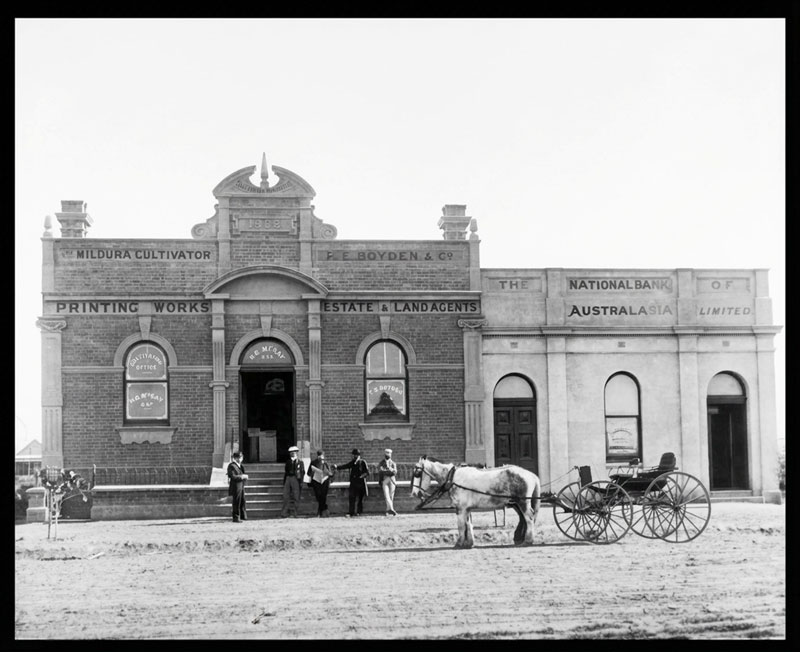 |
J.W. Lindt. The Mildura Cutltivator newspaper building 49 Deakin st Mildura in 1889 also the office of Land Agent F.E. Boyden.
Collection lantern slide Mildura Art Centre.
The newspaper ran 1888-1920. The building is now part of LaTrobe University Mildura City campus. |
Introductory note: My essay's are usually concentrated on the photographers. However this essay is about one of the many late 19th - early 20th century showman who used photographic lantern slides for their travelling presentations.
It was when I was researching the work of J. W. Lindt in Mildura (south western New South Wales on the Victorian boarder) that I became interested in the intriguing character and career of William Herbert Jones - later Herbert Garrison. An 'interesting' life!
Glass lantern slides were in wide use for entertaining projected light shows from the 1860s to the 1950s. The term reflected the need to slide the transparent positive photographic image on glass into a projector ‘lantern’ with a light source powerful enough to create an enlarged image on a flat surface some distance away. Ever more powerful lamps were invented to increase the size and quality of the projected image.
By the 1980s, 35mm colour film slides and carousel projectors had largely replaced lantern slide presentations. Today educational light shows are done digitally, for a long time PowerPoint was the go-to software whereas today there are many presentation apps available.
The production and reception of lantern slide have been the subject of scholarly surveys in recent decades. I can only ponder just what the cumulative cultural experience or influence lantern slide shows had on the appreciation of the photographic arts in the 20th century.1
By the late 19th century the rapid growth of transport, travel, newspapers and literacy enabled hundreds if not thousands of now forgotten mostly middle class male public speakers to earn a living on national and international circuits. Popular lecturers could be celebrities and attract large audiences for several hours of long performances. Usually the touring speaker had travelled to or had experience of the topics they spoke on.
One interesting case is that of W. Herbert Jones whose career as a professional speaker was boosted in 1889 when The Weekly Times of 7 December 1889 reported that he had been recruited by the Chaffey Brothers to visit and research their Mildura Irrigation Colony and prepare a series of illustrated 'limelight' (ie projected lantern slide) lectures to be delivered 'thoughout the colonies'. The purpose was to inform the public and attract settlers and investors. Famed Melbourne photographer John W. Lindt (1845-1926) it was noted had also been engaged to visit Mildura at the same time as Jones to make views for use as illustrations in Jones' lectures.
In 2023 the Mildura Arts Centre presented 'JW Lindt in Sunraysia in 1889' an exhibition using digital images made from the Centre’s suite of forty-five glass lantern slides of Lindt's Mildura views.
Lindt was in Mildura from 25 November to 5 December 1889 and his Views of Mildura and Around were available in early 1890 as loose prints and in albums at the offices of Chaffey Bros Ltd in Swanston St Melbourne, from Lindt’s Melbourne studio at 7 Collins St East, and from W. Nevill’s General Store in Mildura.
The profit-sharing arrangement with the Chaffeys is not known. Lantern slides from Lindt’s originals were used in various illustrated lectures on the scheme in Victoria and England in the 1890s. The set of Lindt lantern slides held by Mildura Art Centre appear to be unique but are not available online.
In January 1890 twenty prints by Lindt were jointly lodged with the Victorian Patents Office Copyright Collection in Melbourne by Lindt Melbourne land agent for the Mildura settlement F. E. Boyden (1858-1930) and Jones.2 Their patent was also registered in England in Kew archives. This would suggest the trio had a business arrangement to protect and license Lindt’s images independent of Chaffey Bros.
Other speakers also gave promotional lectures using the Lindt slides including in April 1890 the Rev John Reid MA (1832-1911), a Shakespeare expert, scholar, critic and Unitarian Church minister in Melbourne. He was well known for his oratory.3
Lindt’s Mildura images have his characteristic skill in landscape, urban composition and figure composition. Some of the river scenes have the touch of picturesque that Lindt was also known for. Otherwise few examples of Lindt’s Mildura work are known in other collections.
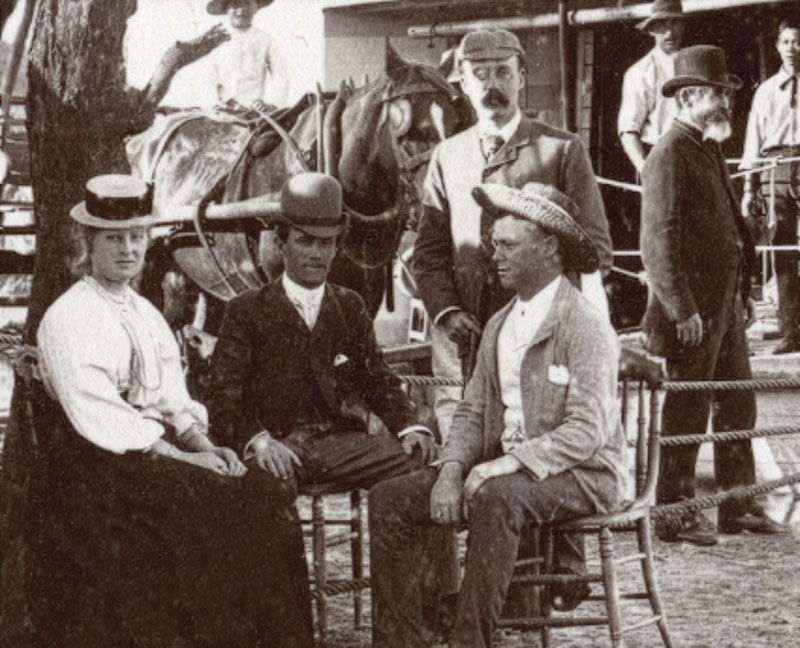 |
JW Lindt: Jones is the dapper young man with moustache and cap
[detail] Lindt’s group portrait in the The Landing Place and SS Ruby, State Library of Victoria |
As a valuer for the Mildura Lindt glass plate collection, I became interested in the role of William Herbert Jones (1859-1935 ) aka W. Herbert-Jones and from 1906 by deed poll as W. Herbert Garrison. William Herbert Jones was born in Lynton, Devon in 1859, the son of a farmer with a substantial acreage.4
He trained as a Wesleyan preacher and in1883 was active founding the Young Men’s Christian Association and the Temperance Union in Christchurch New Zealand. In 1884 he was invited to come to Ballarat Victoria to start a Y.M.C.A of which he was elected general secretary in Septembe.5
In Victoria, Jones was busy with speaking engagements including a talk on ‘Reminiscences of his travels in New Zealand’ to an audience of three hundred at The Mechanics' Hall.6 By November 1887 he had taken on a position as manager of the Australian speaking tour of American Civil War veteran Major Henry C Dane (1833-1895) and planned to tour internationally with him. Dane had been a professional speaker since the 1870s and was a mesmerising orator on a range of subjects. He planned to tour the Australian colonies and New Zealand and add lectures on those topics. Dane did not use lantern slides, he relied on oratory.7
In 1889 W Herbert Jones was recruited by the Chaffey brothers to accompany Lindt on his visit to Mildura. Jones would have been expected to research and prepare commentary for public lectures promoting the scheme using lantern slides of Lindt’s images. Jones retained his job managing Major Dane’s tours.
The Chaffeys may well have noted Major Dane’s plans to tour to England and Europe.
The first very elaborate presentation on Mildura by Jones was advertised on 4 January 1890, The Geelong Advertiser reporting that:
We understand that Mr W. Herbert Jones, who lectured here recently on New Zealand in connection with the Dunedin Exhibition and deservedly attracted large audiences, has been engaged by the committee of the Mechanics' Institute to deliver a lecture shortly on Mildura, the great irrigation estate of the Chaffey Brothers. The lecture will be illustrated by 80 dissolving views on a mammoth scale covering 10,000 superficial feet of space. The committee of the Institute is to be congratulated on having secured the services of so able and popular a lecturer on a subject which should commend itself to all classes of the community.
Jones had clearly become skilled in presenting profusely illustrated talks but may have learned more about how to captivate an audience from Major Dane.
The Ballarat Star of 1st march 1890 reported W Herbert Jones had sailed for England with Major Dane to lecture for two years on Australia and in particular Mildura and the Chaffey Bros. Jones who now styled himself Herbert-Jones FRGS.8
As an expert in volcanoes he returned to Australia in August 1892. Henceforth he presented himself as a Fellow of the Royal Geographic Society and expert on Oceania. His program included:
Lectures on the principal colonies, Australian exploration, the irrigation settlements on the Murray, New Zealand, the land of the Maori and the Moa, the aboriginal races of the Pacific, Ceylon, &c., and they are illustrated by some 500 dissolving views. Mr Jones contemplates travelling through the leading districts of the colony shortly, stopping at the most attractive places, and those where it is desired by the inhabitants he should lecture, and his first appearance will probably be in Melbourne, under the auspices of the Royal Geographic Society.
Jones supplied British reviews stating that;
‘Crowds from Dublin to London, and many villages in between, flocked to hear Herbert-Jones’s mesmerizing stories and to watch images which very few Britons had ever seen before – of serene fjords, boiling geysers, Māori chiefs, and exotic birds on the other side of the world. Herbert-Jones’s was ‘a powerful speaker and entertainer’, ‘a brilliant and popular lecturer’.9
Several reports corroborate his talent. In a letter of 1892 German scientist in Melbourne Ferdinand von Mueller wrote
‘Among all the splendid lectures to which I have listened during a long series of years, those of Mr. Herbert-Jones were particularly brilliant. He is by natural gift quite an orator. He has mastered the subject on which he speaks by very lengthened personal travels and observation. His word pictures are most impressive as well as instructive, and by a strain of humor also very entertaining.10 One review noted that ‘His pictures are remarkably fine; they form a unique collection of over 2000, some 800 of which are used by the lecturer to illustrate every phase and feature of the country’.
A glimpse of quite how much of a performer Jones had become is a newspaper cartoon from his 1894 New Zealand tour when he was reported as mimicking bird calls and stamping his feet while making Maori war cries as part of his performance.
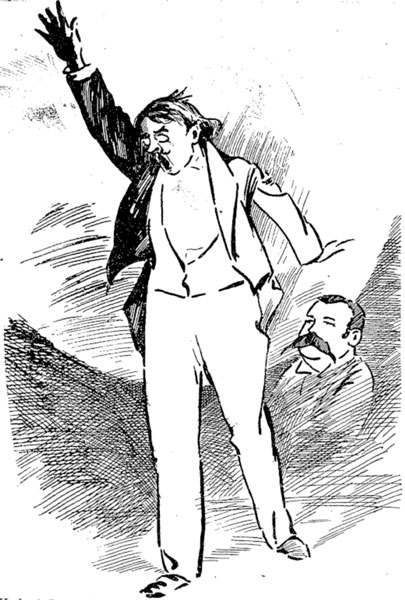 |
Herbert Jones F.R.S., A.B.C. etc., lecturing at Wellington Opera House’ caricature by W. Blomfield,
from The New Zealand Observer, Vol XV. – No. 832. New Series, No. 141 8 December 1894) |
Jones charmed senior government officials into commissioning him to write a book on New Zealand for British tourists and potential settlers, and to pay him to return to England to give ‘one thousand lectures’ on the country.11 Only one copy is known. The pattern for the next few years was a round of lectures and it seems extensive travels.
A report in The Launceston Daily telegraph of 12 June 1895 titled “Sir W. HERBERT JONES’, expressed ‘doubt that any other man had seen as much of the colonies of Australiasia’ and that he had a collection of over 2000 pictures to draw on in particular for his dioramic lectures with a list of venues. According to a 1920 report Jones reputedly spent five years in New Zealand and eleven years in Australasia. However there is, a curious lack of shipping and travel references.
During World War I, W Herbert Garrison worked extensively and energetically for the War Office organising some 600 patriotic rallies and lectures. Postwar he returned to his religious interests, forming the British Israelites Association who believed that the Lost Tribes of Israel had settled in Britain. He provided a foreword for the 1921 book The Two-Fold British Race in Britain and Palestine.
More extreme views followed in the 1920s. Garrison predicted Armageddon on 29 May 1928 which didn’t happen and the Second Coming in 1936 but died in London in July 1935. His role as a speaker must have been sufficiently profitable to fund his travel if as much of it as claimed was undertaken. William Herbert Jones was still sufficiently well known enough for New Zealand papers to note his passing. His collection of pictures is possibly held by the British-Israel Federation in England.
William Herbert Jones/Garrison and fellow professional speakers of the late 19th to early 20th century were the forerunners of TV presenters podcasters and influencers.
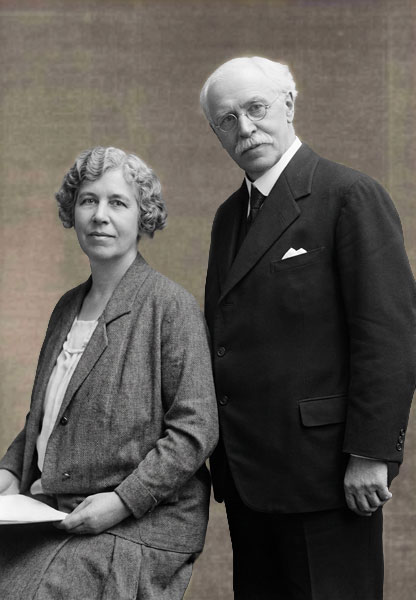 |
Mrs and Mrs Herbert Garrison 1935
obit The North Devon Journal 6 August 1935 p 4 |
Notes:
- For the impact of the format and colonial Australia especially see Martyn Jolly’s web site
- Photographs of Mildura [picture] / J. W. Lindt, F. E. Boyden and W. H. Jones. Lindt, J. W. (John William), 1845-1926, photographer.
- ‘Mildura its Progress and Prospects illustrated with nice light views’ Melbourne Argus 5 April 1890 p.7
- For biography of Jones see Sarah Ogilvie, ‘New Zealand’, The Dictionary People. The Unsung Heroes who Created the Oxford English Dictionary , Random House, 2023 , p 105-108. Jones was thought to have been the source of Maori words. He appears been given to exaggeration of his experiences and some deception. His geographic lecturing in England appears to finish in 1898.
- Temperance Lecture at Sebastopol’, Ballarat Courier 20 June 1884, p 4. Church of England Messenger and Ecclesiastical Gazette for the Diocese of Melbourne and Ballarat Monday 12 October 1885, p. 6. Jones wrote an account of his cycling trip with YMCA secretary Mr Walsh; Bicycling. Ballarat Courier,16 February 1884 p. 4. Jones may have been the amateur footballer referred to in New Zealand papers in the 1880s.
- From our correspondent’, Ballarat Courier Monday 29 September 1884, p3 Jones was preacher for the evening service at the United Methodist Free Church in Peel St on 14 December ‘close a week’s mission’ Ballarat Courier 13 December. 1884, p. 4
- Ballarat Star Saturday 5 May 1888, p. 2 ‘We understand that Mr W. Herbert Jones, late general secretary- of the Y.M.C.A., has accepted an offer made him by Major Dane, the lecturer, who visited Ballarat some time ago, to take the sole management of an extensive tour which Major Dane commences next week by opening a series of lectures in the Athenaeum Hall, Melbourne.
- After the season there Mr Jones intends again introducing the Major to Ballarat for two or three lectures, about the end of May, upon subjects which several leading citizens have expressed the wish to hear, such as “Olympia,” “America,” “A Summer in Greece,’ &c. Major Dane and Mr Jones will tour the whole of Australia, and then proceed probably to Japan, China, India, and some of the principal cities of Europe, and finally to Great Britain. The Major will add two lectures to his already varied repertoire— one on “ New Zealand ” and another on “ Australia. Ovens and Murray Advertiser 13 August 1892, p 7
- One of the English newspaper reviews was sent to a journalist in New Zealand who in turn wrote an article exposing Herbert-Jones as a fraud who couldn’t not have visited the places he described.
- Ferdinand von Mueller to W. Herbert Jones, 1892-11 [92.11.00b]. R.W. Home, Thomas A. Darragh, A.M. Lucas, Sara Maroske, D.M. Sinkora, J.H. Voigt and Monika Wells (eds), Correspondence of Ferdinand von Mueller, <https://vmcp.rbg.vic.gov.au/id/92-11-00b>, accessed December 21, 2023
- 'The wonderland of Oceana : the land of the Maori and the moa : the world in miniature : new dioramic lectures on New Zealand / by W. Herbert-Jones, F.R.G.S., Australasian traveller : with 800 superb pictures.W Herbert-Jones Wellington : Govr. Print., 1895,Hocken Library University of Otago
Reference: An obituary from an online newspaper - The North Devon Journal
DISTINGUISHED NORTH DEVONIAN’S DEATH
Mr. Herbert Garrison’s Remarkable Career.
By the death of Mr. Herbert Garrison, F.R.G.S., Secretary-General of the British- Israel World Federation, which occurred on July 24th, at the B-I College, Brooke Hill, Harrow Weald, North Devon has lost one of its most remarkable sons. Born at Caffyns, Lynton on 4th July, 1858, he was the son of the late Mr. and Mrs. William Jones. Many years ago he changed his surname by deed poll, but throughout his life maintained a close and affectionate association with his relatives and many friends in North Devon. At his funeral there were present among the great company who attended, his sister, Mrs. Jacob Thorne, of Incledon House, Georgeham, and his brother- in-law, Mr. W. J. Haydon, of Parracombe.
Mr. Garrison, who was a striking man in physique and appearance, as well as a most interesting and forceful personality, was much- travelled, and an acknowledged authority on the British Empire. His lectures on Empire and other subjects were given in many parts of the world, and established for him a considerable reputation as a keen and independent thinker and a close observer of human affairs. His greatest title to fame, however, was his virtual establishment in 1919 of the British-Israel World Federation. Three or four dozen Associations in that year have grown to some 350, and the work has how become almost worldwide.
Mr. Garrison organised all the fifteen Congresses of the Federation, and dozens of special missions in London and the Provinces. The acquisition of the present headquarters of the Federation is acknowledged, in the current issue of “The National Message,' to have been “due entirely to Mr. Garrison's bold action." Mr. and Mrs. Garrison gave £1,000 towards the purchase price, and also their fine collection of ail paintings to the College. Later, Mr. Garrison made a gift to the Federation of his library of several hundred volumes, and his unique collection of lantern pictures, numbering many thousands.
As a young man, Mr. Garrison (then young Herbert Jones) was converted under the lay ministry of Mr. George Doubt, of Lynton. In turn he was Wesleyan local preacher, Wesleyan minister - he was in college under the Rev. Peter Prescott - he went to New Zealand, where he came into touch with and became an intimate friend of the late Sir George Williams, the founder of the Y.M.C.A. movement. With him. Mr. Garrison was instrumental in founding several Y.M.C.A.'s in New Zealand. On his return home he lectured extensively, and had much to do with raising money for the erection of the famous Central “Y.M" in Tottenham Court Road, London.
On one occasion Mr. Garrison was personally thanked by Queen Alexandra for one of his lectures. It is of interest to mention that one of the members of the British-Israel staff at headquarters is a brother of Alderman J. Smale, of Barnstaple. At the 1855 meeting of the General Council of the B-I Federation, Mr. Garrison was elected Deputy-President as “some recognition" of his record of work.
return to main Lindt page: click here, includes Lindt's Mildura photographs (State Library of Victoria)
More essays by Gael Newton AM
|