Bernard Otto Holtermann (part 2)
>> see also A. P-R. 1953
It was now 1872. Early in that year Holtermann would undoubtedly have read with care his copy of the Australian Town and Country Journal for its excellent mining reports. He would also have noted a name new to him. Beaufoy Merlin had written in an entertaining yet factual manner regarding his participation as an official photographer in the recent Victorian — New South Wales Eclipse Expedition to Queensland, an account which the editor deemed worthy of a full page.
He would also have noted that Merlin was a photographer as well as a writer; indeed he must have been an expert to have been selected as official photographer to the N.S.W. section of the Expedition.
17 February 1872 saw the flotation of the Beyers and Holtermann Star of Hope Gold Mining Company (Limited), with a capital of £72,000 in shares of £1 each, the two senior partners retaining the major portion of their interests. This sum was a comparatively modest one, since four or five of the contemporary flotations ran into six figures. Holtermann stipulated, very wisely as it turned out, that he was to be appointed mine manager.
Towards the end of the following month Beaufoy Merlin reached Hill End and at once inserted in the Hill End and Tambaroora Times a notice declaring the photographic service which the American & Australasian Photographic Company was now offering. It can only be a matter of speculation as to the exact date of his first meeting with Holtermann.
But, at any rate, within two months, allowing time for the wood engravings to be cut, two striking panoramic illustrations of half-page size, appeared in the Australian Town and Country journal, dramatically depicting the great reefing area along the western slope of Hawkins Hill. Both were acknowledged to Beaufoy Merlin, otherwise one might well have thought that they were made from some of those cleverly-executed (bird's eye' views which were popular at the time. The original negatives are still extant in the Collection — of perfect technical quality in 10'' by 12'' format.
To obtain such a panorama a major operation must have been necessary. It involved moving the coating caravan, the large format camera and accompanying lens of long focus along a rough track to a distant westerly ridge where there had been previously erected, in a clearing on one of the precariously steep slopes which are everywhere on the northern side of the Turon, a high camera platform of substantial construction and absolute steadiness — made 'possible only by the erection of stages and appliances in the highest trees'.
The author feels sure that Holtermann must have been the key to this formidable undertaking. It is quite unlikely that there could have been anyone else in Hill End, who, at once, was interested in photography, likely to feel sympathetic towards such a grandiose pictorial vision, possessed the necessary finance as well as being able to provide the bush carpenters and other labour.
First in Hill End and later on in Gulgong, Merlin continued with his house-to-house coverage. Holtermann had his mine managership to occupy him (but he was on several occasions reproved by the Board for unauthorized absences). The Star of Hope was slowly but surely moving to its astounding crescendo. In ' the Hill End Observer for 22 October, it was reported that 'two new veins have been cut which promise a rich return; the richest vein, from which the specimens were taken which so excited the wonder of the people of Hill End about a fortnight ago when they were exhibited in Mr G. Hodgson's shop window, can now be seen in the face of the workings through nearly the whole extent of the claim, while innumerable other gold-bearing veins, some with heavy gold, are also to be seen.'
Early on 29 October, a final charge was exploded by the evening shift at about 2 a.m. in order to leave work for the incoming morning shift. That charge disclosed a veritable wall of the metal, the world's largest specimen of reef gold. As mine manager, Holtermann was at once noticed, and, realising the geological and historic importance of the find, gave immediate instructions that the specimen was to be brought out intact.
This was, of course, easier said than done. The mass had to be separated from the matrix; it was both heavy and fragile and had to be manipulated in the dark and confined space of the shaft. Then, when it reached daylight, it had somehow to be carried to the top of the steep ridge. Ore was normally broken up into pack-horse loads, but this piece had to be precariously manhandled, resting on six crowbars, carried by twelve miners, before it reached the doubtful safety of the dray which awaited it.
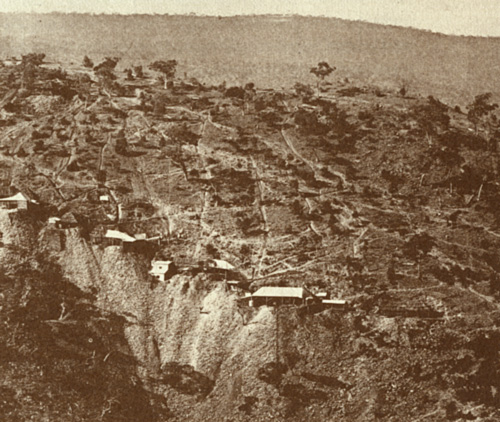
Merlin's panorama of the western slopes of Hawkins Hill, showing the line of reef; the Star of Hope is the fourth building on the right.
Measurements were soon taken. The specimen was four feet nine inches high, two feet two inches wide, and averaged four inches in thickness. It weighed 630 lbs. but the weight was not all gold, for it was veined with slate and quartz - the actual gold content was estimated as being in excess of 3,000 ounces.
There is a story to the effect that Holtermann endeavoured to purchase the specimen, but the matter is not mentioned in the company's letter-books. He had always possessed some faith in minor talismans, but, now, here was a major one which would carry him forward to all that the world had to offer. Indeed he may not even have tried, for on a previous occasion when he had wished to buy rich specimens, he had been fobbed of by the Board - mining companies were exceedingly touchy where gold specimens were concerned.
In the end the great treasure, along with other good specimens and high-grade quartz, went as routine to the stampers of Pullen and Rawsthorne in Church Street. The crushing was booked for the first week of November and by the 9th the result was officially announced as 15,581 ounces of gold from 72 tons of stone - the record which had been anticipated. A few weeks later, the shareholders received back about three-quarters of the capital they had invested.
To record the monster's brief but exciting existence some photographs had been taken. There was one by Merlin depicting it in proud isolation, a picture which was later used by Bayliss when he was assembling the montage on which Holtermann's stained glass window was based. Another photograph taken by the early photographic partnership of Beavis Bros., whose operator must have arrived post haste from Bathurst, showed the specimen surrounded by members of the syndicate and others.
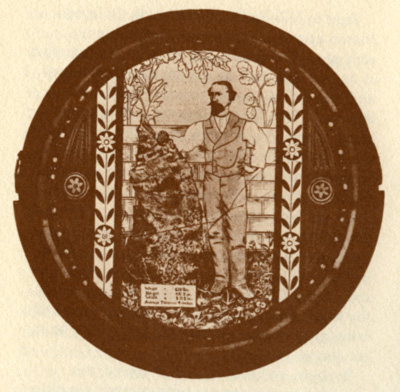
The stained-glass window in the tower of Holtermann's house, now in the archive of the Sydney Church of England Grammar School. Photograph : J. C. Young.
Although Holtermann neither found, nor at any time owned the 'monster' it was noted in the company records as 'Holtermann's Nugget', presumably for simplicity of reference. Little matters such as discovery or ownership did not prevent Holtermann from associating his name with the discovery for the rest of his life. He advertised his later commercial ventures with a woodcut or lithograph showing himself standing beside the 'nugget', based on a montage made by Charles Bayliss a year or so later.
Meanwhile Beaufoy Merlin and his camera crew had returned from Gulgong and had recommenced work at Hill End, Ending plenty of business, for the settlement had substantially increased both in population and commercial activity. Several of the photographs taken at this time show Holtermann prominently included.16 As the late Jack Cato commented to the author : 'ln the great days of the gold rushes, many a photographer must have quitted his studio and darkroom to join in the tumult of the search, but surely Holtermann must have been the only gold miner to have neglected his mining to follow the camera.'
The photographer would now be working on his plans for Holtermann's great International Travelling Exposition, which was to consist of an extensive display of photographs, examples of raw materials, natural produce, prepared zoological specimens, and models of the machinery. Merlin's imaginative conception was far ahead of its time but the idea fell on welcome ears. Holtermann had long wished to do something for his adopted country and Merlin, whose health might have been already failing, 'must have had the ambition to achieve something more rewarding and more important than his house-to-house work.
The Exposition was announced with considerable wealth of detail in the press in early January 1873, and with the New Year, Merlin commenced work as Photographer to Holtermann's Exposition.
During the summer, Holtermann was the subject of a number of personal attacks in the Hill End and Tambaroora Times, stimulated no doubt by persons whom he had publicly held responsible for the effigy burning episode. This was an age of venomous gossip and malicious innuendo, and Holtermann was even castigated as a publicity seeker because of his charitable donations listed in the newspapers - this at a time when even half-crown donations were acknowledged. No doubt partly as a vehicle for reply, he purchased an interest in the new paper, the Hill End Observer and Tambaroora Herald17 but unfortunately no copies have survived for scrutiny.
Two decades of enquiry have failed to disclose any particular action on the part of Holtermann which could be considered as harmful to another person. One exception might be mentioned - and this is his failure ever to acknowledge his great debt to Hammond. It must have been very galling to Holtermann to have a new arrival come, uninvited, into the claim upon which he had toiled for so many years, and, defying him, easily find a rich series of veins. (Incidentally Hammond's diaries do not include any reference to what action he proposed to take had he been wrong about the veins to the west.)
The malice against Holtermann seems to have arisen only from the fact that he was different — a man of ideas backed by indefatigable driving force. To be different is ever to arouse suspicion, but to be different and wealthy is insuperable. When 'as a substantial donor (£150)' he was invited to speak at the laying of the foundation bricks, on New Year's Day 1873, of the new and long-overdue public hospital,18 he took advantage of the opportunity to express his principles
'... he did not intend to squander his hard earnings away. He was ready to help anyone deserving of aid; he had done so, and would do so again wherever merit called for consideration. Having accumulated a fortune, he proposed devoting a percentage of his income towards charitable institutions, and of all charities none could excel in their usefulness (as a hospital.) He deprecated the practice of persons leaving the country with all the wealth they had amassed; he intended to do differently; he meant to contribute to the institutions of the colony which had supplied him with his wealth . . .19
Shortly afterwards the shares in Krohmann's and Beyers and Holtermann's (then standing at 72/73 shillings) were the subject of a strong 'bear' selling attack. The shares recovered fairly quickly to 60/- and 62/6. 'Bears' were again active at the end of March when the shares were forced down to 49/- and even a few at 35/-. Some ground was recovered, but by mid-April the market had settled down at 35/- or less than half the figure of six months before.
An event of note was the visit of the new State Governor, Sir Hercules Robinson, and Party on 11 March, this including the Hon. G. A. Lloyd (Colonial Treasurer), Captain St John (Aide-do-camp) and Mr H. de Robeck (Private Secretary). On the next day, His Excellency inspected the 'new public buildings' (the Hospital, Church of England, and Public School presumably), and fired a shot at Krohmann's which happily disclosed much rich gold.
At the official dinner that evening at Coyle's Club House Hotel, with J. W. Lees,20 P.M. in the chair, Sir Hercules delivered one of those forthright speeches for which he was well known, with special emphasis on the appalling discomfort the party had soldered during the coach trip from Bathurst. The Hon. G. A. Lloyd also spoke — 'he believed the sun shone on no more loyal people in the universe than the inhabitants of Hill End. Here in the remote district of Hill End, amongst those vast mountain passes, a reception had been given to H.E. which excelled anything he had witnessed elsewhere (great cheers). The masons, the children, the arches, the mottoes, the banners, the shouts and that dinner were indicative of an attachment which could not be doubted ...'21
About June Holtermann resigned his managership at the Star of Hope Co., and turned his initiative towards the Mullion, a reef to the north of Orange. Here, for more than a decade, attempts had been made with inefficient equipment to tap the deep leads which were believed to exist in the area. Several shafts were sunk in an endeavour to avoid an underground stream, but on all occasions the water burst forth with tremendous force. Holtermann believed that if pumps of sufficient power were installed, the mine could be kept dry. Accordingly a new engine and pump were obtained and christened in front of a large party with the nome Holtermann's Enterprise. (After which there was eating and drinking galore, for which Mr Holtermann had provided on a grand sca1e.'22
But the new powerful pumps achieved little more than the old ones and, after a few further attempts in the following year, he gave up the unequal struggle against the forces of nature. The Mullion was to be his last major practical activity in gold-mining.
By mid-April Merlin had reached Orange, after paying visits to such places as Bathurst, Rockley and Montefores. On 24 April the Sydney Morning Herald's Travelling Correspondent reported : 'When on my road, close to Orange, I met the equipage of Mr Beaufoy Merlin, the photographer and collector for Holtermann's intended Grand Exhibition. Mr Merlin is sparing nothing, time nor pains, taking views of all the places of interest throughout the districts he travels and obtaining specimens of the various industries en route.'
Merlin's tour of the central west concluded at Dubbo and he returned via Carcoar and Goulburn, to Sydney in late July or early August. An intensive coverage of Sydney followed, totalling I80 exposures, concluding with several of Randwick Racecourse. The most attractive of the Sydney series are those around Circular Quay, showing numerous sailing ships at the wharves - the presence of some of these ships making it possible to date the photography accurately.
With the exception of a posthumous press article, this fine series was Beaufoy Merlin's last work. He died on 27 September 1873, at the comparatively early age of forty-three. Holtermann had lost a good friend, but the photography for the Great Exposition was to be continued by Charles Bayliss, who had long been Merlin's assistant.
Holtermann was now losing interest in Hill End. No wonder, for gold production was falling rapidly. From the 'nugget' year of 1872, the Annual Gold Escort returns from Tambaroora (which included Hill End) fell quickly : 80,592 ounces, then 62,834 ounces, then 25,266 ounces in 1874. By 1879, the returns no longer amounted to five figures. It was the end of a great epoch.
Soon Holtermann would no longer to be seen around the settlement, an unmistakable figure in his American-style buggy turn-out, ( complete with a pair of smart dapple-greys driven by his Oriental groom, Ashod; no longer would he be seen with resplendent sash at functions organised by the Manchester Unity Independent Order of Oddfellows, Lodge No. 47, Loyal United Miners. His thoughts had turned to Sydney, where his wife and daughter Sophia were already installed. His second daughter Esther, was born at St Leonards on 27 January, 1873.
In Sydney he would erect a gentlemen's residence on a grand scale to reflect his material success. It would have twenty principal rooms, with ceilings fourteen feet high. There would be supporting offices in keeping - and there was to be a tower. Of course, many a successful gentleman's home had a tower, but his would be different. He had purchased a suitable block of land on the heights of North Sydney (then St Leonards) and the tower was completed in the spring of 1874,
The tower was almost ninety feet high, commanding a magnificent view in all directions - the Harbour, Botany Bay, and the Blue Mountains thirty miles to the west -and its staircase was adorned with a circular window in stained glass depicting the wealthy prospector and his giant specimen. For the year 1874, there is still extant Holtermann's own Lett's No. 9 Octavo Diary23 bound in green cloth with both blind and gold embossing.
Treasure indeed : while most of the earlier papers had been written to impress the public, the Diary was a private matter. Here are found a host of business transactions, details of state and interstate trips, opinions of people he either knew personally or by repute. As master of a great house, he had much to do with the hiring of staff, most of whom proved far from satisfactory and the labour turnover tended to be rapid. The entries are regrettably spasmodic with considerable variation of detail and there are entries for only about half the pages. But one would hope for the Diary's eventual publication if only for the thread of conscious and unconscious clamour. Business matters are paramount, but there are occasional references to family outings, such as the note for the Easter Race Meeting on 6 April when 'plenty of people looked at Mrs B.O.H.' (Family life is more in evidence in numerous photographs in the Collection of distinctly Amateur type showing picnics in the bush and children's parties at home.)
Apart from its general interest, the Diary contains a varied amount of welcome information. It tells us when he placed the first order for the little marked bottles which were to contain his trusted remedy, 'B.O.H. Australian Life Drops', of which more later; the date when the last stone boring (turning) was placed on the tower; the names of his two grooms (Ashod from Singapore) and Fred Grunway (an Aboriginal). Notable omissions were anything about the stained glass window or any definite locations of his various North Shore properties.
But the most important omission is the absence of any reference to the ordering of the great lens for the huge panoramas. The lens - in fact there were several lenses of varying focal lengths — would have come from France or Germany. The calculation, manufacture, correction and transport of such a lens would have taken at least a year. Holtermann had also obtained for Bayliss a new cameral: of format 18'' by 22'', this being the full size of a sheet of albumen printing paper.
Now was revealed the unprecedented purpose of the high tower - it was expressly designed as a camera support - the world's tallest 'tripod' for the world's largest camera. And with that giant camera Holtermann would take giant photographs, bigger than had ever been seen or even thought possible. He would take them to Philadelphia for the 1876 Exhibition, where he would gain first award for photography - and of greater importance, he would show the millions of visitors the glory without equal of Sydney's magnificent Harbour.
By the late winter of 1875, everything was ready - lens, chemicals, sheets of plate glass - for the attempt. The word 'attempt' is used advisedly, for it is most unlikely that anyone in the world had ever attempted the hand-coating of a sheet of plate glass measuring more than three feet by five feet and weighing fifty or sixty pounds. Now Holtermann and Bayliss were to achieve this, not under controlled conditions in some form of laboratory but in a temporary wooden room25 constructed above the tower that was camera and darkroom combined. And after each exposure and processing stage, a huge plate had to be manhandled down several flights of narrow tower staircase to a room set ready with a fire for drying and equipment for varnishing. Varnishing is essential for the preservation of any collodion plate and even this anal stage cannot be considered simple, for the wet-plate coating has little or no adherence to its glass support.26
The stupendous enterprise is outlined in the holograph and so is its cost, recorded as £1,000, and there are references to failures and practical difficulties. The giant panorama was in three sections - two negatives 3'2"' by 5'3'', covering Garden Island to Miller's Point and one of 3'2"' by 4' for Miller's Point to Long Nose Point.
Many other panoramas were taken in different sizes, the most important of which was on 18" by 22" negatives; when this series was joined up, the ensuing panoramic view measured thirty-three feet. This panorama, and some smaller versions measuring five feet and three feet respectively were sold extensively as Holtermann's Views.
photo-web special 2008 note:
an exceptional copy of this panorama is in the National Gallery of Australia's collection
Thus it was that Holtermann and his technician made photographic history. In Australia, far from the great centres of progress and invention, they had successfully produced the world's largest negatives. The claim was accepted locally with some doubt for the populace had long been conditioned to the acceptance of the idea that everything that was newest and biggest in the world must necessarily happen in the brash young United States. The matter was loyally settled by the Sydney Evening News of 22 October 1875:
'Mr B. 0. Holtermann, the well-known gold-miner, and one of the richest men in the colony, claims to have produced the largest photographic views in the world. This is, of course, saying a great deal. Our Yankee friends who are proverbial for big things, may possibly be inclined to dispute Australia's claims to photographic superiority . . . Apart from the size of the pictures, they are splendid specimens of the photographer's art, the outlines being sharp and clear, and the various objects shown coming out prominently before the eye.
The difficulty of producing pictures of such size can best be understood and appreciated by photographers, among many of whom, we understand, it is believed that it is not possible to execute photographs of such magnitude. If such a belief exists, Mr Holtermann claims to have dispelled it, and to have worked a revolution in the art of photography . . . the whole of the perspective is shown much clearer than can be seen with the the naked eye.
Signboards between two and three miles off can be seen easily without the aid of a glass . . . These views are the principal ones; but Mr Holtermann's studio is stocked with thousands of photographic views, all splendid works of art of different parts of New South Wales and Victoria. It is his intention to start for England early next year with his grand panorama, his principal object being to induce Immigrants to Come to Australia.
>> continues
Introduction / Processes / Holtermann / Merlin / Bayliss / Iconography / the Plates / Bibliography
>> see also A. P-R. 1953
The text and notes to the plates: copyright © Keast Burke 1973
The original GOLD AND SILVER plates were taken from the Holtermann negatives, Mitchell Library Sydney.