Beaufoy Merlin (page 2)
<< previous page
>> see also A. P-R. 1953
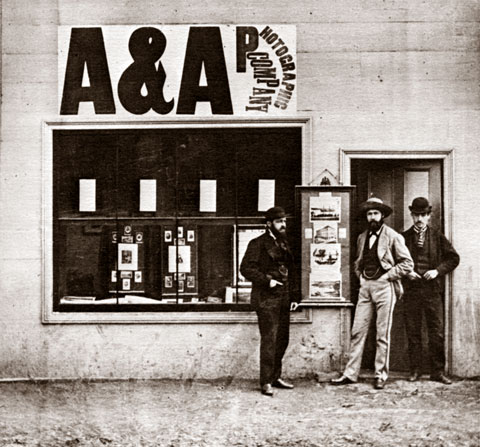
Studios of the American & Australasian Photographic Company, Hill End.
Confident young Charles Bayliss stands in the doorway, behind him is his assistant, on his right the caravan driver.
In the windows can be seen a display of carte-de-visite portraits, and to the left of the doorway are examples of Merlin's 1870 photography of Sydney. (18850)
The A. & A. Photographic Co. remained in Hill End for three months, and visited the Turon River and the older mining settlement of Tambaroora, a few miles away to the north.
But nowhere is there recorded the very important date when Merlin was approached by a well-attired local citizen, his waistcoat adorned by a heavy gold chain carrying a miniature lucky charm - a person whom he had often observed in the streets of Hill End.
The date would have been fairly early, for it is most unlikely that two individuals possessing similar qualities of initiative and driving force could long remain apart. Great events were to arise from the encounter, but the story must wait upon its logical turn.
Meanwhile a studio for the A. & A. Co. was built on a block of ground owned by Holtermann in Tambaroora Street, close to its intersection with Short Street.
It was an historic meeting this - when the gold of Holtermann first came into close association with the silver of Merlin's photographic process.
After three busy months in Hill End, the caravan moved on to Gulgong, several days travel to the north. Assuredly both towns would have made a strong appeal to a man of Beaufoy Merlin's artistic taste and inclinations as any visitor to the areas would confirm today.
Merlin methodically set about his coverage of Gulgong. With his well equipped carte-de-visite caravan, he moved about everywhere and photographed everything. It is certain that no area in the world, and certainly no town within
a matter of months of its foundation, was as thoroughly photographed during this period as was Gulgong.

Black Lead, north of Gulgong, 1872.
Merlin is shown on horse-back to the left of the coating caravan; the driver of the caravan is holding a spare wet-plate slide. (18402)
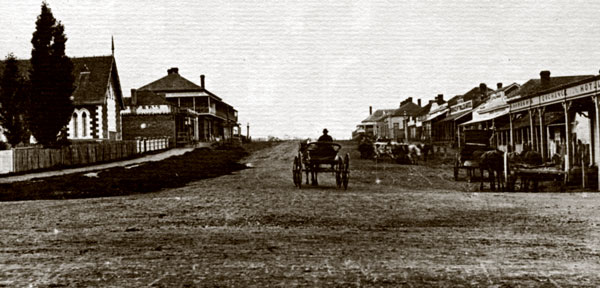 Street scene, Orange; note Merlin's caravan (far right) behind the dray. (126)
Merlin photographed all the business premises in the town, every church and every school and almost every house -and in each instance groups of people, be they the principal or the customer or just the regular run of the passers-by, were realistically included in the picture.
Across the span of exactly ten decades we can share the pride of the successful miner with his half-dozen nuggets shining in the tail of his dish; we can observe the official visit of the Clerk of Petty Sessions; we can approve the pride of Father O'Donovan in his neat new church.
We are introduced to the newspaper men outside their offices, the medicos beside the pharmacies, the hotel-keepers and their wives, the bakers and the butchers.
Gulgong lent itself to this field of photography much better than Hill End, but by early October the market had been exhausted and the team returned to Hill End, there to continue its regular house-by-house programme.
During the comparatively short time that Merlin had been away, Hill End had developed considerably and the new series of illustrations provided some valuable comparisons with the earlier ones. He was in Hill End on that never-to-be-forgotten Saturday, i9 October, when Holtermann's great specimen was brought to the surface - and carefully photographed.
In December 1872 he moved on to Bathurst and he was in this town when he learnt that he had been officially appointed `Photographic Artist of the Holtermann Exposition', an outline of which undertaking was given in the previous chapter.
On his trip to the central west, he was not satisfied merely to take a very large number of photographs but also made time to describe his travels. These articles are of considerable length and combine descriptions of the landscape with entertaining sidelights of the journey.
They were printed in three issues of the Australian Town and Country Journal, of 19 April, 5 July and 27 September 1873. A few extracts from the initial article should suffice to give the reader an impression of Merlin's ability as a writer.
'When I arrived in Orange, at 7.30 p.m., the place was all alive and aglow. Grocers' shops and butchers' stalls shone brilliantly amid the umbrageous decorations and floral wreaths, while numbers of well-dressed people -the ladies particularly -gave commotion to the scene.
In fact, it was Christmas Eve, and gaily did the Orange men and women celebrate it!
The weather being fine, and the streets less rutty and irregular than in many other colonial towns I wot of, it was impossible not to enjoy a stroll through the principal thoroughfare.
The principal stores were particularly brilliant and busy on the occasion referred to, while the graceful facade of [the] Commercial Bank, relieved by its "shady lustre", to quote a phrase of Milton's, the excess of radiance around. Branches or saplings of gum-tree made a bad Christmas substitute for the old English holly.
Surely something better than dingy grey might be got to remind us of dark green. Notwithstanding the dull character of the foliage, the shops presented a really pretty appearance, and kept many a flaneur gazing at them till midnight ...
`If there were no chimes, no predatory waifs, no blithe revellers - to welcome in King Christmas, after the fashion of the old-world countries, there were "genial revellers a few" in Orange to celebrate the event; and I think the first flush of day must have warmed the ear before the last echoes of hilarity died away.
`When I first put in an appearance at breakfast next morning, I found myself vis-a-vis my landlord only. Everybody had gone away, some to visit country friends, others on picnic excursions, and I presume some to church.
Everything was still and in oppressive contrast with the excitement of the preceding evening.
Now, my host of the "Commercial", certainly as jolly kind-hearted a fellow as ever I met, was, through his tremendous Christmas Eve exertions hardly "up to the mark".
Performances at the public bar for twenty hours on the stretch, are not conducive to sprightliness of conversation. Our tete-a-tete was not therefore at breakfast animated, nor was a stroll along the deserted and dusty streets very lively afterwards.
It was singular with what unamity of purpose the people had deserted the town. I had, however, a good opportunity of noticing its cheerful position and growing importance.
In the principal street there are indications at once of wealth and taste. The district around Orange is very fertile, and signs of agricultural progress are everywhere apparent. Some good specimens of cereals and other products, as well as minerals, will attest the resources of this locality in Holtermann's exhibition.'
It is believed that the 10" by 12" section of the Collection includes all of the negatives taken during the tour of central western New South Wales and provides records of Bathurst, Rockley, Orange, Dubbo, Trunkey, Carcoar, Goulburn and some unidentified places -the latter group apparently made on the return trip.
When Merlin came back to Sydney in late July or early August, he soon became more than ever convinced of the need of the colony for a 'Holtermann Exposition' to travel abroad. This was when he read, in the columns of the Melbourne Argus for 26 July 1873, an account of the current Vienna International Exhibition. It was a magnificent affair set in 450 acres of wooded parkland beside the Danube, but `New South Wales is lamentably conspicuous by her absence, and such apathy is very much to be regretted, for an Exhibition like this ... where all the world is, so to speak, on its trial; not to be there is to argue yourself unknown.'
Meanwhile there was his photographic coverage of Sydney to be attended to - which was duly done, two hundred 10" by 12" negatives being obtained.
It was intended, according to the Sydney Mail for 2 August, that the Exposition should include 'well-executed photographic views of every town in all these colonies ... with the more elaborate views to be glass transparencies, enlarged from the originals and vividly coloured. In the same section, there are also to be large-sized albums of each town, with other ready means of information.'
When the weather was unsuitable for the obtaining of `pleasing views of the environs of Sydney', he wrote an article for the Town & Country Journal, on the matter of the New South Wales failure at Vienna.
`Not only have the Victorians made themselves famous to our depreciation, but even the Queenslanders are imitating the example of the latter. It certainly needed a man of energy and means, a man of practical experience and undaunted spirit, in a word, a man like Holtermann, to stir up the stagnant waters of public apathy and infuse a little go-ahead-ism into this community.
Why should we not display the country's resources in conspicuous places, show to the over-crowded nations of Europe what a fine field there is here for honest labour and the investment of capital?
It pains one to note the listlessness with which people hear about an exhibition, in which varied specimens of the country's mineral treasures, of her unrivalled timber, of her infant industries will be brought together, and made clear to all who take the trouble of opening their eyes.
On social, commercial, and political grounds it is the bounden duty of the people of New South Wales to prove to the world that she has within her territory the material of future greatness; and it is to be hoped all men of true patriotic spirit in the colony will cooperate with Mr Holtermann in demonstrating on a large scale the country's wealth, and its attractiveness as a scene of industrial operations.
I cannot, up to the present time, boast of much sympathy on the part of the community with Mr Holtermann's comprehensive scheme; but I have reason to think when its extent, and the more obvious results likely to arise from it, become better known, the people generally will appreciate what is being done for them.
How much more telling will the exhibition of the country's resources be when displayed in every country town of the United Kingdom and principal cities of Europe, than mere statistical statements, Agent-generals' letters, or the speeches of paid lecturers.
I firmly believe that thousands will yet be attracted hither by the Holtermann display, who would not otherwise leave the old world, or if they did, would seek a new home in the United States of America.'
This was Merlin's last public act : the next issue of the Journal, 4 October 1873, carried his obituary:
`The numerous friends of Mr Beaufoy Merlin throughout the colony will learn with deep regret that he died after a very short illness on Saturday afternoon [27 September] of inflammation of the lungs supervening upon the epidemic (a kind of influenza) which has lately been so general in Sydney.
Mr Merlin won the esteem of a wide circle of friends by his great kindness of heart, and singularly unpretentious, straightforward and general character. Energetic, temperate, and active to a remarkable degree, his unexpected decease will surprise as well as grieve all to whom he was known. As a photographic artist he was almost without a rival, while his talents as a writer were of a very superior kind, although want of leisure greatly interfered with his literary tastes.'
Merlin died at his home, Abercrombie House, a two-storey building in Holterman's [sic] Terrace, 105 — 118 Little Abercrombie Street, Leichhardt, where a medical practitioner had been treating him for five days for pneumonia.
Beaufoy Merlin had been betrayed by his great love; the wet-plate process called for fixation by means of the deadly potassium cyanide in the closely-confined quarters of a coating caravan.
Almost thirty years of continuous inhalation could not but threaten the lungs of the strongest man. Merlin was buried on 30 September 1873 in the Church of England cemetery at Balmain, today the site of a Pioneers' Memorial Park, near to the Leichhardt Town Hall.
Merlin would have been deeply depressed at the end by the feeling that there was so much more that he wanted to do and could have done.
He would have hoped that sufficient had been completed to provide a sound basis for the travelling exhibition. He would have felt sure that his work would achieve its intended object when displayed overseas.
But he could not have known that, a century later, modern methods would make possible magnificent enlargements - five times larger for general gallery purposes, ten times larger for the selection of individual groups, thirty times larger for the study of notices or handbills.
Australia must forever owe a deep debt of gratitude to Beaufoy Merlin, for his photography proved to be the true historian of that time and place-incomparable, authentic, unchallengeable.
>> continues (Bayliss)
Introduction / Processes / Holtermann / Merlin / Bayliss / Iconography / the Plates / Bibliography
>> see also A. P-R. 1953
The text and notes to the plates: copyright © Keast Burke 1973
The original GOLD AND SILVER plates were taken from the Holtermann negatives, Mitchell Library Sydney