Harold Cazneaux
Australian Photographer
1878–1953
Gael Newton AM
An editted version of a previously unpublished piece, written around 1978
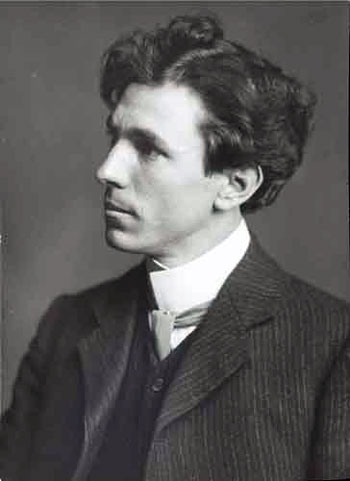
Harold Cazneaux had a long and varied career as an outstanding Australian photographer. This began in Adelaide at Hammer Studios as an photo and artist-retoucher from 1896 untl 1903. In 1904 he joined Freeman Studios in Sydney as a retoucher but soon as chief camera-operator. Cazneaux’s talent was recognised as soon as he began exhibiting around 1906. He continued to be acclaimed in local and overseas salons over the ensuing decades.
From 1920 Cazneaux worked from the studio at his home in Roseville, Sydney, producing a fine body of work, both professional and personal, in portraiture, landscape, architecture, industry and urban scenes. Cazneaux’s work was widely published in his lifetime, most often in Sydney Ure Smith’s The Home magazine, in Art in Australia and many other titles. In 1952 a national tribute evening was held in Sydney to mark his great contribution to Australian photography. Although his images mostly date from before World War II, Cazneaux was active printing for publication and exhibiting until his death in 1953. |
|
|
From the time he arrived in Sydney from Adelaide in 1904, photographing his adopted city was one of Cazneaux’s first and most enduring interests. Yet it was the passing of the ‘old Sydney’ of colonial buildings, narrow byways and horse-drawn vehicles that appealed to him most as a subject for his personal exhibition work. This interest was probably influenced by the ‘old Sydney’ subjects that had been popular with painters and etchers in Sydney since the 1890s.
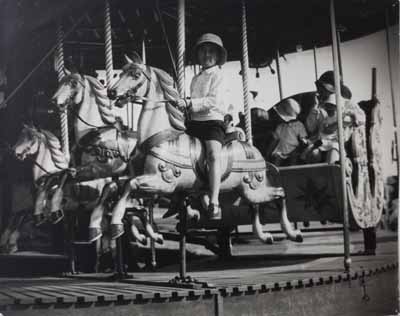
Of all his work, Cazneaux’s pictures of Sydney have perhaps the greatest appeal for a contemporary audience: their charm and spontaneity so well evoke the life of the city over thirty years. During this period Sydney changed from gas to electric power, from hansom cabs to motor cars, from a skyline of terraces to a jagged mountain range of modern buildings, and from ladies who came to town in ankle-length skirts to sun-worshippers in brief swimsuits.
 |
| |
In his later years, Cazneaux cherished a wish that his old Sydney work could be published as a book, and spent time preparing his negatives and prints to this end. He was encouraged by the success of a large portfolio of his work published in Contemporary Photography magazine in 1948 under the title “The Sydney of Yesterday”. But the book project was unrealised in his lifetime. In 1978, as the curator of photography, I mounted Cazneaux’s Sydney at the Art Gallery of New South Wales, which led to a book by David Ell Press in 1980: Philip Geeves presents Cazneaux's Sydney 1904-1934.
The Cazneaux’s Sydney exhibition included etchings of Sydney subjects by artists such as Syd Long and Lionel Lindsay, as well as Jessie Traill’s studies of the building of the Sydney Harbour Bridge. On this rare occasion, when a photographer’s work was hung beside that of traditional artists, it became apparent that photographs have a sense of immediacy – of the frozen moment in time – that is unique to the medium. This sense of the subject’s lingering presence was evident even though Cazneaux worked in a style that sought to suppress much of the realism inherent in the camera. His work was inspired by and executed in the style known as Pictorialism or Photo-Impressionism.
Pictorialism was the first real ‘art’ movement in photography and originated in England in the late 1880s but had most impact in Australia in the 1890s as active amateur-professional photographic societies were formed. The movement sought to explore the potential of the camera as an art form, not just a recording device. It was developed not by the professional studios but by amateurs who had been introduced to photography in the 1880s – the era of the ‘snapshooter’ and the Kodak slogan: “You Press the Button – We do the Rest!” |
|
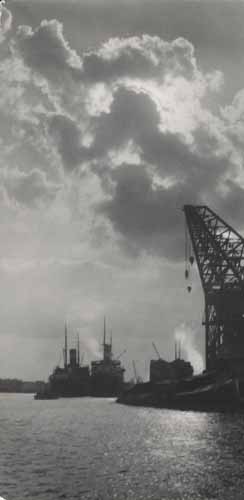 |
Sydney Harbour Bridge -
construction crane |
|
The Pictorialists emerged at a time when detailed realism was no longer as popular as it had been during the High Victorian period. Instead, taste in the 1890s favoured the Impressionist style (particularly the tonal impresionism of J.M. Whistler), Aestheticism and Art Nouveau. In sympathy with this new spirit, the Pictorialists turned away from the even lighting and fine detail of earlier photography and introduced soft atmospheric effects, rather sombre tones and masses of simplified harmonious shapes into their images. To achieve these effects, various processes were used to subdue the detail and fine tone recorded by the camera, including the simple device of leaving the lens out of focus or printing through chiffon.
For these reasons, Cazneaux’s photographs of Sydney do not concentrate on the details of specific locations, and are often reminiscent of Impressionist paintings in their atmospheric effects. Some of his early pictures were even titled An Impression, suggesting that they were the photographer’s personal and poetic response to the subject. His Sydney work conveys the impression the city as a whole made on him. We may occasionally wish, for historical reasons, to be able to discern details in the scene, but we should stand back from such close scrutiny and allow his images of the city to move in and out of focus in a rather cinematic fashion.
Cazneaux was concerned to capture fleeting images of the life around him, which he sensed would be lost in time. From the late 1920s, Cazneaux developed a more modern style. His soft, atmospheric vision of the city was replaced by bright, clear light patterns and geometric shapes that fitted the increased drama and pace of the Jazz Age. He saw the changes in the 1930s when the modern industrialised city replaced the old buildings and ways.
Despite the incursions of motor cars, telegraph poles and engineering marvels such as the Sydney Harbour Bridge, which dominated the skyline, Cazneaux’s Sydney was a humanised place. He paid tribute to modern forms such as the Bridge, and satisfied the taste for bright patterns, but his scenes were usually enlivened by the city’s inhabitants on their business about the place.
As well as the activity of the figures, his scenes convey a feeling of a particular time of day or state of the weather. Cazneaux’s work was marked by his ability to capture a moment in time in a way that seemed effortless, spontaneous and naturalistic.
The people are in action and will have moved shortly after the exposure; the light will change, the rain perhaps stop, and finally day merge into night. These fleeting glimpses were achieved because Cazneaux knew the sort of picture he was after and would wait patiently for the right time or day to press the button. Sometimes this involved subterfuge; he would disguise the camera or appear to be looking in another direction when he wanted to capture people unawares.
Cazneaux’s scenes are pitched at an intimate and human level. He would not have had much sympathy for Max Dupain’s monumental semi-abstract study of wheat silos at Pyrmont, made in the late 1930s, or for his reduction of the figure of a sunbaker to a triangular form. To him, the ultra modern work often seemed soulless, as did many aspects of modern living, compared with the gentler pace of the years before World War I.
Even when he used a high viewpoint, in the modern manner, to reduce the subject below to a pattern of shapes, Cazneaux remarked that his own picture of sunbathers below him depicted
“.... the old and the young spread out on the hot sand doing nothing, thinking nothing ..... wonderful subjects expressing human emotion, pattern and anatomy.”
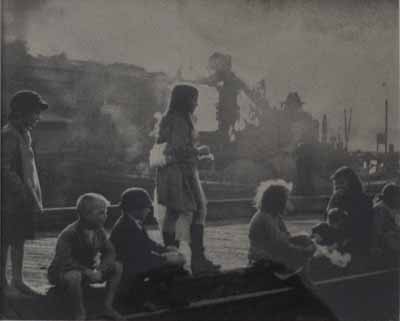
Yet it is not appropriate to class Cazneaux as a documentary photographer in the sense of one concerned with social or political conditions. His work was not directed towards revealing either the poverty of the slum children he photographed or the hard labour of the wharfies.
Ugliness of scene or society was not seen as a subject for Pictorialists. They wished to show the best side of the city by creating beautiful and imaginative photographs. Cazneaux’s Sydney work with his joy in his adopted city and his medium and those human story telling touches, remains a treasured heritage.
Selected exhibition at the Art Gallery of New South Wales (Sydney)
Project 7 - Harold Cazneaux: 1878 - 1953 (1975), Art Gallery of New South Wales, Sydney,
30 Aug 1975–28 Sep 1975. 47 works exhibited
Harold Cazneaux, Art Gallery of New South Wales, Sydney,
22 Dec 1989–11 Mar 1990. 64 works exhibited
Harold Cazneaux: artist in photography, Art Gallery of New South Wales, Sydney,
05 Jun 2008–10 Aug 2008 - 72 works exhibited
The AGNSW holds 196 works of Harold Cazneaux
more on Harold Cazneaux
More papers by Gael Newton AM
photo-web contents
|