 |
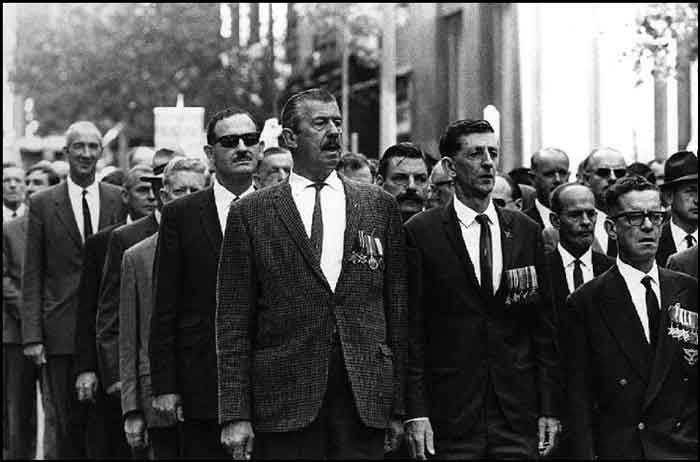
| Robert McFarlane, 1968, actor Chips Rafferty marching in Anzac Day Parade |
In an essay called “Assimilation of the Machine” which included a critical analysis of photography, Lewis Mumford spoke about the photographer’s “Heightened delight in actuality.” McFarlane expresses this. He has that enviable, all-seeing eye which is sensitively tense when involved with a subject; alert to any flicker of movement, any relevant gesture or any change of structure or balance which could enrich or destroy the validity and interpretation of his chosen material.
Like his predecessor and would-be mentor, Brassaï, he is touched by the simple realities of life on earth and is prepared to settle just for that. He has resisted the seductive perversions of the deviationists’ clamour for manipulation and sometimes their politico-sociological influences; his work is a mix of polished photojournalism laced with a stiff shot of responsible aestheticism and above all a love of humanity.
The performing arts have absorbed a lot of his focus. In 1973 he photographed in Moscow the self-exiled dancers Valery and Galina Panov. By publishing the plight of these talented yet persecuted people he was instrumental in having them transferred to Israel. This is tantamount to the approach of Lewis Hine who with the power of his photography did a lot towards the abolition of child labour in the States in 1908.
In an article about photojournalism, McFarlane appropriately quotes Hine as saying “You have the possibility through your medium of showing those things that need to be appreciated or changed.” The spices of his life are people in multifarious personal contexts. Boxers training in gymnasiums, the sceptical rocker in the crowd, a non-heroic Chips Rafferty marching with the old boys on Anzac Day, the lost lovers couchant in the park “happening”, the semi-stripped Gillian Jones in a flagrant gesture before an audience in Heat Wave and Oz editor, Richard Walsh backed up by a wall of press cuts, type sets and the paraphernalia of publishing.
It is the current fashion, probably set by photojournalists to shoot a portrait with a great spread of related context. It is supposed to enlarge the personality of the sitter by showing him or her in a wrap-around of chosen inanimate objects. Quite often the reverse occurs and the objects prove more interesting than the personality and are enhanced by the sitter’s presence. Remove the body altogether and picture improves no end.
I can’t agree that this method is getting down to the nitty gritty of the portrait. What matters is squeezing out every drop of personality and character from, not only the face but what is behind that face and you don’t do it by filling up the picture area with clutter and giving the head a low spatial priority. This reduces emphasis on the all important form and distinction of the person concerned.
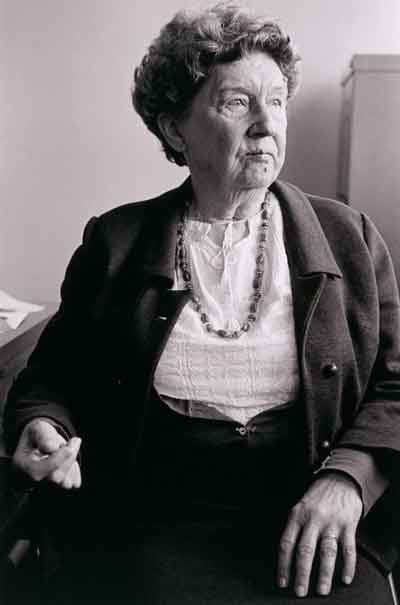 |
| Robert McFarlane, 1976, Christine Stead |
But McFarlane also shows some fine singular portraits with contracted contexts like photographer, Eugene Smith and composer, Nigel Butterley at work, the forthright, authoritative and characterful Christina Stead (terrific portrait) and Jennifer McGregor. It is regretted there are so few organics like the beautiful landscape of “Hampstead Heath” and “My Grandfather – Gilling Plains”. Both these pictures, plus two moving seascapes offer delightful passive resistance to the neuro-active atmosphere compounded by so many images of people.
There’s nothing “wafty” about McFarlane’s photography.
Max Dupain, October 4th, 1985
More on Max Dupain
More on Robert McFarlane
photo-web contents page