|
Man Ray
His Place in Modern Photography
Review by Max Dupain
This is the review by Max Dupain of James Thrall Soby’s Man Ray 1934 book.
The review was published in The Home Magazine October 1935
Original spelling, punctuation and ligatures retained.
The images are as produced in the magazine - see note below about the first photograph.
The photographs have been given new captions
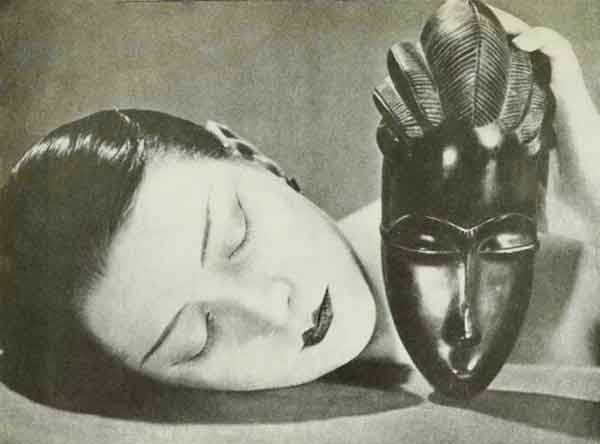 |
Man Ray 1926: surrealist photograph Noire et Blanche.
The serene face is Man Ray's muse and partner, Kiki de Montparnasse (Alice Prin).
The mask belonged to George Sakier, American designer and art director for French Vogue, friend of Man Ray.
This photograph was cropped by the magazine - the uncropped version is below the article. |
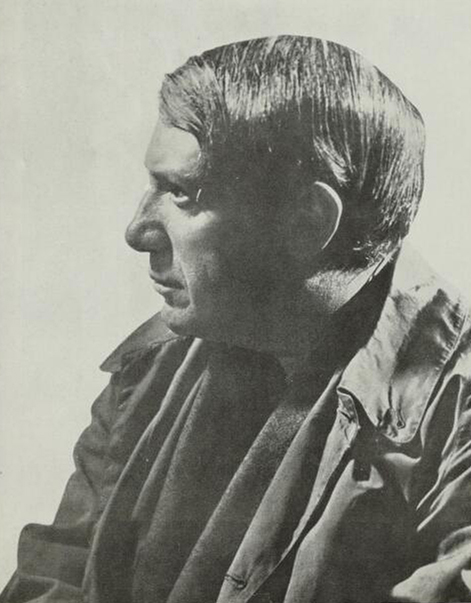 |
| Man Ray 1932: Pablo Picasso, the legendary Spanish painter and sculptor. |
The importance of Man Ray in photography is analogous to that of Cezanne in painting, and it does not seem imprudent to prophesy his enjoyment of an equivalent greatness.
This is suggested by the recent publication of Man Ray by James Thrall Soby, of America. It is a compilation of one hundred and four Neogravure plates epitomising his work between the years 1920 and 1934.
To the academicians of photography Ray’s strange selection of subject and montage treatment mean nothing more than experimental novelty. The use of such elements as a lamp reflector, mirror and plaster head of Venus bound into one composition, or the so-called “amputated nudes” do not please those who were not born for adventure and discovery. But we cannot deny Man Ray’s æsthetic valuations of tone and design.
It is impossible to doubt the sincerity of purpose when we look at his gallery of portraits: James Joyce, Le Corbusier, Eisenstein, Picasso, Schoenberg, Derain, Braque, Tristan Tzara. Each treated with amazing versatility and an almost complete unity of æsthetics and technique. Void of a purely mechanical quality, though full of beautiful photographic tone and textures and expressing a reserved spontaneity, each is a separate individual; Corbusier with the sensitive turn of neck and uplift of head, eyes full and clear and emphasised with the black rims of celluloid, the lift of the strong forehead carried round the head with the sleek edge of hair, gives to us alertness, and a nature fearless, imaginative, lovable, progressive and vigorous in the assurance of its convictions.
Contrast this with Eisenstein. So cleverly arranged to suggest movement and keenness, he has something of the twentieth century business sense and cunning as well as creative ability. Only in one or two of the portraits has Man Ray introduced studio props to emphasise his effect. He has concentrated on the head, often only the main portion of the head, and extracted its essence.
Photography concerns us with the faculty of selection; and bound up with this is observation and design; so much so, in fact, that the form of the subject becomes the all-important feature in the design of a photographic composition. How we shall treat the subject is a matter which only partly concerns the design. Man Ray, in his lust for simplicity, possesses a great capacity to “select” and “treat” the most complex of subject matter so that by ingenious lighting systems it is broken down to a design of essential lines and masses. No matter what his subject matter may be, figure, still life, interiors, montage or landscape, his sensitive judgment enables him to control the elements of his design by the selection of viewpoint. Once these main lines and masses are established, the finer points of emphasising or subduing particular textures and masses are made with hand-controlled light.
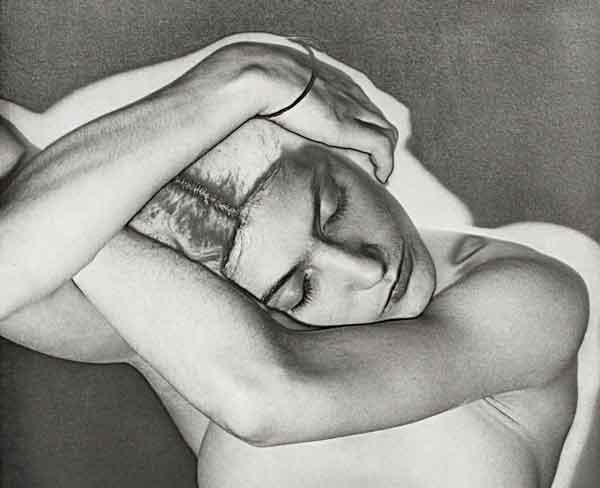 |
| Man Ray 1932: Sleeping Woman; a solarized gelatin silver print; It highlights Man Ray's pioneering use of solarization—a darkroom technique that partially reverses tones. |
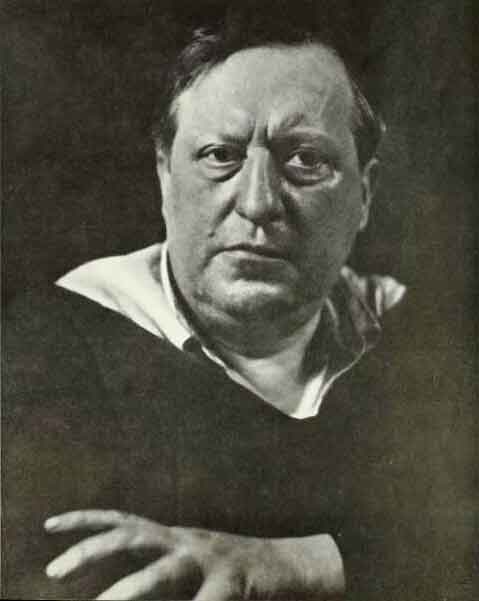 |
| Man Ray 1932: André Derain (1880–1954), co-founder of the Fauvism art movement alongside Henri Matisse. |
He has developed his technique so far that there appears to be no division between it and his æsthetic sense. He finds no difficulty in reversing portions of positive prints into the negative counterpart, thereby making his tonal relationships more elastic. A peculiar granular texture in some of his prints (which some of us to-day consider a technical fault) is made use of as a pure photographic base, thereby subduing detail and often assisting the chiaroscuro.
The production of his Rayographs during 1921 and 1928 might be considered purely experimental, but they reveal a sound knowledge of tone and an ingenious method of controlling it. Even in these abstract designs the peculiar style of Man Ray can be distinctly felt in the beauty of the tonal gradations and the uniqueness of the ideas.
One feels with Man Ray that all earthly elements have their own peculiar interest and artistic value; it remains for the artist to observe and present them through his own conscious self. We are convinced of Man Ray’s uniqueness by his complete isolation as a graphic artist; it is hard to trace any external influence, painter or photographer, in his essays, either in their basic ideas or execution. The recent vast advance in photo-mechanics has left him unchanged, he has avoided the false extravagances of modern studio lighting, and the world-wide influence of motion picture technique has not hampered the pure individuality of his expression. He is alone. A pioneer of the twentieth century who has crystallised a new experience in light and chemistry.
The photograph below is re-produced to illustrate what the orginal looked lke - uncropped.
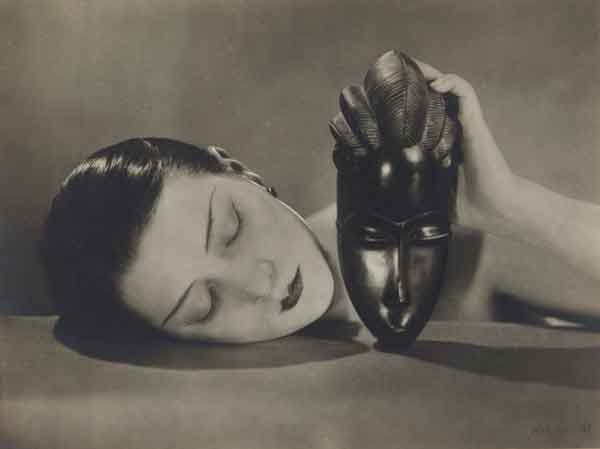 |
| Man Ray 1926: surrealist photograph Noire et Blanche. |
Return to Max Dupain - Max Dupain writings
Photo-web contents page
a few extras:
 |
| The Home Magazine, 1935 Cover |
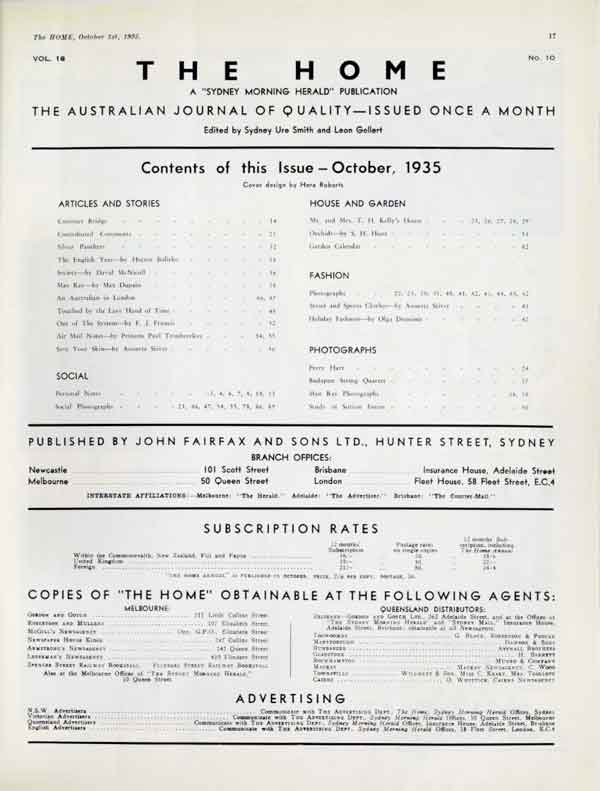 |
| The Home Magazine, 1935 table of contents |
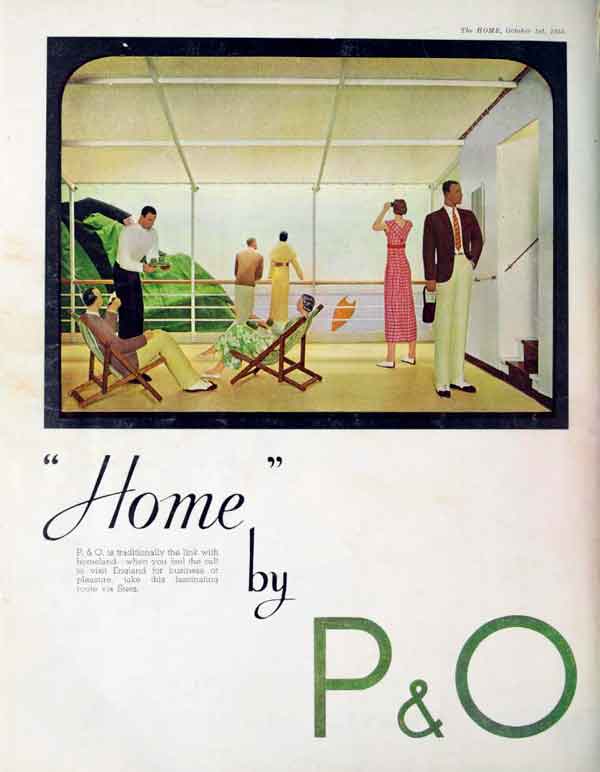 |
| The Home Magazine, 1935 back cover |
|