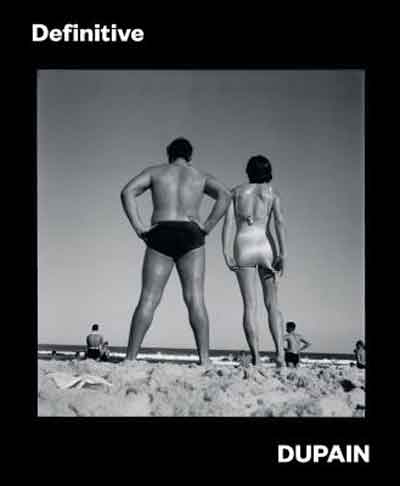
Definitive Dupain — The Catalogue
Edited by Avryl Whitnall · State Library of New South Wales, 2026
reviewed by Gael Newton AM September 2026
The catalogue for the State Library of New South Wales's exhibition, Definitive Dupain, is a fabulous publication with pages of exquisitely produced photographs. I admire it and congratulate the curator on bringing this catalogue together. It is a gem!
Max Dupain died in 1992, and in the years since, the State Library of New South Wales has quietly become the keeper of his legacy, now some 250,000 negatives. In 2011 the Library acquired the negative archive of Max Dupain & Associates, the firm Dupain founded with his associates Jill White and Eric Sierins after his long-term studio owners, Hartland & Hyde, decided to end the arrangement.
Since 2015 the Library has also been custodian of the personal exhibition negative archive that Dupain bequeathed to his long-time studio associate Jill White, who had used it to make new prints and to enable books, exhibitions and print sales. The Library has mounted six Dupain exhibitions since 1991, the first in Dupain's lifetime. |
|
Dupain's long and varied career meant he was able to publish a run of picture books in later life on Australia-wide subjects, and it is why, from 1992, Jill White was able to continue with other thematic titles.
The strength of the Dupain archive has meant that the Library can boldly claim its first exhibition and major publication surveying the now-complete archive as the Definitive Dupain. There are 200 prints in the exhibition, covering a sixty-year practice from the late 1920s to 1992, and many are illustrated in the accompanying book. With an archive that size progressively being made available online, there are bound to be more discoveries. But the claim is a fair measure of the respect in which Dupain is held. The symbolism of this substantial publication matters too, because 2026 is the Library's 200th anniversary.
Curators like me, who have shepherded various collections into photobook form, can never pick up a new title without forensically clocking every design choice, from the overall tone and message to the paper stock and font sizes. Most important is the quality of the reproduction, but equally the intelligence and sensitivity in the editing of the images. Every new sequencing and placement of images, in exhibition or publication, is a new conversation between the images.
The photobook as a subset of fine art publishing has flourished in some form since the 1840s. Mid to late twentieth century advances in printing and economies of scale enabled photographs to be reproduced at such high quality that the photobook became a major path to photographic connoisseurship. Two-stage duotone printing in particular made it possible to capture the full range of high and low tones, the delicate tonal and detail content of original prints. Definitive Dupain provides generous large plates of the finest quality on the glossier pages, as well as diversity through images of varied size across other matt-finish pages.
Definitive Dupain is on exhibition in the Library until 18 July 2027, so there is plenty of time still to see it, but I suspect the book will sell out earlier than that — especially the limited edition with the flash red cover. I have known most of these photographs for fifty years, but there were discoveries for me that make Definitive Dupain a special new experience, and a revelation of an aspect of his work that gets overwhelmed by the icons and bold geometry of his best known work.
Definitive Dupain is coffee-table size, which matters for the pleasure of seeing detail in the images. It is very well sewn-bound, so it opens flat and won't break, and the paper quality is high. Everything about it says this is a book made to do justice to the size and character of the archive, which meant endless design decisions and commitment. A striking feature is the range of paper stock, from high sheen to glossy to matt, with white and red pages, inspired, probably, by the tomato red square that Dupain used on his letterhead, interspersed to mark different sections.
I can well imagine the debates and decisions that went into a quite complex design approach, but one clearly governed by respect for the images.
The sensitivity that has gone into the cover says it all about the thinking behind this book. Here the cover is mercifully a smooth, tough charcoal board, and the decision to do without a dustjacket says something too, about the sort of long-lived, regularly used tome this is meant to be. Any photo lover is driven mad by books with black pages, or glossy white ones that register every fingerprint, sometimes etching in so fast that unless they are wiped immediately the marks are permanent. You need gloves to read those. They end up as sad, dog-eared second-hand-store titles.
Set into the front cover is a photo-like gloss print of a 1939 Dupain icon, Forms at Bondi, with an embossed plate mark, another subtle clue positioning the book up there with the fine print-illustrated book. It may well have meant two stages in production. The inner endpapers are a lovely warm silver, so evocative of the silver that is the bedrock of black and white photography.
What else is fun about Definitive Dupain? For a start, after a plain title page, Max would have approved, you go straight into a portfolio of fifteen gloss-finish pages of very finely reproduced images surveying Dupain's career, with no captions. A matt-finish section follows, carrying a few images bled to the edge, with white pages interspersed. The front matter is delayed: the message is that the pictures come first.
The plate sequence opens with a delicate c. 1947 image of native grass trees in central Australia. All the simplicity Dupain sought is there, and with it a reminder of the delicacy he was capable of, and of the stress he placed in all his interviews on his personal emotional response to the subject as the driving force of his work, as much as the bold forms and geometry we associate with his modernist orientation. Then comes a double-page spread of Max's wife Diana and their children Danina and Rex, reflected in the family car's bumper bar in 1956, one of the few of these spreads that works. It is a rare light-hearted image.
The other eight double-page spreads, one photograph run across two pages, don't work, especially the bifurcated alternative Sunbaker, fingers closed, on pp. 150–51. That is my one complaint about the design of this catalogue.
So many curatorial decisions here, and interesting ones. I feel I am in dialogue with Avryl Whitnall, the curator of both the exhibition and the book, as the pages and their propositions unfold for my consideration. A lesser-known interior still life, a flower study at an unusual angle, is set against an Aboriginal girl in a tin shed in central Australia. There are lots of unfamiliar images full of pattern, including a pairing of pin-ups in a locker room opposite an elegant glamour portrait. I know Dupain's CSR pictures, which date mostly from the 1950s to the late 1970s, and had not found them that exciting. But the 1960 image of burning cane fields recalled the soft-focus landscapes that began Dupain's career in the 1920s under the influence of the photo impressionism known as Pictorialism (an example is shown on p. 41).
Book editors often pair images across facing pages on formal grounds as well as by motif; it can be quite stupid, or a sign of despair, when an image doesn't seem to fit anywhere else. The pairing of a 1938 male nude with a large discus, taken in a studio, against the discus-shaped dome of the ultra-modern 1958 Richardson house at Palm Beach, is quite brilliant. It shows how much the two have in common in their emphasis on structure and on organic, sensual form, an example of the surprising 'conversation' between images that a book spread can reveal.
The captions come on the last page of the initial suite of images, followed by a nice quote from Dupain. There is then a subtle shift to matt black and red paper, which continues until the next gloss suite of images at page 121, and then one of the red pages that enliven the publication overall. A large section beginning 1920–40 and ending 1980 onwards covers the Dupain career in chronological order. It ends with a haunting, complex image, shot upward, of the diving tower and pool at Ryde swimming pool, taken in May 1992; Dupain died on 27 July that year. It is followed closely by a wonderful self-portrait with bare torso by the elderly Max in Fiji in 1988, on a rare trip outside Australia. I think of Rembrandt's later self-scrutiny. As the decades unfold there is an increasing solemnity, finishing with the late-life still life Death by candlelight of 1990 — but no loss of passion.
The design is clean, the text size easily readable, the bolding of quotes appropriate, and there is a lot of varied sizing of images, some with their film edges showing, some listed as details, though it is not clear how many come from prints by Dupain, prints by Jill White, or the Library's own printing from the negatives. As is to be expected, there are many pictures I did not know: page 48, for instance, a pure European modernist high-angle down-shot of a laneway, c. 1936.
The list of works and the acknowledgements come at the end, on matt paper.
Overall, this book is the best way to experience Dupain's long and diverse career of sustained excellence and creativity. For me it was also the first to bring home just how delicate, gentle and emotionally affecting so many of his images are. There are superb still lifes and serene images throughout. A 1980 interior of the Dupain beach house at Newport is exquisite. That ruminative side of Dupain gets overwhelmed by the modernist geometry and bold architecture of his favoured post-war contemporary architects.
I have spoken of the visuals of the book rather than the texts, but the account of Dupain's career by Whitnall is highly readable and comprehensive, with quite a few gems; there is an essay by Dupain biographer Helen Ennis that draws back to look at the various broader influences on him; and the delightful homage by the much younger Australian photographer Trent Parke, on their shared love of light, is a great choice.
My final recommendation: whether you get to the exhibition or not, this is a must-have book for anyone with an interest in photography, which means you should buy one for yourself and another for a friend. Christmas is coming!