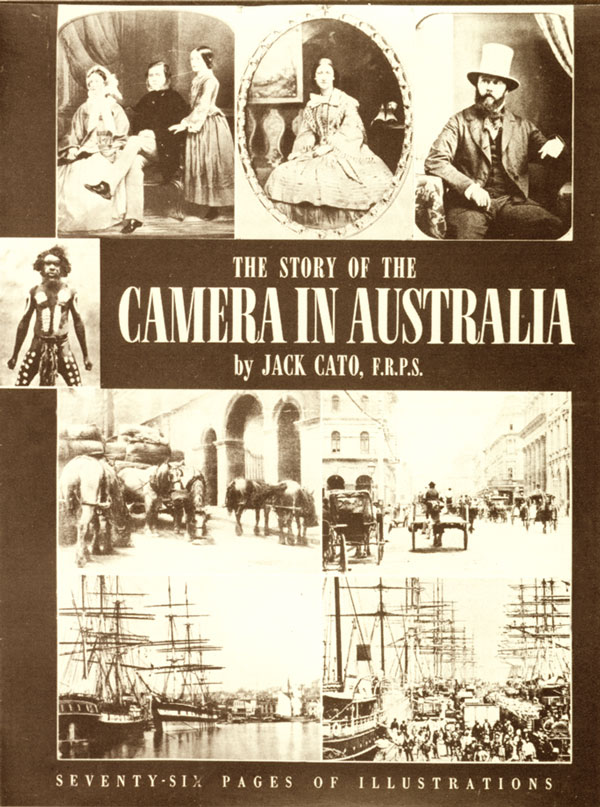
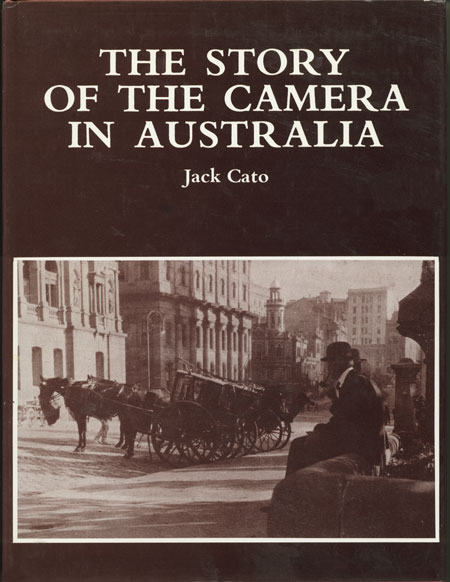
The Story of the Camera in Australia, first publishedby Jack Cato in 1955, was the first comprehensive attempt to document the evolution of the medium across Australia, from the arrival of the daguerreotype to the mid-20th century. Cato was a prominent society photographer, and his writing reflects a mix of rigorous historical chronicling and a deeply personal, often anecdotal appreciation for his predecessors.
The book is organized chronologically and geographically, tracing how photography moved from a colonial curiosity to a professional industry and an art form. It begins with the "miracle" of the first daguerreotypes in the 1840s and follows the itinerant photographers who hauled heavy equipment through the Australian bush to capture the goldfields and expanding frontiers. Cato dedicates significant space to the major commercial studios of the late 19th century, such as Kerry & Co. and Freeman Brothers, who documented the rising urban landscapes of Sydney and Melbourne.
A major focus of the book is the shift toward "art" photography. Cato highlights the work of figures like Harold Cazneaux, who moved away from clinical documentation toward a more atmospheric, soft-focus aesthetic that defined the early 1900s. The book provides specific chapters on the development of photography in Tasmania, Victoria, New South Wales, Queensland, South Australia, and Western Australia.
Cato paints early photographers as heroic figures. He describes the physical toll of the "wet-plate" era, where practitioners had to coat and develop glass plates in portable darkrooms (often tents or carriages) in the middle of the Australian heat. Beyond the art, Cato explores how the camera became the primary record-keeper for Australian life. This includes the documentation of Indigenous peoples (though viewed through a 1950s lens), the rise of the "postcard" boom, and the role of photography in the two World Wars.
As a practitioner, Cato writes extensively about technical shifts from the daguerreotype to the ambrotype, the tintype, and eventually the dry-plate process and how these innovations changed the business of photography. While it remains an essential reference, modern historians often note that Cato’s work is Melbourne/Sydney Centric and leans heavily toward the developments in the major southeastern cities.
The book is written more like a collection of stories than a academic dissertation, which makes it highly readable but occasionally prone to romanticized legends.
The book was reprinted in 1977 and 1979.