
November 2026
this text draws heavily on two excellent and recommended texts - see notes below (Geoffrey Batchen and Art Gallery of NSW)
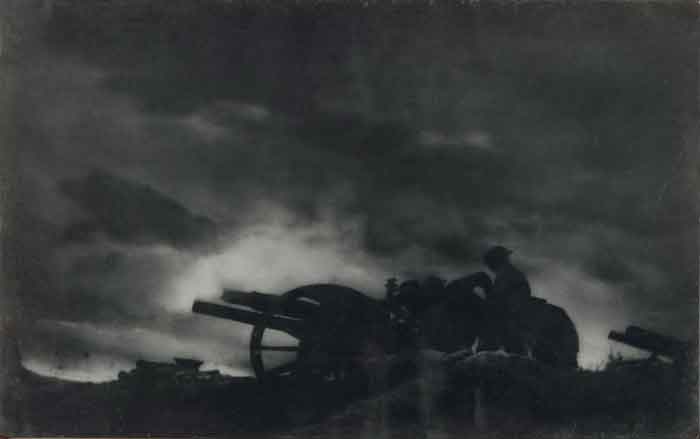 |
| Cecil Bostock, 1918, Day Breaks, Cold, Shrieking, Bloody (original negative, Herbert Wilkins) |
Enlistment and the voyage out
Bostock enlisted in the Australian Imperial Force on 14 February 1917 — Valentine’s Day. He gave his age as 29 and listed his occupation as “artist & photographer”, though he had been born in Sheffield in 1884 and was in fact about 32. That made him old for a recruit; the average Australian soldier was 23. In his report for Photograms of the Year 1917 he had already noted the many photographers who had “joined the colours”, and that some would not return.
He was posted as a gunner to the Field Artillery reinforcements and sailed from Sydney on HMAT A28 Miltiades on 2 August 1917, with about 1,020 men. The ship left in the small hours, with well-wishers in boats crowding around it at the Heads.
Bostock kept two notebooks. The first, titled An Impression, is the diary of an artist on his first great journey. In it he longs to stay and sketch at Wellington Harbour; he rushes for his camera to snap towering clouds off Panama; and he marvels at a dazzle-camouflaged ship in the convoy, painted with a huge wave on one side and a whale on the other: “quite a ‘futurist boat’”.
He landed at Glasgow on 2 October 1917. As he travelled south, the furnaces of Britain’s war industry moved him to write about chimney stacks “belching forth flame & smoke”. He then went into training at Heytesbury in Wiltshire.
While he was in England, Bostock unexpectedly became the Sydney Camera Circle’s voice abroad. Harold Cazneaux’s commissioned essay for Photograms of the Year 1917 had been lost when the ship carrying it was sunk, and Bostock wrote the report Pictorial Photography in Australia in its place. Back in Sydney, Cazneaux took over Bostock’s studio in Denman Chambers, Phillip Street, for the duration.
At the front
Bostock served in France and Belgium with the 39th Battery, 10th Field Artillery Brigade, rising to the rank of corporal. He fired 18-pounder field guns, planned barrages, read maps and plotted German positions. On one occasion he acted as an intelligence officer.
His second notebook, a pencilled Army Book 136, records a war very different from the one he set out to fight. At Heytesbury he had written of crushing “the ravaging octopus of the unscrupulous Hun organism”. At the front he wrote instead of burnt-out tanks whose interiors were “a charred & twisted mass of metal – the inmates sharing a similar fate”, of fields of the dead, and of going 62 hours without sleep under shellfire.
He was gassed with mustard gas more than once, “affected pretty severely”. One shell landed fifteen yards from him and left him concussed and half-buried. Another left a splinter in his leg. He was bombed and strafed from the air, and he recorded “the singing sound of the bomb flying through the air, then the crash of the burst”.
He was also, characteristically, outspoken. He thought British officers snobs who called the Australians “those beastly Australians”. He found army methods “20 years out of date”, with “millions of pounds of money” wasted on absurd regulations. He did not think much more of the gulf between the treatment of officers and men.
His unit took part in breaking the Hindenburg Line on 29 September 1918. In the pursuit that followed, Bostock recorded scenes of liberated France: thirty French civilians at Montbrehain, hysterical after living in a fouled tunnel, and villagers at Prémont who insisted on sharing their meagre food with their liberators.
He was granted ten days’ leave in Paris just before the Armistice and saw no more fighting. When the news of 11 November came, he wrote that “nobody seems to be excited at all – & many would not believe it”.
Concerts, the Photographic Section and London
After the Armistice his unit stayed in France and Belgium. Bostock found an American sergeant who was an excellent pianist, and the two formed a jazz band and a concert party to entertain the troops, with a concert in the hall at Le Cateau.
His Souvenir Belgium 1918–1919 album, with its modernist cover designed by Bostock himself, includes “My concert party, Flavion”. It also includes a photograph captioned “my office”, showing Bostock in uniform and glasses at a map-covered desk, and snapshots of captured German guns.
Early in 1919 his Blighty leave came through, and he was offered a position in the AIF Photographic Section at Horseferry Road, London. He “gladly accepted”, as it gave him a chance to see the “Greatest City in the world”. He stayed nine months. He joined the Royal Photographic Society and the London Camera Club, photographed Big Ben and Kew Gardens, made a series of carefully lit self-portraits in uniform, and courted Violet Kathleen Hewett, who became his wife.
He sailed for home on HMAT Aeneas on 22 November 1919, reached Sydney on 12 January 1920 and was discharged on 19 February 1920. The very next day, the Commercial Artists’ Association of NSW gave a “dinner and smoke night” to welcome him back to civilian life.
The watercolours and sketches
Bostock drew throughout his service. On 14 August 1919, while he was still in London, The Bulletin reported that 54 of his watercolours were on show at the Camera Circle Studio in Sydney. All of them, it said, had been painted on active service and some under fire: “his gun-pit was his studio, and his artist’s material was carried in his haversack.” Presumably Cazneaux arranged the display.
Surviving pencil sketches in the Art Gallery of NSW archive include Gas, No 1 Gun, Spoil Bank, 39th Battery, Somewhere in Flanders, a roadside crucifix in Flanders, and A deserted home, Bavelincourt, and gas masks. One sketch, titled in quotation marks “The Voice of the Gun”, shows a camouflaged field gun firing, with a halo of light and smoke at the muzzle. It already looks forward to his great photograph. The Australian War Memorial also holds a Bostock work, Hamel after July 4th.
“Day Breaks — Cold, Shrieking and Bloody”
In August 1919 a small, dark print by Bostock was hung at the London Salon of Photography in Pall Mall. Its title was “Day Breaks — Cold, Shrieking and Bloody”. It shows field guns and helmeted gunners silhouetted on a ridge against a churning sky, with brilliant white smoke pouring from the muzzles. It was reproduced on special tipped-in paper in Photograms of the Year 1919, the only image in that volume to show actual combat.
When Bostock showed it again at his solo exhibition of 101 photographs at the Kodak Salon in Sydney in November 1921, the Sydney Morning Herald wrote that it “seems to personify the spirit of war”. Alek Sass, in the Australasian Photo-Review, called it “a picture and a photograph beyond criticism”.
For a century the picture was credited to Bostock alone. The Art Gallery of NSW still catalogues it that way, dated 1918. But in History of Photography (published online January 2026), Geoffrey Batchen points to a detail everyone had missed. The caption in Photograms of the Year credits “Capt. Wilkins and C.W. Bostock (AIF)”.
Captain George Hubert Wilkins was one of only two official Australian war photographers. He won the Military Cross and Bar, and later became a celebrated polar explorer and aviator. Bostock had no camera at the front, only a snapshot camera that he used on leave.
Batchen identified the source of the image as a half-plate glass negative in the Australian War Memorial, E03197. It shows an 18-pounder of the 4th Brigade, Australian Field Artillery, in action near Cléry-sur-Somme on 2 September 1918, during the fighting around Mont St Quentin and Péronne. Wilkins was almost certainly the photographer.
In 1919 both men were working in the Photographic Section in London, and that is where the collaboration must have happened. Comparing the two images shows how much Bostock transformed the plain record negative. He removed a standing gunner and a jerry can, shifted a gun closer, turned the foreground into a strip of black, made the sky dominate the picture, and painted in the incandescent smoke. The result is a work of the darkroom rather than the battlefield.
For Batchen, it is a photograph about war rather than of war, made by a man who had been there. Bostock withholds detail so that the viewer can feel something of what the gunners felt. The title spells it out in four blunt, unheroic words, with the rhythm of a war poem.
The photograph remains Bostock’s only exhibited image of the war. Vintage prints are held by the Art Gallery of NSW and, according to its catalogue, the State Library of NSW (call number SV/314).
Afterwards
Bostock went back to Sydney, rejoined the Camera Circle (which met in his studio until 1921) and built an inventive commercial practice. He returned to the war in 1934 with The Book of the Anzac Memorial, N.S.W., for which he photographed the Hyde Park memorial and its sculptures and painted the frontispiece. The war left its mark on him all the same. Max Dupain, who joined Bostock as an apprentice in 1930, remembered in 1990 that his master’s war experiences “just about did him in”.
Bostock died in Sydney on 27 December 1939, in debt. His possessions were sold, and as a result relatively little of his work survives in public collections.
Quick facts
- Service number: 35589
- Enlisted: 14 February 1917 (declared age 29; actually about 32)
- Embarked: Sydney, HMAT A28 Miltiades, 2 August 1917; arrived Glasgow 2 October 1917
- Unit: 39th Battery, 10th Field Artillery Brigade (4th Division Artillery), AIF
- Rank: Gunner, later Corporal
- Wounds: gassed (mustard gas) more than once; concussed by a shell blast; shell splinter in the leg
- Action: Hindenburg Line, 29 September 1918, and the pursuit through Montbrehain, Prémont and Le Cateau
- 1919: AIF Photographic Section, Horseferry Road, London
- Exhibited: 54 war watercolours, Camera Circle Studio, Sydney, August 1919; “Day Breaks — Cold, Shrieking and Bloody”, London Salon of Photography, August 1919
- Returned: left England on HMAT Aeneas 22 November 1919;
disembarked Sydney 12 January 1920; discharged 19 February 1920
Key resources for the article above
other resources
- Australian War Memorial — Corporal Cecil Westmoreland Bostock (embarkation and nominal rolls)
- Australian War Memorial — negative E03197, Wilkins’s source image, Cléry, 2 September 1918:
- Australian War Memorial — Bostock, Hamel after July 4th
- National Archives of Australia — service record
- Art Gallery of NSW collection — Day breaks-cold-shrieking-bloody (164.1977)
- Bostock, “Pictorial Photography in Australia”, Photograms of the Year 1917 (Internet Archive)
- Martyn Jolly and Daniel Palmer, “Salon Pictures, Museum Records, and Album Snapshots: Australian Photography in the Context of the First World War”, History of Photography 43:1 (2019)
- Jeff Maynard, The Unseen Anzac: How an Enigmatic Polar Explorer Created Australia’s World War I Photographs (Scribe, 2015) — on Wilkins
- On photoweb: Bostock’s souvenir photographs of Belgium (1918–1919)
- On photoweb: The Book of the Anzac Memorial, N.S.W. (1934)
return to main Bostock page