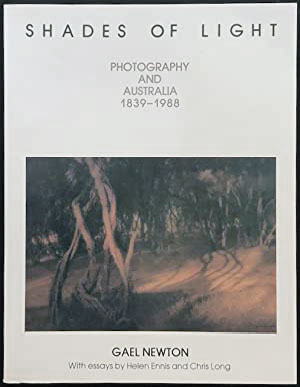
Click here for the contents page of the online version of Shades of Light
Shades of Light: Australian Photography 1839 to 1988 is the publication and exhibition catalogue written by Gael Newton, published in 1988 by the National Gallery of Australia (then the Australian National Gallery). There two others eassy, by Helen Ennis and Chris Long.
Newton’s primary goal was to move beyond a technical history of cameras and chemicals. Instead, she traced a "progressive" lineage, focusing on photographers who viewed the medium as a vehicle for personal expression, social commentary, or formal experimentation. The book tracks the transition from the functional "documentary" photography of the colonial era (capturing the landscape for survey and science) to the self-conscious artistry of the 20th century.
A significant portion of the book examines how Australian photographers moved away from the romantic, soft-focus "Pictorialism" toward the sharp, industrial, and graphic "New Photography" of the 1930s. Newton discusses how photography helped shape the Australian identity, from the rugged pioneers of the 19th century to the urban, diverse perspectives of the 1970s and 80s. It remains one of the most comprehensive surveys of the medium's evolution in Australia, tracing its journey from colonial documentation to contemporary art.
The book provides a chronological and thematic framework for understanding how photography functioned in Australian society over 150 years. Newton’s approach was "progressive," meaning she focused on photographers who pushed the boundaries of the medium, rather than just those who produced commercial or purely documentary work.
The book covers the arrival of the daguerreotype and the use of photography for scientific survey and land exploration (notably featuring figures like Richard Daintree). Newton analyses the turn-of-the-century shift where photographers sought to emulate fine art through soft focus and atmospheric effects. The book details the transition to "New Photography" in the 1920s and 30s, influenced by European trends like the Bauhaus, characterized by sharp focus, dramatic angles, and industrial subjects. It oncludes with the rise of the "creative" photography movement of the 1970s and 80s, where photography became firmly established in the museum and gallery context.
Newton highlighted the importance of women in early Australian photography, such as Pegg Clarke and Olive Cotton. Unlike earlier histories that focused strictly on technical milestones, Shades of Light connects photographic styles to the broader social and cultural shifts in Australian history.
The publication accompanied a massive exhibition that signaled the National Gallery's commitment to photography as a core pillar of its collection. The book is heavily illustrated, featuring over 150 plates that serve as a visual record of the "progressive" lineage Newton identifies. It includes detailed biographical notes on photographers, making it a primary reference for researchers of Australian art history.
While subsequent scholarship has expanded on specific niches (like Indigenous photography or digital transitions), Shades of Light is still considered the "foundation stone" for the study of Australian photographic history.
Shades of Light argued that Australian photography was never just a mirror of the world, but a sophisticated, evolving art form that actively participated in international art movements while maintaining a distinct local character.
Click here for contents page for the online version of Shades of Light
Return to photoweb books